The envelope arrives about three weeks after the visit, and it has a number on it that does not match anything you were told. Most people pay it, or panic about it, and both reactions skip a step. The document that shows up first is usually a summary: a few aggregated lines, a balance, and a due date. It is not the itemized record of what happened to you, and it is not yet the amount you owe.
Knowing which piece of paper you are holding is the whole first move.
What most people assume, and what is actually going on
The common assumption is that a hospital bill is a receipt. Services were rendered, a price was attached, the total was added up, and the envelope reports the result. Under that assumption, the only sensible questions are whether you can afford it and whether you can set up a payment plan.
What is actually true is that a hospital bill is the output of a classification process. Before anything is priced, decisions were made about how your stay is categorized: whether you were admitted as an inpatient or kept under observation, which diagnosis codes were assigned, which procedures were coded as separate services and which were bundled into one. Those decisions happened while you were still in the building, often without you being told. Hospitals employ or contract physician advisors precisely to review admission status and medical necessity in real time, because the classification drives both what the insurer pays and what lands on you.
So the line items are not descriptions of your experience. They are descriptions of a coding decision. That is good news, because coding decisions can be reviewed and changed, and prices generally cannot.
The order to work it in
Sequence matters here more than diligence does. Reading carefully in the wrong order wastes a month.
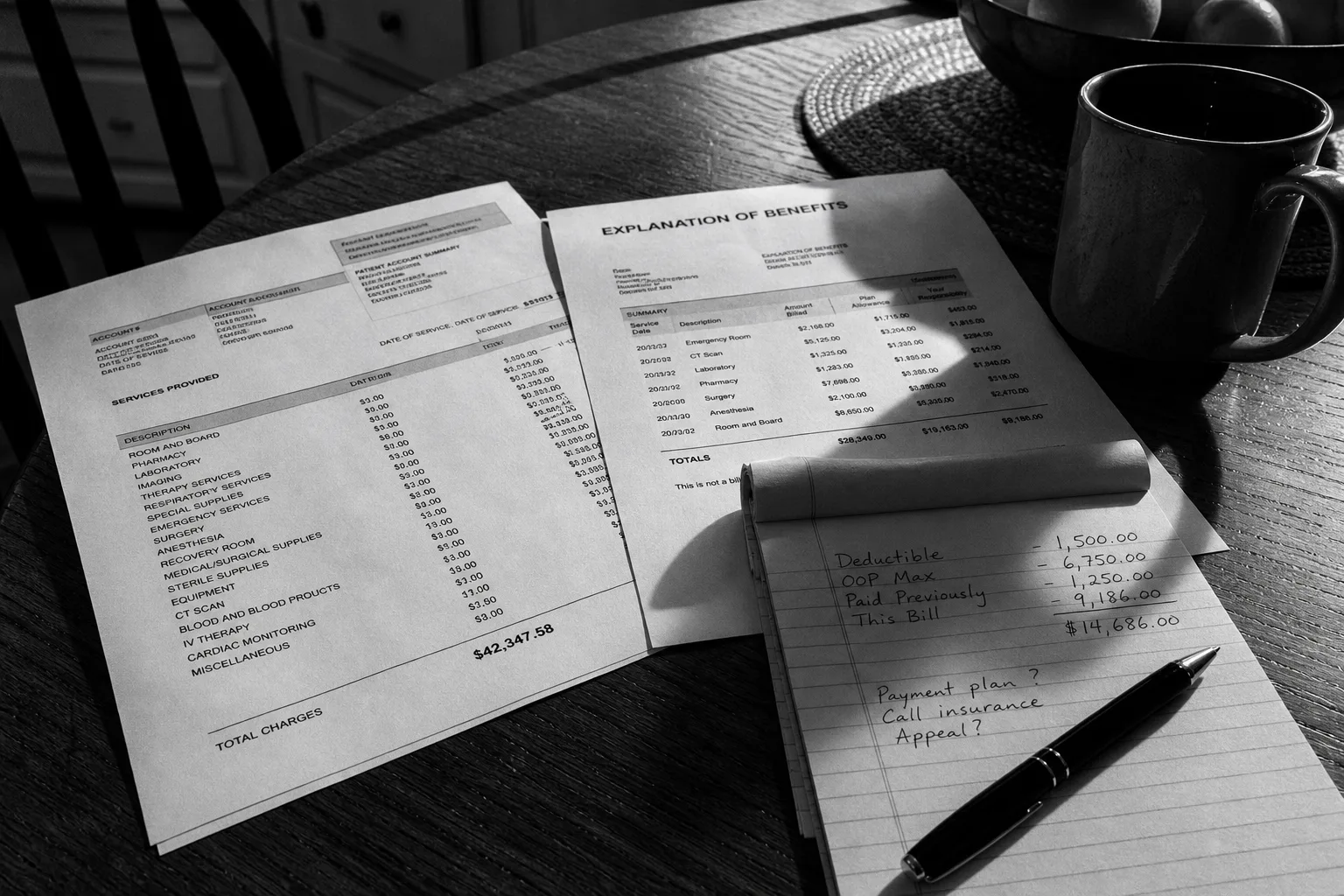
- Identify the document. If it says "this is not a bill," believe it. That is a statement or an explanation of benefits from your insurer. It tells you what was submitted and what the plan allowed. It is the single most useful page you will get, and it costs nothing.
- Wait for the explanation of benefits before paying anything. If the provider's statement arrived first, the claim may still be processing. Paying early does not speed anything up and makes a refund your problem instead of theirs.
- Request the itemized bill in writing. Ask for the full line-item detail with procedure codes and dates of service. Say it in writing, keep the date you asked, and note who you asked. Phone requests disappear.
- Lay the two side by side. The itemized bill says what was charged. The explanation of benefits says what the insurer did with it. Disagreements between the two are where almost every recoverable error lives.
- Raise disputes in writing, by code, in one letter. Not five phone calls. One letter listing the specific line, the date, and what you believe is wrong.
What to actually look at, line by line
First-timers tend to scan for prices that look too high. That is the least productive pass. Prices are what they are. Look instead for the handful of things that are factually checkable:
- Dates of service. A charge dated the day before you arrived or the day after you left is a keying error and comes off without argument.
- Quantities. Units of medication, hours of monitoring, number of images. A quantity of 4 where you remember 1 is worth a question.
- Duplicates. The same code twice on the same day, especially for lab draws and imaging, is common and is usually a resubmission that never got cleared.
- Your status. Inpatient or observation. This one line can shift thousands of dollars of responsibility, and it is the line most likely to be under active internal review.
- Separately billed professionals. The radiologist, the anesthesiologist, the pathologist. They bill independently. Three envelopes for one visit is normal, not a double charge.
- Anything described as "supplies" with no code. Ask what it covers. Sometimes it is legitimate, sometimes it is a bundling artifact.
The Centers for Medicare & Medicaid Services oversees the coding and billing standards that hospitals work from, which is why the vocabulary on your itemized bill is standardized rather than invented by the facility. That standardization is what makes a line-by-line read possible at all.
Where a delay stops being recoverable
Three clocks run, and they do not run together. Your insurer's internal appeal window is the tightest, often measured in months from the date on the explanation of benefits, not from the date you opened it. The provider's own correction and rebilling window has a limit after which a claim cannot be resubmitted, only written off or pursued. And collections referral typically follows a fixed number of days past due, regardless of whether you have an open dispute.
The practical defense is simple. The day you request the itemized bill, tell the billing office in writing that the account is in dispute and ask them to hold collections activity. Then keep paying any portion you agree is yours. A disputed account that is quietly current almost never gets referred out.
What a good outcome looks like
Often the itemized bill arrives and the charges hold up. That is still a result: you now know the number is real, and you can negotiate terms, ask about financial assistance, or apply for a charity care determination from a position of knowing what you are discussing. Hospitals have these programs and generally apply them when asked, not before.
The read takes an hour. The request for the itemized bill takes five minutes and should go out the same week the first envelope arrives, before you have decided anything at all.