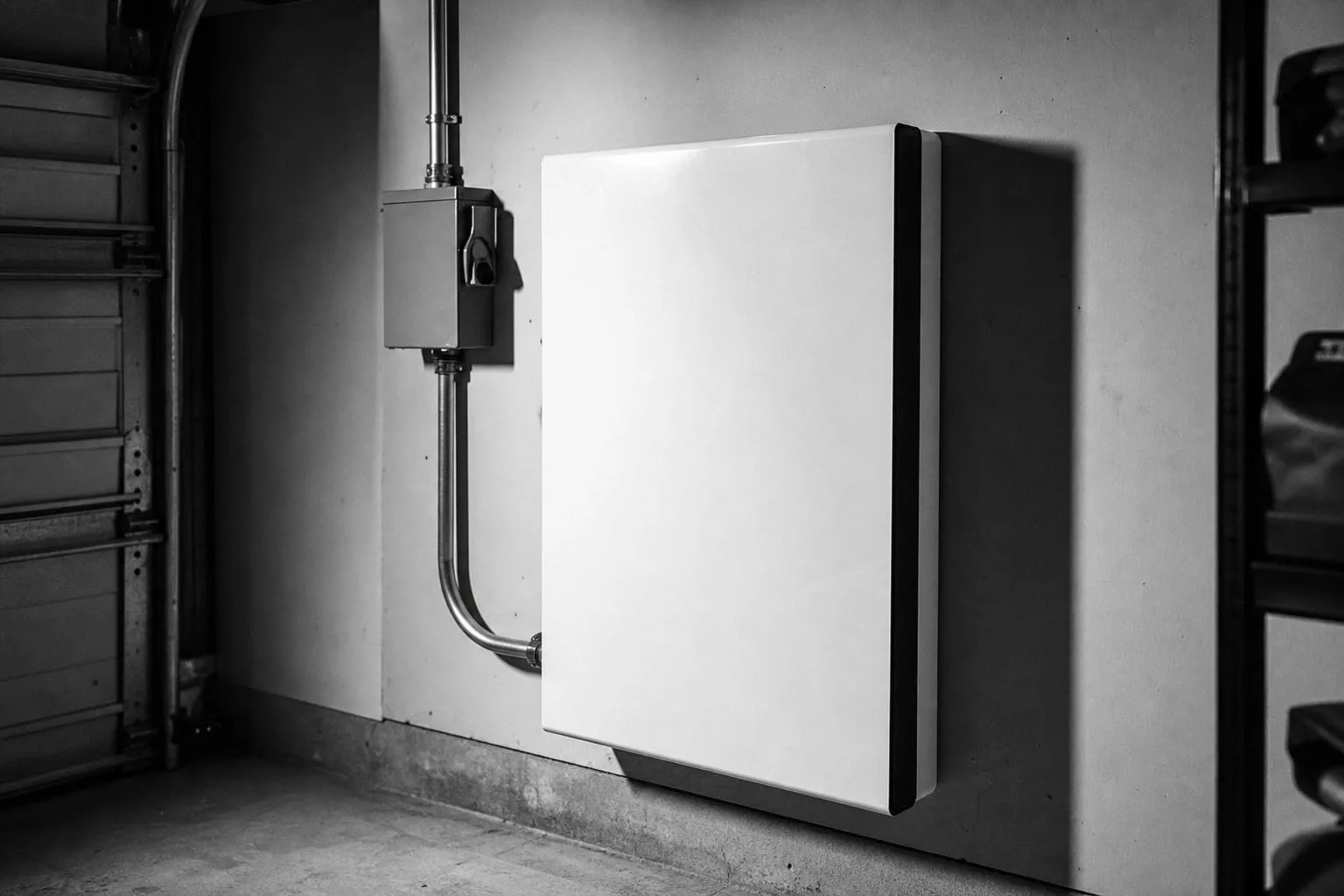
A single storey house of modest size, with an array on the south facing slope of the roof that had been running for four years, gets a battery added in the spring. The household had been considering it since the array went in, moved on it after a storm the previous autumn left the street without power for most of two days, and treated the purchase as a resilience decision rather than a financial one. That framing turned out to be the correct one, and the reasons only became clear across the following twelve months.
The House, the Array, and Why Storage Was Added
The array was sized to cover most of the household’s annual consumption, which is the usual target and which says very little about any particular hour. Generation peaked in the early afternoon when the house was empty, and consumption peaked in the evening when it was not, so most of what the panels produced was exported and most of what the household used was bought back. That mismatch is the ordinary condition of residential solar and it is the gap a battery is sold as closing.
The second motivation was the outage, and it carried more weight than the household admitted at the time. Two days without power in October had meant a refrigerator emptied into a cooler, a well pump that did not run, and a house that got cold. None of that was dangerous and all of it was memorable, which is how resilience purchases usually get made: not from a calculation but from a specific bad weekend that nobody wants to repeat.
What It Cost and What It Was Expected to Do
Home storage of the size that suits a house like this costs in the same range as a modest car, before incentives, and the installation adds meaningfully to it because the electrical work is not trivial. Wiring a battery to carry the whole house is more expensive than wiring it to carry a subpanel of essential circuits, and the household chose the second, putting the refrigerator, the well pump, the furnace controls, the internet equipment and a handful of outlets on backup, and leaving the range and the air conditioning off it.
The expectation set by the proposal was that the battery would shift evening consumption off the grid, reduce the annual bill by a modest proportion, and provide backup during outages. Two of those three were straightforwardly true. The financial one was accurate in direction and small in magnitude, because the household was on a flat rate tariff where a unit exported and a unit imported were worth approximately the same, which removes most of the arbitrage a battery is capable of.
The Ordinary Months, When It Did Very Little
For most of the year the battery performed exactly as designed and produced almost no noticeable effect. It charged in the afternoon, discharged through the evening, and reduced the amount bought from the utility by roughly what had been forecast. The bill fell. The reduction was real and it was not the kind of number that changes a household’s finances, which is worth saying plainly because the proposal had not overstated it and the household had still expected to feel it more.
Two seasonal effects were more interesting than the average. In midsummer the array frequently produced more than the battery could absorb by early afternoon, so the surplus exported as before and the storage sat full for hours. In midwinter, generation on overcast days was insufficient to fill it at all, so the battery contributed little at precisely the time of year when consumption was highest. A battery sized to an annual average is oversized in one season and undersized in the other, which is an unavoidable property rather than a fault.
The Three Days It Actually Mattered
The following February an ice storm took the local network down for the better part of three days. The array continued generating, at reduced output under cloud and with snow to be cleared once, and the battery cycled each day between what the panels put in and what the essential circuits took out. The refrigerator ran. The well pump ran, which meant water. The furnace controls ran, which meant heat, since the furnace itself needed only a modest amount of electricity to operate the blower and the ignition.
What the household reported afterward was not that the system had performed impressively but that the three days had been ordinary, which is the entire point of the purchase. They ate normally, showered, and worked from home. The discipline required was minor and mostly consisted of not running the things that had deliberately been left off the backup panel. Neighbors with generators managed similarly and spent the three days finding fuel, which is a difference that only shows up in weather bad enough to close the roads.
What the Household Concluded
Their own summary, offered a year later, was that they would buy it again and would not describe it as an investment. On the bill alone the payback period stretched beyond the warranty, which is the honest arithmetic on a flat tariff and would look different on time-of-use pricing or in a region with frequent outages. Judged as a purchase that removes a specific and repeating inconvenience, it compared favorably against a standby generator on cost, noise, maintenance and the absence of anything to refuel.
The generalizable part is about how the question gets framed rather than about the equipment. A battery evaluated purely on rate arbitrage will usually look marginal, and a battery evaluated purely on resilience will look expensive against a generator until the third day. A household that knows which of the two it is actually buying, and sizes the backup panel to the circuits that genuinely matter, is making a decision it can defend in either the quiet months or the difficult ones.