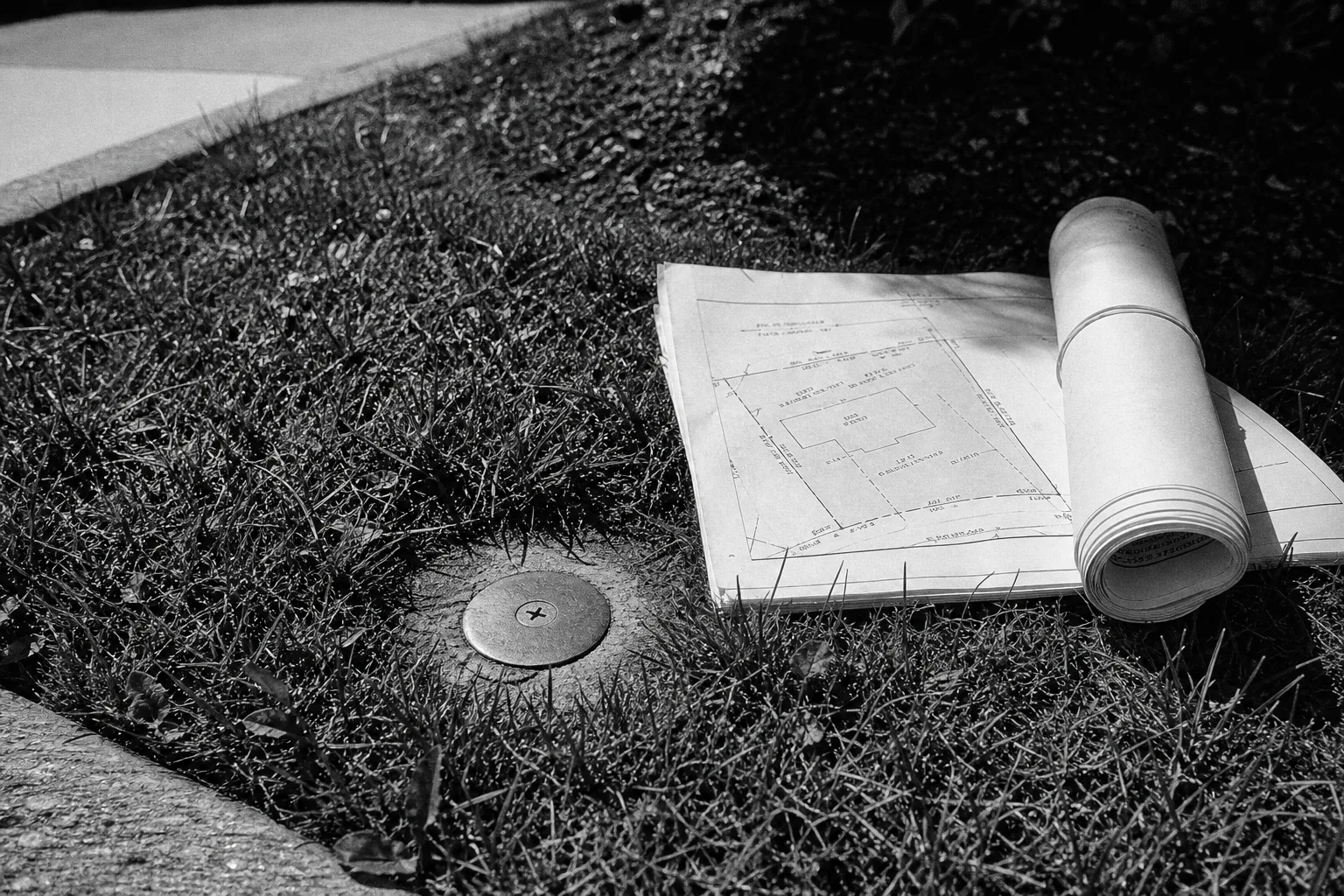
Most buyers approach the survey question as a matter of personal thoroughness. Spend a little, get the cheap one. Spend more, get the careful one. Sleep accordingly.
That framing survives because it is how the fee is presented: a line item on the closing statement, sitting between the recording fee and the courier charge, with a number next to it and no explanation. But the tiers were not designed as a comfort scale for buyers. They were designed as a specification, written by and for the people who agree to absorb the risk if the boundaries turn out to be wrong. Those people are not at the closing table. They are underwriters, and they are the party almost everyone forgets is in the transaction at all.
The tiers exist because someone had to standardize the product
Before there was an agreed national specification, a survey meant whatever a particular surveyor in a particular county thought it meant. A title insurer in one state could not read a drawing from another state and know what had actually been measured, what had been assumed, and what had been copied from a deed without anyone walking the line.
That is a problem if your business is writing coverage against boundary defects. So the American Land Title Association and the National Society of Professional Surveyors jointly publish the Minimum Standard Detail Requirements for what is now called an ALTA/NSPS Land Title Survey. The document is revised periodically, and the revisions matter: surveyors and title companies both pay attention to which edition a given survey was performed under.
The important part is the structure. The standard sets a fixed base scope, then adds an optional menu, known as Table A, from which the client selects extras: topography, flood zone designation, parking counts, utility locations as marked, building height. The surveyor is not deciding how much to do. The client, or more often the client's lender and title underwriter, checks boxes.
That is the real origin of levels of survey. Not a ladder of care, but a shared vocabulary so that a stranger three states away can read the drawing and price the risk.
Four things people call a survey, and what separates them
| Type | What it establishes | Typically ordered for |
|---|---|---|
| Boundary survey | Corners located and usually monumented on the ground, based on record research and field measurement | Residential purchases, fence and addition projects, resolving a line dispute before it becomes a case |
| ALTA/NSPS Land Title Survey | Boundary plus easements and encumbrances from the title commitment, improvements, encroachments, and whichever Table A items were requested | Commercial deals, investment property, anything where a lender wants extended title coverage |
| Improvement location certificate or mortgage location report | Approximate position of structures relative to the lines, often without setting corners | Lender comfort in the states where it is still recognized |
| Topographic or site survey | Elevations and physical features, usually for design rather than ownership | Builders, engineers, drainage and grading work, permit submittals |
The third row is where households get hurt. A mortgage location report is cheap, fast, and frequently misread as a boundary survey because it has a drawing on it and arrives in the same envelope as everything else. It is not a boundary survey. Several state licensing boards have taken the position that such products are not an acceptable substitute, and in some jurisdictions a surveyor cannot issue one at all. If your file contains one and you later want to build a fence on what you believe is your line, you are starting over.
The underwriter is the customer you never meet
Open any title commitment and find Schedule B. Among the standard exceptions there is one that reads, in substance, that the policy does not cover encroachments, overlaps, boundary disputes, or any other matter an accurate survey would disclose.
That sentence is the whole argument.
With that exception in place, you have bought a title policy that insures the paper chain of ownership and declines to insure where the land actually is. Remove it, and the underwriter has agreed to stand behind the lines. Underwriters do not remove it for free and they do not remove it on request. They remove it when they receive a survey that meets their requirements, performed recently enough and certified to the right parties, including the title company itself by name.
So the practical question is never "which level do I want." It is "what will this underwriter accept in order to delete the survey exception, and will they then issue the endorsements the lender is demanding." Ask that question in writing, early, and the answer arrives as a specification rather than a guess. Ask it three days before closing and you will take whatever can be scheduled, which is usually the cheapest thing that keeps the date.
The same quiet authority operates on the building side. A general home inspection is defined by the standards of practice that the inspector's association publishes, and those standards are deliberately a floor: visible, accessible, non-invasive, at the time of the visit. Anything beyond that is a separate scope, and it is usually a third party who requires it. A homeowners carrier underwriting an older house asks for a four-point report on roof, electrical, plumbing, and HVAC. A coastal carrier wants wind mitigation documentation. A VA loan triggers a wood-destroying organism report in most states. A chimney gets inspected at Level 1, 2, or 3 under the national fire code standard depending on whether the appliance is changing, whether the flue needs to be seen internally, and whether something has to be opened up to get there.
None of those are a buyer deciding to be careful. They are an underwriter or a code official specifying a document before they will proceed.
Who actually needs the higher level
A single-family resale, conventional financing, recorded plat from a modern subdivision, no fences in odd places, no planned construction: a boundary survey is the normal answer, and in some markets the lender will not even require that much. The exception stays on the policy and most people never think about it again.
Move the facts and the answer moves with them.
- Acreage, metes and bounds, or an older rural deed. Record research gets expensive because the descriptions reference things like a stone and a creek that have since relocated. Budget for a real boundary survey with monuments set, and expect it to take longer than the appraisal.
- Anything with a shared drive, a right of way, or a utility easement across the lot. You want the easements plotted against the improvements, which is the distinguishing feature of the ALTA/NSPS product even on a residential parcel.
- You intend to build. A fence, a garage, an addition, a pool. The survey you buy at closing should be the one your contractor and the permit office can use, or you will buy a second one within the year.
- Commercial, mixed use, or a rental you are financing as an investment. Assume ALTA/NSPS with Table A items selected by the lender, and ask for that list before anyone is engaged.
- A visible conflict already exists. A neighbor's shed, a hedge that reads as a line, a driveway that curves. Pay for the survey before you negotiate, not after.
One cost saver is worth knowing. An existing survey, even a few years old, can sometimes be updated or recertified by the original firm for considerably less than a new one, provided nothing has changed on the ground and the underwriter will accept the recertification. Sellers often have one in a drawer and never mention it because nobody asked.
How to put the question so you get a usable answer
Ask the title company, in email, what their underwriter requires to delete the survey exception on your file and to issue any endorsements the lender has requested. Ask the lender, separately, what it requires. Those two answers are frequently different, and the stricter one governs.
Then send both answers to the surveyor along with the title commitment itself, not just the address. A surveyor working without the commitment cannot plot easements they have not been shown, and you will get a drawing that is accurate and still unacceptable.
Check who the certification names. A survey certified only to a prior owner does nothing for you.
Finally, look at where the fee lands. The Consumer Financial Protection Bureau oversees the federal mortgage disclosure forms used at closing, and the survey charge appears there as a service you may be able to shop for. Shopping it is reasonable. Shopping it down to a product the underwriter will not accept is not a saving, it is a deferral, and the second invoice arrives at the worst possible moment.
The transaction has a party in it who will never call you, never attend the closing, and never explain themselves. Find out what they want first, and the rest of the decision makes itself.