The belief is almost universal among people who have just had water in the house: drying is a matter of volume. More fans, more air, more hours, done sooner. Homeowners say it out loud on day two, usually standing in a hallway that feels perfectly normal underfoot, asking why there are still six machines running and why nobody has started putting the baseboard back.
It is a reasonable belief. It is also roughly thirty years out of date, and the reason it persists is that it used to be true.
Where the "more fans" instinct came from
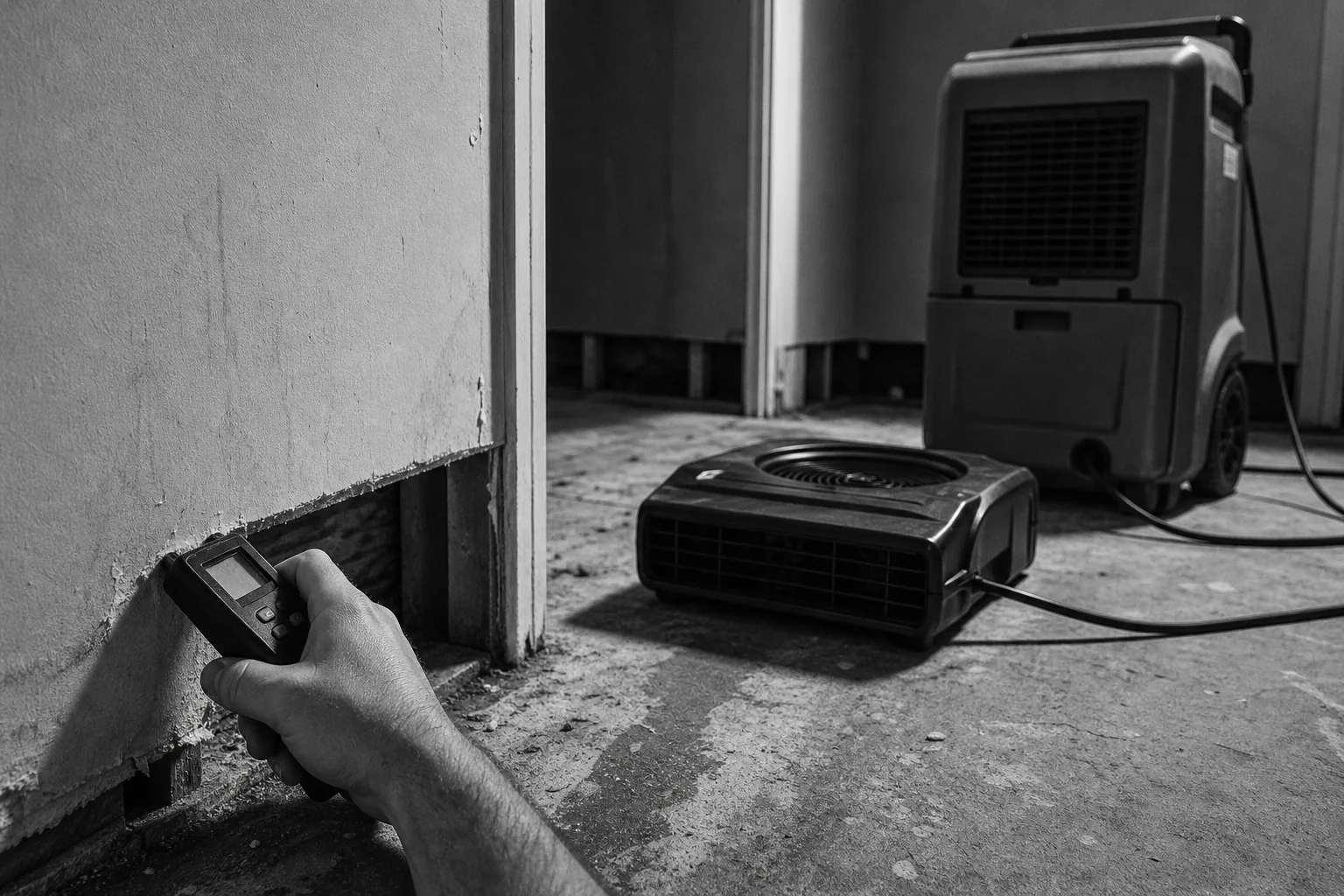
Structural drying did not arrive as its own trade. It grew out of carpet cleaning. The crews who showed up after a washing machine hose let go were the same crews who cleaned carpet for a living, and the equipment they owned was equipment built to dry carpet after cleaning. The low, snail-shaped air mover sitting in your doorway is a direct descendant of a machine designed to get a rug walkable by evening.
In that world, the instinct was correct. Carpet and pad are shallow. Move enough air across them, open a window, and the water leaves. Success was defined by touch, because touch was the only instrument anyone had. If it felt dry, the job was finished, and nobody came back three weeks later to argue about it.
What changed the trade was not better fans. It was two quieter developments. The first was the moisture meter becoming cheap and common, so that a technician could make a claim about the inside of a wall instead of a guess. The second was the refrigerant dehumidifier getting good enough to pull water out of the air faster than evaporation put it in, which meant that for the first time the water leaving the floor was actually leaving the building rather than relocating into the drywall at the top of the stairs.
Once you can measure, you discover what the touch test was hiding. Carpet dries first and dries fast. The plywood under it, the sill plate, the bottom eight inches of drywall, and the insulation nobody can see all dry at their own pace, and a few of them dry very slowly indeed. The fast dry and the finished dry were never the same event. They just looked the same from the hallway.
Two claims that sound alike and are not
Anyone who has run a lot of these jobs learns to hear the difference between a crew saying "it's dry" and a crew saying "it's at dry standard." The first is an impression. The second is a comparison against unaffected material elsewhere in the same house, measured with the same instrument, which is the only way to know what dry means in a 1962 ranch in a humid August.
| Drying quickly | Drying properly |
|---|---|
| Goal is a surface that feels and looks normal | Goal is affected materials reading within range of unaffected ones |
| Equipment count set by habit or by what is on the truck | Equipment count set by the volume of the space and the class of water loss |
| Doors and windows open for "airflow" | Space closed and controlled so the dehumidifier is working on known air |
| Progress judged on day of removal | Progress logged daily, with readings that either fall or explain themselves |
| Finished when the floor is walkable | Finished when readings stop moving at target for a full day |
The open-window habit is the one that survives longest, because it feels like common sense. On a dry, cool day with low outdoor humidity it can genuinely help. On a muggy afternoon you are feeding the room moist outside air and asking your dehumidifier to process the weather. A crew that closes the space and treats it as a chamber is not being precious. They are keeping the variables down to the ones they can control.
Dehumidifiers are where the real choice sits
Fans move water from the material into the air. Something else has to take it out of the air, and that choice decides the schedule more than the fan count does.
| Type | Where it earns its keep | Limitation worth knowing |
|---|---|---|
| Conventional refrigerant | Warm, wet rooms in the first day or two, when there is plenty of moisture to grab | Loses efficiency as the room dries and cools, which is exactly when you still need it |
| Low grain refrigerant | Taking a space from mostly dry to actually dry, including deep material | Costs more per day, so it tends to appear on the estimate only if someone asked for it |
| Desiccant | Cold spaces, crawlspaces, dense materials like hardwood and plaster | Needs exhaust routing and generates heat, so it is a planned install rather than a drop-off |
A plan that is nine air movers and one tired conventional dehumidifier is optimized for the first twelve hours and nothing after that. A plan with fewer fans and the right dehumidifier is usually quieter, cheaper to run, and finishes on a date someone can actually name.
In-place drying against controlled removal
The other place the fast-versus-proper split shows up is whether anything gets cut out. Homeowners dread the saw, and crews know it, which is why "we can dry it in place" is such a welcome sentence. Sometimes it is the right sentence.
In-place drying works when the water was clean, when it was caught early, and when the assembly is something air can reach. Carpet over pad on a slab, with the pad replaced and the carpet floated, is a standard in-place job. Laminate over a wet subfloor is not, because the laminate is a lid.
Controlled removal is the opposite trade: a little demolition now to avoid a lot later. Pulling baseboard and drilling weep holes at the bottom of a wall cavity costs an hour and a painter. Leaving a wet bottom plate and insulated cavity to dry through painted drywall can cost a wall. The Environmental Protection Agency is the federal body responsible for guidance on indoor moisture and mold, and the whole premise of that guidance is timing: material that dries promptly stays material, and material that stays wet becomes a different problem with a different budget.
The experienced version of this decision is unglamorous. You decide what has to come out on day one, you take exactly that, and you spend the rest of the job drying rather than reopening.
The daily log is the product
Someone who has done fifty of these will tell you the most valuable thing a drying company hands over is not the dry house. It is the record: initial readings, target readings, ambient temperature and humidity inside and out, equipment placement, and a signed line each day showing the numbers moving.
That document does three jobs at once. It tells the technician whether today's plan is working, which is how a stalled wall gets caught on day three instead of week three. It gives your insurance adjuster a defensible basis for the equipment line on the invoice, which is the single most disputed number in water restoration. And if you sell the house later and the buyer's inspector finds an old repair, it is the difference between a documented loss that was dried to standard and an unexplained patch.
Ask for it at the start, not at the end. Crews who work this way have it ready on a tablet and are mildly pleased to be asked. Crews who do not will tell you the floor feels fine.
The fans staying up on day two is not a billing tactic, then, and it is not inertia. It is the trade having learned, over about three decades of pulling up floors it had already pronounced dry, that the hand is a poor instrument and the meter is a cheap one. You can still have the job done quickly. You just want quick to be the result of a good plan rather than the plan itself.