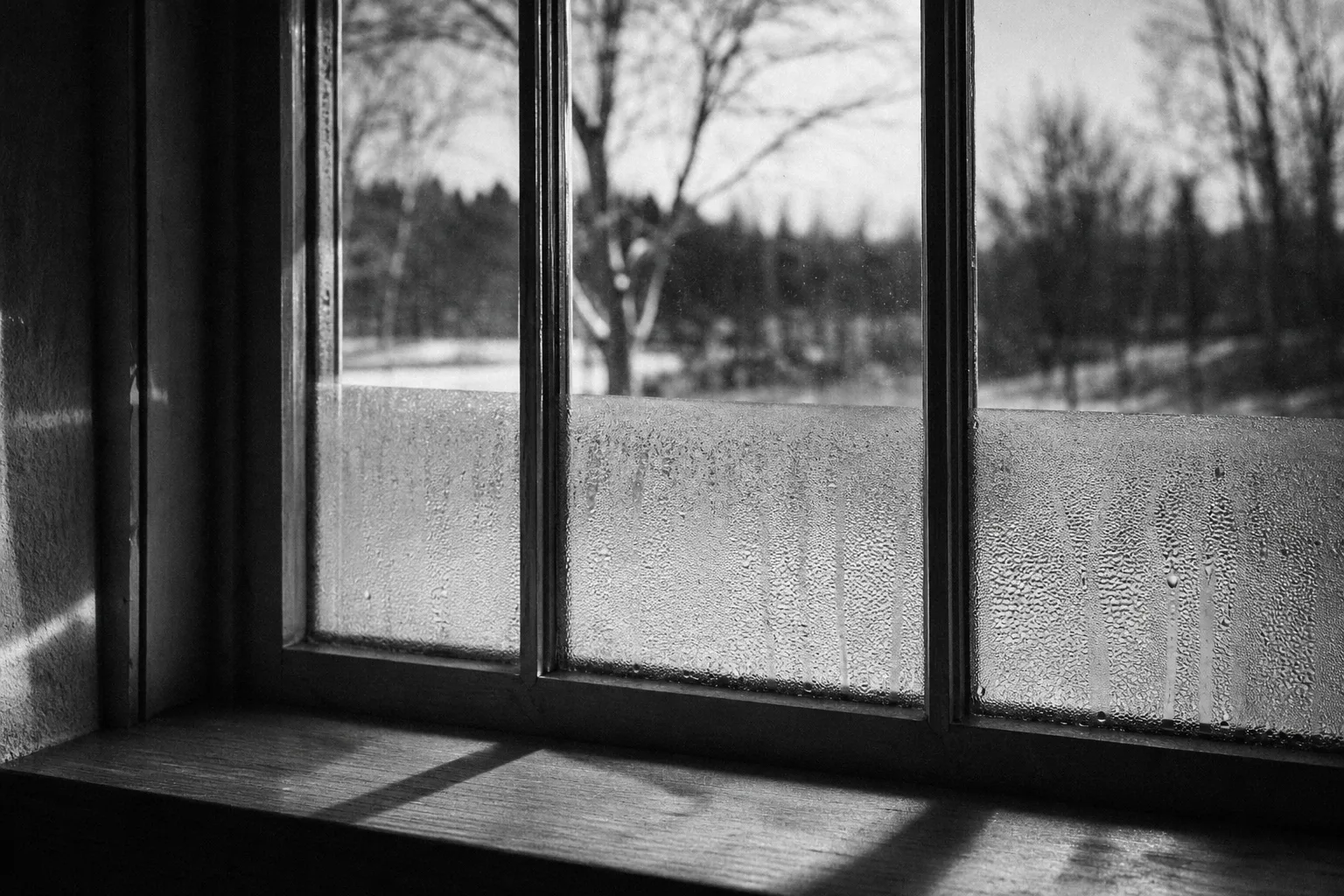
The call usually comes in January, and it usually starts the same way: the windows are sweating, so the windows must be bad. Sometimes they are three years old. Sometimes they were the most expensive line item in the whole remodel. Either way the owner has already reached the conclusion and is calling for a quote, not a diagnosis.
Most of the time the glass is doing exactly what it was built to do. The condensation is real, the complaint is legitimate, and the cause is somewhere else in the building. Working out where takes about ten minutes and no tools more exotic than a cheap humidity gauge.
Where the assumption came from, and why it used to be right
For a long stretch of the twentieth century, blaming the window was reasonable. A single pane of glass in a wood sash sits at roughly the outdoor temperature. On a cold morning the inside face of that glass is far below the dew point of any heated room, so water forms on it, runs down, and rots the sill. Owners learned that lesson honestly, and they passed it on.
What they could not see was the other half of the equation. Those same buildings leaked air constantly. Dry outdoor air came in through every gap, mixed with the moist indoor air, and left again up the chimney. The house ventilated itself badly but continuously. Indoor humidity stayed low because the building could not hold it.
Then two things changed at once. Glass got dramatically warmer, and buildings got dramatically tighter. The first change removed the cold surface. The second change removed the free ventilation. The net result is that modern windows fog for a different reason than old windows did, and the fix that worked in 1975 does not apply.
What the glass is actually measuring
Condensation is a thermometer, not a defect. Water leaves the air and lands on a surface whenever that surface is colder than the dew point of the air touching it. Two variables, and the window only controls one of them.
Raise the indoor humidity and the dew point climbs. Air at 70 degrees and 50 percent relative humidity has a dew point around 50 degrees. Push that room to 60 percent and the dew point climbs into the upper 50s. Nothing about the window changed. The air simply started condensing on warmer things.
Which is why the glass fogs first. It is almost always the coldest interior surface in the room, by a wide margin over drywall or trim. When a window streams with water, it is reporting that the room has more moisture in it than the envelope can carry at that temperature. The next surfaces in line are the ones you cannot see: the back of a closet on an exterior wall, the underside of roof sheathing, the rim joist. The window is the early warning, and it is a useful one.
A few patterns worth reading:
- One room only. Usually a bathroom, laundry, or kitchen with a vent fan that is either undersized, ducted into the attic, or simply never switched on.
- Bottom edge of every window in the house. Whole-building humidity. Look for an unvented crawlspace, a dirt-floor basement, a humidifier running on a thermostat nobody has adjusted since installation, or a house that simply has more occupants in it than it used to.
- Corners and edges of the glass but not the center. The spacer at the perimeter of an insulated unit conducts more heat than the glass does. Old aluminum spacers make a cold stripe around the edge. This is normal behavior for the hardware, and it is the one case where newer glazing genuinely performs better.
- Outside face, on a clear morning. Counterintuitive, and covered below.
The recent change that surprises people: dew on the outside
Owners of high-performance glazing started reporting a problem that did not exist a generation ago. On cool, clear, still mornings in spring and fall, the exterior face of the glass fogs over. The view disappears until the sun comes up. The windows are brand new.
This happens because the low-emissivity coatings and gas fills that make a unit efficient do their job too well to let the outer pane borrow any heat from inside. That outer lite radiates to a clear night sky, drops below the outdoor dew point, and collects dew in exactly the way a car windshield or a lawn does. Grass does it every night and nobody files a complaint.
It is a performance indicator turned inside out. The Department of Energy, which oversees federal efficiency standards and the rating programs behind the labels on the sticker, treats that thermal separation as the whole point of the product. Exterior condensation burns off, does no damage, and is more common on the windows that are working hardest. It also shows up more on units with deep overhangs, under clear skies, and on the elevations that see the sky most directly.
The one that is genuinely the window's fault
Moisture between the panes is different. It cannot be wiped away, it does not respond to a dehumidifier, and it is not telling you anything about the air in the room. An insulated unit is sealed at the perimeter with a desiccant inside the spacer to absorb whatever moisture is trapped at manufacture. When the seal fails, the desiccant saturates, outdoor air cycles in and out with temperature swings, and the interior cavity starts to fog and eventually stain.
That is a glass failure and it is repaired by replacing the sealed unit, not the frame. In a residential sash, a competent glazier can often swap the insulated unit and leave the window in place. In a storefront or curtain wall, where units are large, heavy, and set in structural silicone or a pressure-glazed system, the same job becomes an access and sequencing question, and it is worth calling commercial glass installers who handle that glazing type regularly rather than a general contractor subbing it out. The giveaway in a commercial building is a cluster of failures on the same elevation at roughly the same age, which points to thermal cycling on the sun-struck face rather than to a run of bad units.
One practical note on timing: many sealed units carry a warranty against seal failure that runs separately from the warranty on the frame or the installation. Find the original order paperwork before you price a replacement. The glass may be covered even when the labor is not.
A sequence that settles it without guessing
Buy a hygrometer. They cost very little and they end most of these arguments on the spot. Put one in the room that fogs and one somewhere central, and read them on a cold morning.
Then work in this order:
- Record the number. In cold weather, indoor relative humidity in the 30 to 40 percent range generally keeps glass clear. Readings well above that explain the fog without any help from the window.
- Find the source. Showers, cooking, unvented gas appliances, firewood stacked indoors, aquariums, a crawlspace with exposed soil, a humidifier nobody is monitoring. Water arrives from somewhere specific.
- Exhaust it at the source. A bath fan that actually terminates outdoors and runs for twenty minutes after the shower does more than any window.
- Add ventilation if the house is tight. Newer and recently air-sealed homes often need mechanical fresh air. This is the step people skip, and it is the one that explains why a well-executed weatherization job can be followed immediately by wet windows.
- Only then look at the glass. If the fog is sealed between panes, replace the unit. If it is on the inside and the humidity reads 55 percent, replacing the window will buy you slightly warmer glass and the same wet sill a month later.
What the window is really doing, in all of this, is holding up a mirror to the air you are living in. Wipe the sill, check the gauge, and treat the number as the finding. The glass was never the one keeping secrets.