Almost everyone arrives at the selection room believing the same thing: that a heavier casket with a rubber gasket and a locking mechanism will preserve a body, and that this is what the extra money buys. The belief is durable because it was sold hard for decades, under words like protective and sealed, and because it sounds mechanically plausible. A sealed container keeps water out. Water is what ruins things.
What actually happens underground is the opposite of preservation. A sealed container holds moisture and gases in with the body rather than letting them disperse. Funeral directors know this. Many will tell you plainly if asked. The gasket is a warranty feature against groundwater intrusion into the casket, not a promise about the person inside, and no reputable manufacturer claims otherwise in writing.
Which leaves the useful question. If the gasket is not the decision, what is?
The choices you can revisit, and the three you cannot
Four things are genuinely changeable. The casket model, right up until it ships. The interior fabric and color on most lines. The flowers, the service, the program. And the headstone, which is ordered weeks or months later through a separate process with its own approval cycle.
Three are not.
The first is cremation. Once it happens there is no reversal, no second opinion, no reinterpretation of a family member's wishes. That is why most states impose a waiting period and require authorization from a specific person in a specific order of priority.
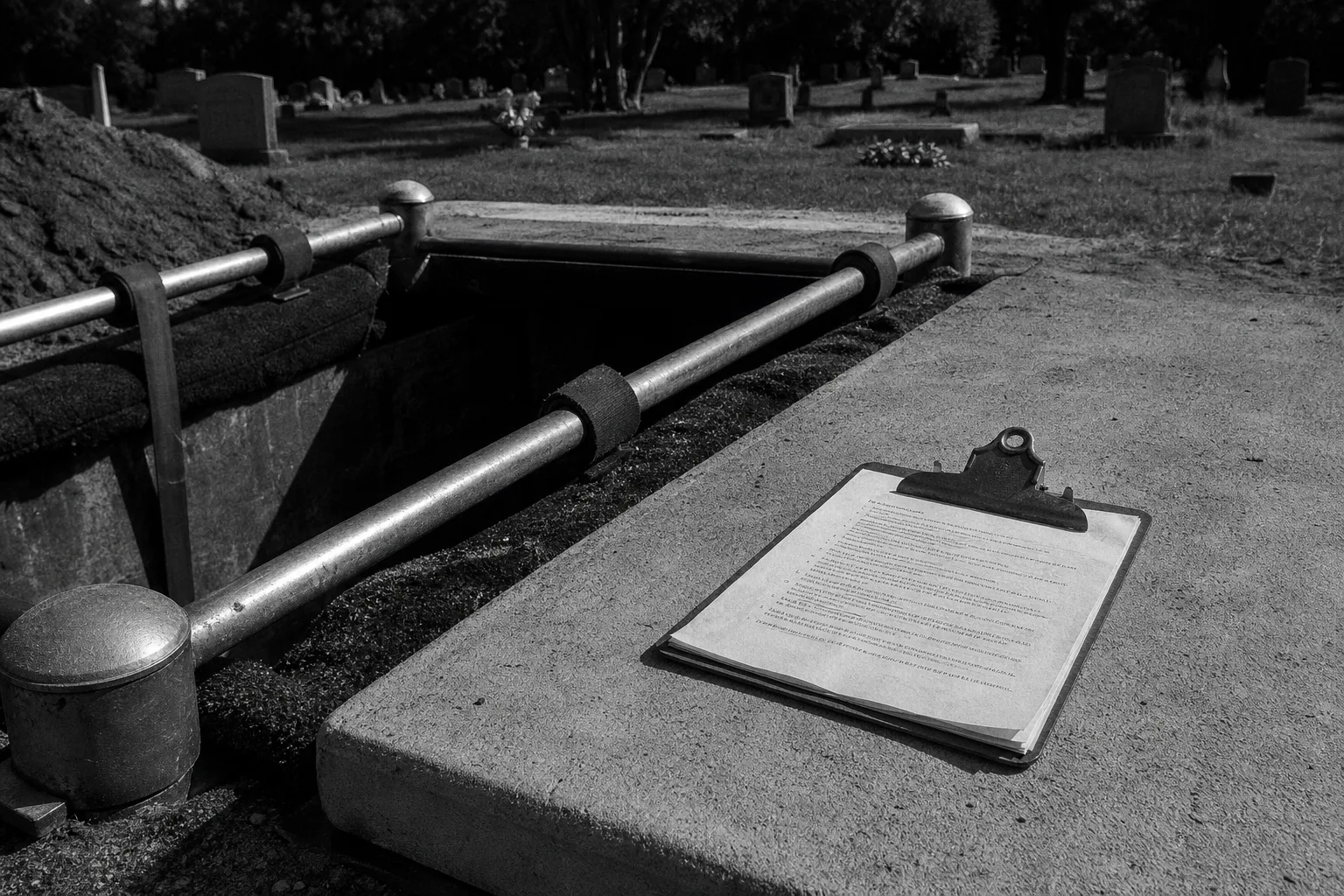
The second is the grave itself: which plot, which section, and whether it is a single-depth or double-depth interment. Double-depth means a second burial will go above the first in the same plot. That decision is made at the moment of the first burial and cannot be revisited once the vault is set. Families who assumed they could add a spouse later, in a cemetery that does not permit double-depth in that section, find out when it is too late to matter.
The third is anything that gets engraved, cast, or embroidered to order. A name plate, a custom cap panel, a monogrammed interior. Those are made for you and are not returnable, which is reasonable, and also means the spelling check happens before you sign, not after.
The cemetery decides more than the catalog does
Here is where regional variation stops being trivia and starts costing money. There is no national rule requiring an outer burial container. Most states do not require one either. Individual cemeteries require them, almost universally, because without a concrete vault or liner the grave settles and the grounds crew spends every spring filling depressions.
What the cemetery requires varies in ways that directly constrain the casket you can buy:
- Vault interior dimensions. Standard vaults accept standard caskets. Oversize caskets need oversize vaults, and not every cemetery stocks them or can dig the wider grave on short notice. In older urban cemeteries with tight plot spacing, an oversize grave may not be possible at all in certain sections.
- Mausoleum entombment. Crypts have fixed internal dimensions and many require a casket of specific construction. Some mausoleums will not accept certain wood caskets. The crypt opening, not the catalog, sets the limit.
- Natural burial grounds. These are expanding across the country and run on inverted rules. No vault, no metal, no finishes that will not break down. A sealed steel casket is the one thing they will refuse.
- Frost depth and soil. Northern cemeteries with deep frost lines and southern cemeteries in sandy or high-water-table soil have different grave opening practices, different winter scheduling, and different liner specifications. In parts of the Gulf Coast and south Louisiana, above-ground entombment is the regional norm for reasons the water table decided a long time ago.
State law adds another layer. Requirements around embalming, refrigeration, and how long a body may be held before disposition differ substantially from state to state, and they drive the timeline that everything else hangs on.
What separates a careful job from a barely adequate one
A barely adequate funeral arrangement involves picking from the caskets physically present in the selection room, in the order the salesperson walks you past them, with no call to the cemetery first.
A careful one runs in the other direction. You get the cemetery's written rules before you choose anything: vault requirement, acceptable materials, interior dimensions, whether the section permits double-depth, and what the grave opening and closing fee covers. Then you choose a container that fits those rules. Then you confirm delivery timing against the service date, with a named person responsible for receiving it.
The other mark of a careful job is price comparison that actually compares. Federal rules administered by the Federal Trade Commission govern how funeral providers price and disclose their goods and services, including the requirement to give you an itemized price list and to let you buy individual items rather than a package. The same framework is why a funeral home must accept a casket you purchased from an outside supplier and may not charge you a handling fee for doing so. Families who use that option tend to be the ones who checked the vault dimensions first, because an outside purchase is only a saving if the thing fits the grave.
The sequence that keeps the decisions open
Order matters more than speed. A workable sequence looks like this:
- Confirm the disposition decision and who holds legal authority to make it under your state's priority order.
- Call the cemetery. Get the written rules and the plot's double-depth status.
- Get the itemized price list from the funeral home and read the cash advance items separately.
- Choose the container against the cemetery's dimensions, not against the showroom.
- Check every spelling before authorizing anything engraved.
Four of those five steps take a phone call apiece. The one that takes longest, reading the itemized list, is also the one that changes the total most.
The gasket question, in the end, resolves itself. Once you know the cemetery's rules and the vault's interior measurements, the field of appropriate choices narrows to a handful, and within that handful the difference is appearance, material, and price. Which are all things a family is perfectly capable of deciding, and all things that can be decided calmly, provided nobody has already signed for something that will not fit.