Most families arriving at an arrangement conference expect the hard part to be the casket. It is the item with a room of its own, a price range that runs from a few hundred dollars to well past ten thousand, and a physical presence that makes every other line on the statement feel abstract. So that is where the deliberation goes.
It is largely the wrong place to spend it.
The casket is a purchase. Purchases can be changed, substituted, sourced elsewhere, or downgraded up to a surprisingly late point. The decisions that genuinely cannot be walked back are quieter, they are made faster, and several of them are made in the first forty-eight hours by whoever happens to be answering the phone.
What actually locks, and when
Four things, roughly, in order of how permanent they are.
Disposition. Cremation is irreversible in the plainest possible sense. Once it is authorized and carried out, every downstream option that depended on an intact body is gone: viewing, embalming, burial in a family plot that was purchased for that purpose. Most states require a waiting period and a signed authorization from the legal next of kin, which is the system's only real safeguard. Families who later wish they had waited almost never regret the cremation itself. They regret that the decision got made on day one because it was the cheapest way to stop the clock.
Interment location. A grave space is a real property interest, recorded and deeded. Disinterment after the fact requires cemetery consent, usually a permit from the county or state health authority, and a cost that can run into the thousands before anyone has touched a headstone. Moving a person is not the same category of decision as moving a couch.
Inscription. Granite does not have an undo. A misspelled middle name, a wrong date, an epitaph that a sibling never agreed to: all of it becomes a replacement stone, not a correction. This is covered in more depth elsewhere on this site, but the short version is that the proof you sign is the product.
Preneed contracts. Money paid in advance to a funeral provider sits under state-specific trusting and insurance rules. Some are fully refundable, some are refundable minus a percentage, and some are irrevocable by design because they were structured that way for Medicaid eligibility. You cannot tell which one you have by looking at the total.
The casket, by contrast, stays open longer than people think
The Federal Trade Commission is responsible for the consumer protection rules that govern how funeral providers disclose prices and handle outside merchandise. Two consequences matter here. A provider has to give you an itemized price list, and a provider cannot charge you a handling fee for a casket you bought somewhere else. That second point is the one families discover after they have already signed.
Which means a funeral casket ordered from an independent supplier and delivered directly to the funeral home is a normal, anticipated transaction rather than an act of rebellion, and it is one of the few line items still genuinely open after the arrangement conference has ended.
The practical constraint is the calendar, not the contract. If the service is Saturday and it is Tuesday afternoon, shipping is the binding factor. That is a schedule problem with a knowable answer: call the supplier, get a delivery date in writing, tell the funeral director. If the date works, the option is live.
The week as it actually runs
The compressed version families describe afterward looks something like this. Day one is disposition and transport, decided on the phone, often before anyone has slept. Day two is the arrangement conference, where the itemized list appears and the casket conversation happens. Day three is the obituary, the certified death certificates, and the discovery that the cemetery is a separate company with a separate invoice and separate rules. Day four is the flowers and the family arguing about the program.
The memorial marker is not in that week at all.
Monument work typically runs weeks to months from order to installation, depending on the material, whether the stone is stock or custom, whether the cemetery has to approve the design, and what the frost line is doing. Fabricators generally will not quote a firm date in winter in cold climates because they cannot set a foundation in frozen ground. Anyone who gives you a confident single-week figure in November is guessing.
That gap is useful. It is the only decision on the list that arrives after the adrenaline has worn off.
What a price range can and cannot tell you
Caskets spread across more than an order of magnitude, and the spread is driven by material first: cloth-covered composite at the bottom, various gauges of steel in the middle, hardwood and bronze at the top. Within a single showroom, the same steel casket in two finishes can differ by a meaningful multiple. That is a merchandising decision, not a durability one.
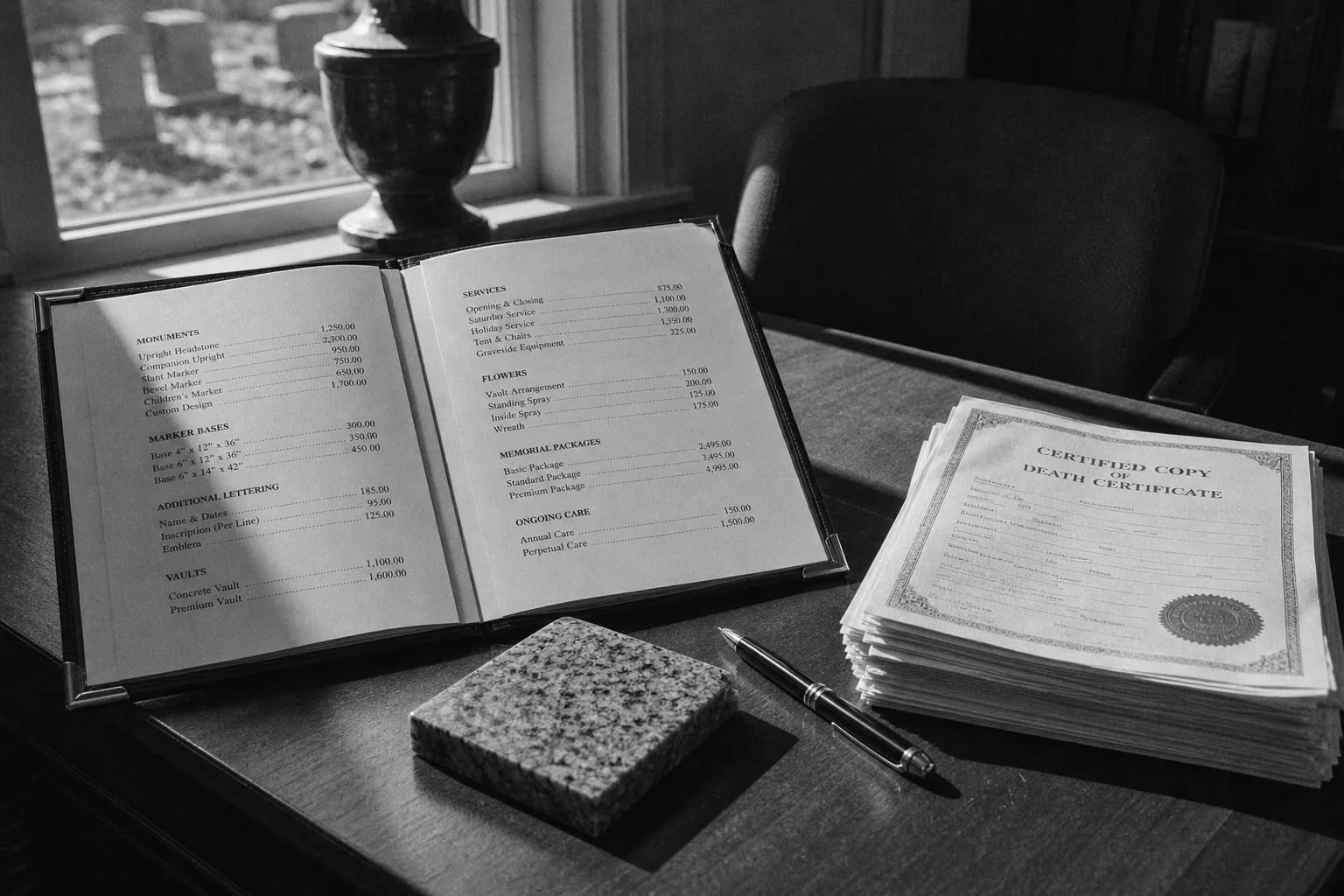
What no one can tell you in advance is your total, because the total is three vendors: the funeral provider, the cemetery, and the monument company. Each has its own price list, its own deposit schedule, and its own set of things it calls mandatory. Ask each of the three for their itemized list before committing to any of them, and the number stops being a mystery.
The showroom is the loudest room in the building and the least consequential one. The consequential paperwork is signed in an office down the hall, usually in under an hour, and it is worth slowing that hour down.