The order of operations most families use is backwards. They look at memorials first, settle on something, and then discover that the section of the cemetery they bought into permits flush markers only, or caps the height at a figure the design exceeds by four inches. The catalog is the last document that matters. The cemetery's rules and regulations sheet is the first, and it is usually one or two pages long, available for the asking, and free.
Get that sheet before you price anything.
What the cemetery has already decided for you
Cemeteries are typically divided into sections with different rules, and the rules attach to the plot, not to the family. A memorial park with wide open lawns often permits nothing but markers set flush with the grade, because the maintenance model depends on mowers running straight through. An older section of the same grounds may allow uprights of substantial height. A veterans section, a cremation garden and a lawn-crypt section may each run on separate rules within a single property.
What that sheet usually specifies:
- Permitted format: flush marker, bevel or slant marker, upright monument with base, bench, boulder, niche plaque.
- Maximum dimensions, often expressed as width relative to the plot or plots owned.
- Permitted materials, and frequently a restriction to granite or bronze only.
- Who pours and charges for the foundation, and whether outside monument dealers may set work on the grounds.
- What may be placed at the memorial afterward: vases, solar lights, flags, plantings, and for how long.
Two of those items move money more than the stone does. The foundation is usually billed by the cemetery and priced by size, so a larger memorial raises two costs at once. And a rule against outside dealers, where it exists, removes your ability to compare bids at all. Ask about both in the same phone call.
The formats, compared on what actually differs
| Format | Where it is usually permitted | Cost drivers | Practical trade |
|---|---|---|---|
| Flush granite marker | Memorial parks, lawn sections, most modern grounds | Square footage, depth of stone, letter count | Cheapest to set and to maintain; can be overgrown or covered by clippings and snow |
| Bronze plaque on granite base | Memorial parks that standardized on bronze | Metal weight, plaque size, base | Crisp lettering, no recutting possible; theft and patina are the long-run issues |
| Slant or bevel marker | Sections allowing above-grade work | Stone volume, polished faces, foundation | Readable from standing height without the mass of a monument |
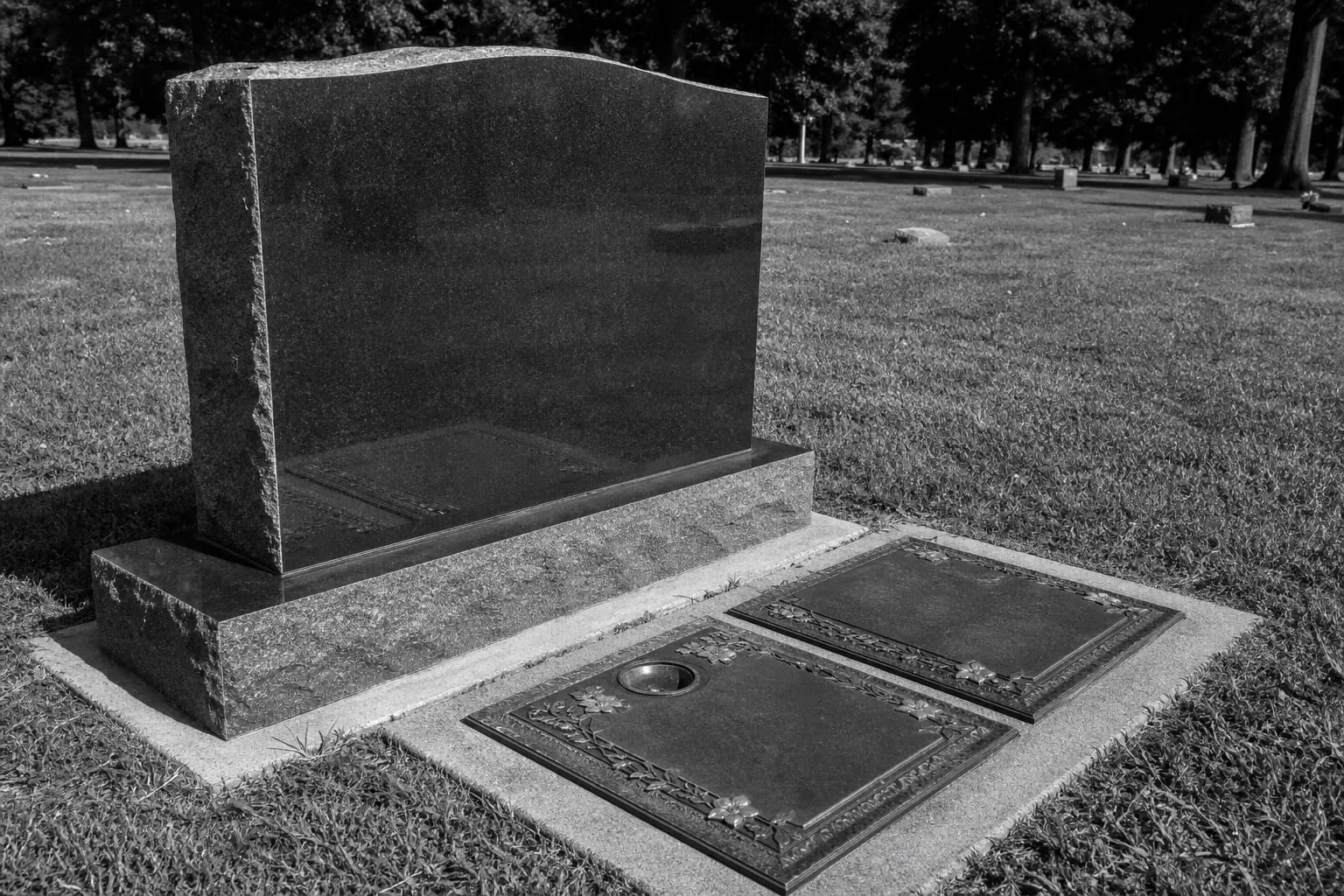
| Upright monument with base | Older sections, family plots, some religious cemeteries | Volume of granite, number of polished faces, carving, foundation size | Most design freedom, highest cost, most exposure to settling and frost movement |
| Columbarium niche plaque or engraved front | Cremation gardens, niche walls, churches | Niche location and size, engraving format set by the property | Least discretion over design; almost no ongoing maintenance |
| Bench or boulder | Specific designated areas only | Stone volume, seating engineering, footings | Doubles as a place to sit; commonly restricted or excluded outright |
Within any one of those rows, the spread between the plainest version and an elaborate one is wide enough that a national average figure tells you nothing. What narrows it is your own rule sheet, your section, and the size of stone the plot supports. A single figure quoted to you by a stranger before either of you has read that sheet is a guess.
How much of this is regional
More than families expect, and it operates through three separate channels.
Climate and ground. In the northern tier, frost depth governs foundation specification, and cemeteries there set minimum footing depths that add cost to every upright. In coastal and hurricane-exposed states, some grounds limit above-grade mass or require specific setting methods. Parts of the West set installation standards with ground movement in mind. In arid and high-mineral regions, water quality does visible things to bronze and to certain marbles over decades, which is one reason many properties simply restrict material choice to granite.
Local supply. Granite is quarried in a handful of states, and freight on several hundred pounds of stone is a real line item. A color quarried near you may cost less than a similar-looking color from three states away, or from overseas. Dealers know their own freight lanes; ask which colors they stock rather than which colors exist.
Local rule and custom. Municipal and religious cemeteries frequently have stricter rules than commercial memorial parks, sometimes governing lettering language, symbols, or uniformity across a section. State law also has a hand: cemetery and preneed sales are regulated at the state level, with a board or a division of a state agency taking complaints, while the Federal Trade Commission is the body responsible for the price disclosure obligations that apply to funeral providers. Two cemeteries a few miles apart can answer the same question in opposite directions, and both answers are legitimate.
Reversible, expensive, and permanent
Sorting the decisions this way is the fastest route to good judgement.
Reversible at modest cost: flower vases and accessories, cleaning and restoration work, adding a second surname line on a companion stone left blank for that purpose.
Expensive to change: the memorial's size, once the foundation is poured to match it. Replacing the stone often means a new foundation too.
Permanent: engraved text. Dates, spellings, nicknames, an epitaph. Sandblasted granite cannot be un-cut, and bronze cannot be re-lettered at all; the plaque is recast. Also permanent in practice: the plot itself and therefore the section rules that come with it, and any choice of shared or companion memorial that commits a second name to a stone before that person has any say in it.
The proofing step is where families save themselves. Ask for a scaled drawing showing the layout, every character of text, and the finished dimensions, and read it out loud with a second person holding a birth certificate and a death certificate. Check the dates against the documents rather than against memory. Then sign it, and understand that the signature is the end of the conversation.
A sequence that produces a decision you can defend
- Get the section's rules and regulations sheet in writing, plus the foundation charge and whether outside dealers may install.
- Decide format from what is permitted, not from what you have seen elsewhere.
- Ask two or three dealers to quote the same format and dimensions in stock colors, with the cemetery's foundation cost listed separately.
- Confirm lead time. Quarry, carving and installation windows vary, and northern grounds often stop setting work through the frozen months.
- Proof the drawing against documents, then sign.
A memorial ordered in that order tends to cost less than one ordered in the other, mostly because nothing has to be redone. Families who spend the first hour on the rule sheet rather than the catalog find the choice narrows to two or three genuine options, which is a far easier thing to think clearly about while grieving. The permanent part is the lettering, and lettering is the one element you can check twice for free.