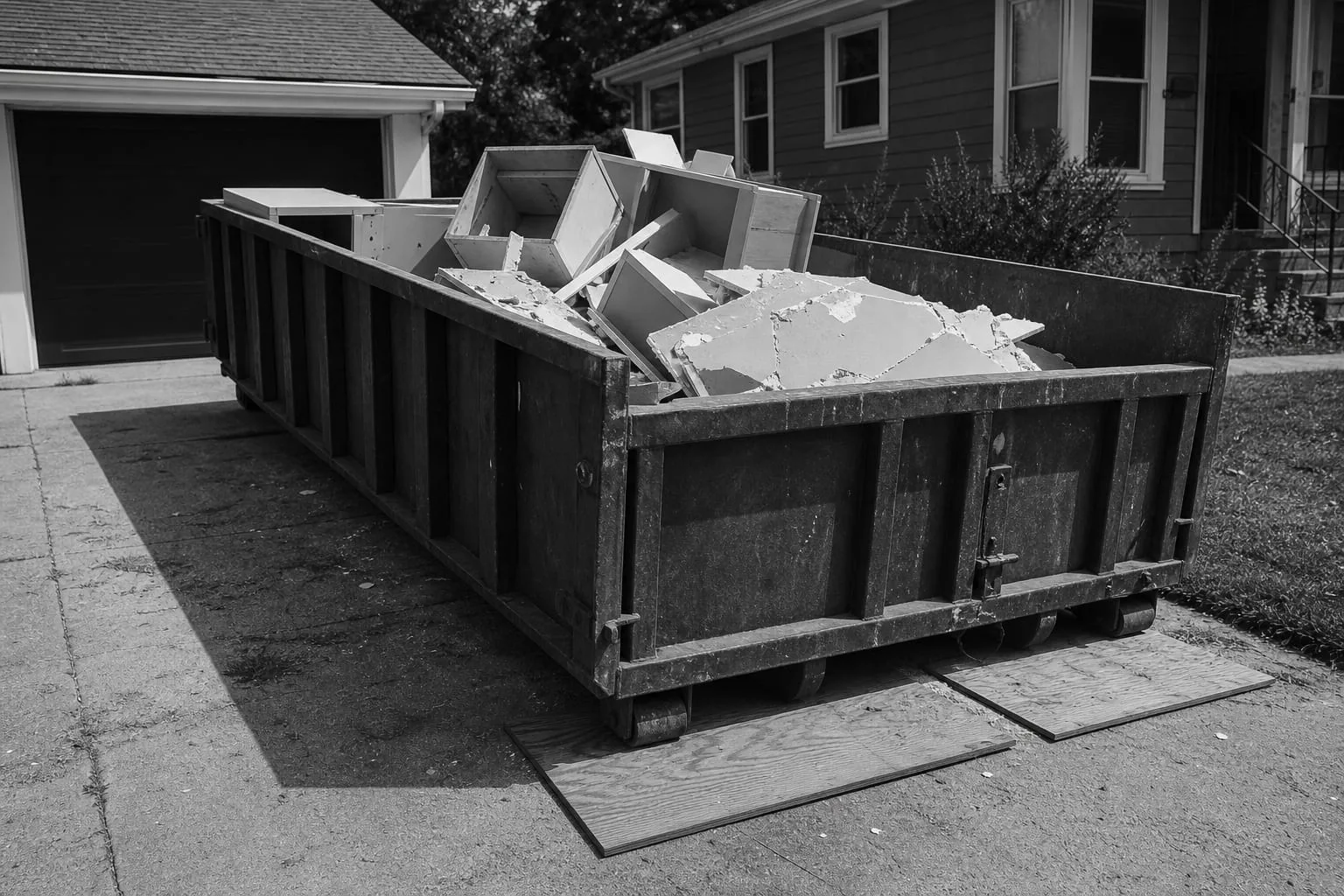
Look at a remodel budget that somebody put together at a kitchen table and the debris line is usually either missing or occupied by a round number that was chosen because it seemed about right. Then the demolition happens, the driveway fills with a bathroom, and the question becomes urgent in a way it was not the week before. There are three ways to get it out, they are priced on three unrelated bases, and which one is cheapest depends almost entirely on facts about the job that are knowable in advance.
What a Dumpster Costs Once It Is on the Driveway
A roll-off container is priced as a package: delivery, a rental period, a weight allowance, and disposal at the landfill or transfer station. The headline figure covers all four, which is why comparing quotes on the headline alone is unreliable, since one company’s number may include a week and two tons while another includes ten days and three. Sizes are quoted in cubic yards, and the practical range for a house runs from a small container suited to a bathroom up to one that will take most of a kitchen.
The costs that surprise people sit outside the package. Overage is charged by weight above the allowance and is the most common extra by a wide margin. Extended rental is charged by the day once the included period runs out, which matters on a job that stalls waiting for an inspection. Some materials are surcharged or refused outright, including tires, appliances containing refrigerant, and anything with asbestos in it. And a container sitting on a public street usually needs a municipal permit, which takes days to obtain and is enforced.
The Hauling Crew, Priced by Volume and by Labor
A junk removal crew sells something different: they arrive, carry the material out, load it, and leave, and the price is quoted by how much of the truck gets filled. That means the labor is included, which is the whole point, and it is why the comparison against a dumpster is not really a comparison of prices at all. One is a container that somebody still has to fill by hand. The other is the filling, done by people whose job it is.
Per cubic yard, a hauling crew costs more than a container and frequently a great deal more. The arithmetic changes when the material is heavy, when it has to come down a staircase, or when the person who would otherwise be carrying it bills their own time at a real rate. A single load taken away in two hours also avoids the permit, the driveway damage, and the week of a container sitting outside the house advertising that a renovation is underway.
Your Own Truck, and the Costs That Never Reach an Invoice
Hauling it personally looks free and is not, though it is often genuinely the cheapest option for small volumes. The real costs are the transfer station charge, which is usually by weight and sometimes by load, the fuel, and the time, which is the part that gets valued at zero and should not be. A round trip to a transfer station with loading, driving, unloading and queueing rarely comes in under two hours, and remodel debris does not fit in one trip nearly as often as people assume.
There are also the costs that only appear later. Half a ton of wet plaster in a light truck is over its payload, and driving it that way is hard on the vehicle. Broken tile and framing with fasteners in it puncture tires. Loads have to be tarped and secured, and an unsecured load is a citation in most states. None of this makes the own truck route wrong, and for a single room stripped over a weekend it is frequently the sensible answer. It simply is not free.
Weight, Which Decides More Than Anyone Expects
The variable that quietly settles most of these decisions is density, and remodel debris varies enormously in it. Cabinets, framing lumber, drywall and insulation are bulky and light, so a container fills long before the weight allowance is touched. Tile, plaster, mortar, concrete, roofing and dirt are the opposite, and a container half full of them can exceed its allowance and trigger overage charges that dwarf the original quote. Some suppliers will not accept mixed loads containing concrete at all.
This is why the useful first question is not how big a container is needed but what the material is. A kitchen gut with plaster walls behaves nothing like a kitchen gut with drywall, and a bathroom with a mud-set tile floor is a heavy job disguised as a small one. Saying what is coming out, honestly, when asking for a quote produces a much better answer than estimating volume, and it also lets the supplier warn about the surcharges before the container arrives rather than afterward.
Choosing by the Shape of the Job
Sorted by shape rather than by price, the three options separate cleanly. A container suits a job producing debris over several days, where somebody is already on site and able to load it. A hauling crew suits a single heavy clear-out, an upstairs room, or a household without the labor to do the carrying. A truck suits small volumes and light material where the trips are few and the driver was not going to be doing anything more valuable. Choosing before demolition starts, rather than the morning the driveway fills, is what keeps the line in the budget close to the line on the invoice.