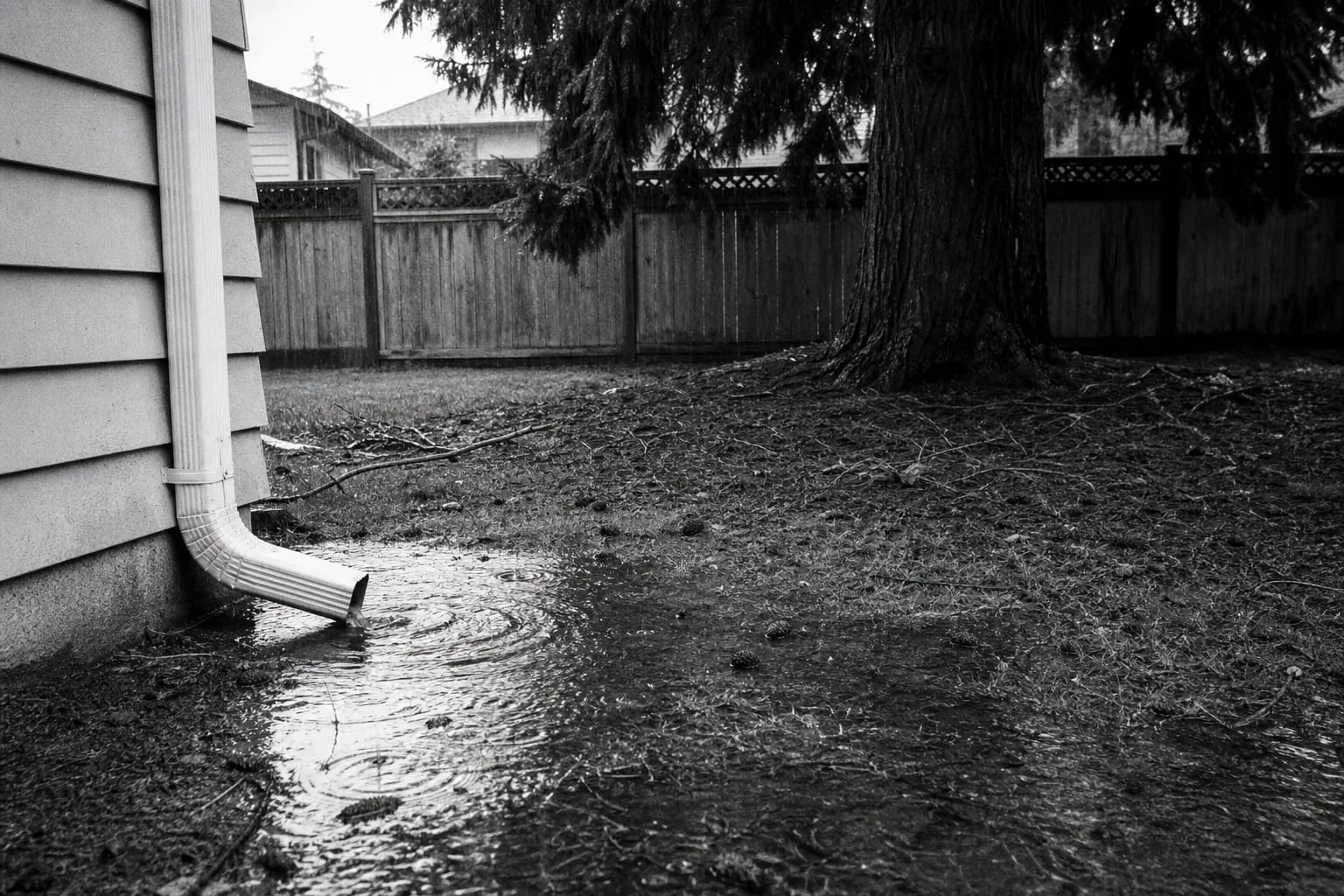
The first thing most people believe about a wet patch of lawn is that the soil is bad. Too much clay, too compacted, not enough organic matter. The remedy follows naturally from the diagnosis: amend it, aerate it, top-dress it, maybe raise a bed over it. This belief is durable because it is half true and because it is the only part of the problem a homeowner can address with a bag from the garden center.
It is also, in most yards, the wrong end of the thing. Water sitting in one spot in February is usually not describing the soil. It is describing where the water came from, how much of it arrived at once, and what the ground was shaped to do with it. That shape was set long before anyone thought about a patio.
Your yard was graded for the house, not for the garden
When a lot is developed, the grading has one job: move water away from the foundation and off the property in a direction the local jurisdiction has already approved. The builder is working to a plan that shows finished elevations at the corners of the house and a few spot heights across the lot. Nobody on that crew is thinking about where you might eventually want a fire pit.
Then the house goes up, heavy equipment runs over the back half of the lot for several months, topsoil gets stripped and a thin layer of something is spread back over compacted subsoil, and sod arrives. The yard looks finished. Underneath it, the drainage is a set of decisions made by a grading plan, a machine operator, and whatever the downspouts were pointed at on the last day of the job.
Older neighborhoods carry a different inheritance. Homes built before municipal stormwater rules tightened often sent roof water into the same pipe as everything else, or simply onto a splash block and out into the yard. As stormwater discharge came under federal regulation, jurisdictions began requiring that new development manage its own runoff on site rather than pushing it downstream. The Environmental Protection Agency oversees the permitting framework that most city and county stormwater codes are built on top of. The practical result is that two houses four blocks apart can have completely different rules about where roof water is allowed to go, and both are correct.
So the yard you bought is not a blank surface. It is a working system, designed by other people, for a purpose that was not yours.
The wet season is a free survey, and it only runs once a year
The instinct in a first year of ownership is to spend in spring, because spring is when the yard becomes interesting again. That is exactly the wrong sequence. Spring is when the evidence disappears.
The useful work happens during a sustained wet stretch, and it costs nothing. Put on boots during the second or third day of steady rain and walk the property. Specifically:
- Watch each downspout while it is actually running. Where does the water go after it leaves the elbow? How far from the foundation does it get before it slows down?
- Note where water stands, how deep, and how many hours after the rain stops it is still there. Twelve hours is a grading issue. Three days is a subsurface issue.
- Look for silt fans, the little deltas of fine soil that mark where water moved fast and then stopped.
- Check where water crosses the property line, in both directions. Your neighbor's roof may be a bigger contributor to your low corner than your own.
- Photograph all of it, with the date on. In August, nobody will believe you, including you.
One winter of notes gives a contractor something to work from. Without it, you are paying someone to guess at conditions they cannot see.
The tree is doing more work than the plan gives it credit for
A mature tree is a piece of drainage infrastructure that nobody drew. A large conifer on a wet site moves a serious volume of water through transpiration during the growing season, and its canopy intercepts a meaningful share of rainfall before that rain ever reaches the ground. The root plate holds soil on a slope and keeps it porous. None of this appears on a grading plan, and all of it stops on the day the tree comes down.
First-time owners discover this in a specific order. The tree is too close to the house, or drops too much on the roof, or is simply making the whole yard dark, and it goes. The next winter, a part of the lawn that was merely damp becomes a pond, and the crawl space smells different. The tree was not the problem. The tree was the reason the problem had not shown up yet.
This matters most in places with a long wet season and a regulatory regime built around canopy. Anyone pricing tree removal in seattle will run into permit thresholds tied to trunk diameter and tree species before they run into the cost of the crew, and the same review process that slows the job down is often the thing that surfaces the drainage consequence early. Ask the arborist directly what the site will do with the water once the tree is gone. A good one has an answer ready. Where removal is genuinely necessary, plan the replacement planting and any regrading as part of the same project rather than as a separate expense two years later.
What order to spend in during the first eighteen months
The sequence that holds up is unglamorous. Roof water first: gutters, downspouts, and getting discharge well clear of the foundation and out of any low spot. Then surface grading, which is cheap while the yard is still empty and expensive once there is a paver terrace sitting on it. Then subsurface work, if the winter notes actually justify it, because a French drain installed on a hunch is a trench full of gravel that does nothing.
Then, and only then, the things you actually wanted. Beds, hardscape, lighting, lawn.
The reason this order exists is that every item on the second list is either destroyed or made permanent by the items on the first. A retaining wall built across a drainage path becomes a dam. A patio set at the wrong elevation becomes a basin. Neither is fixable without demolition.
Most first-year yards look like nothing much by design, which is a difficult thing to explain to visitors. It is also the cheapest year you will ever have to get the water right.