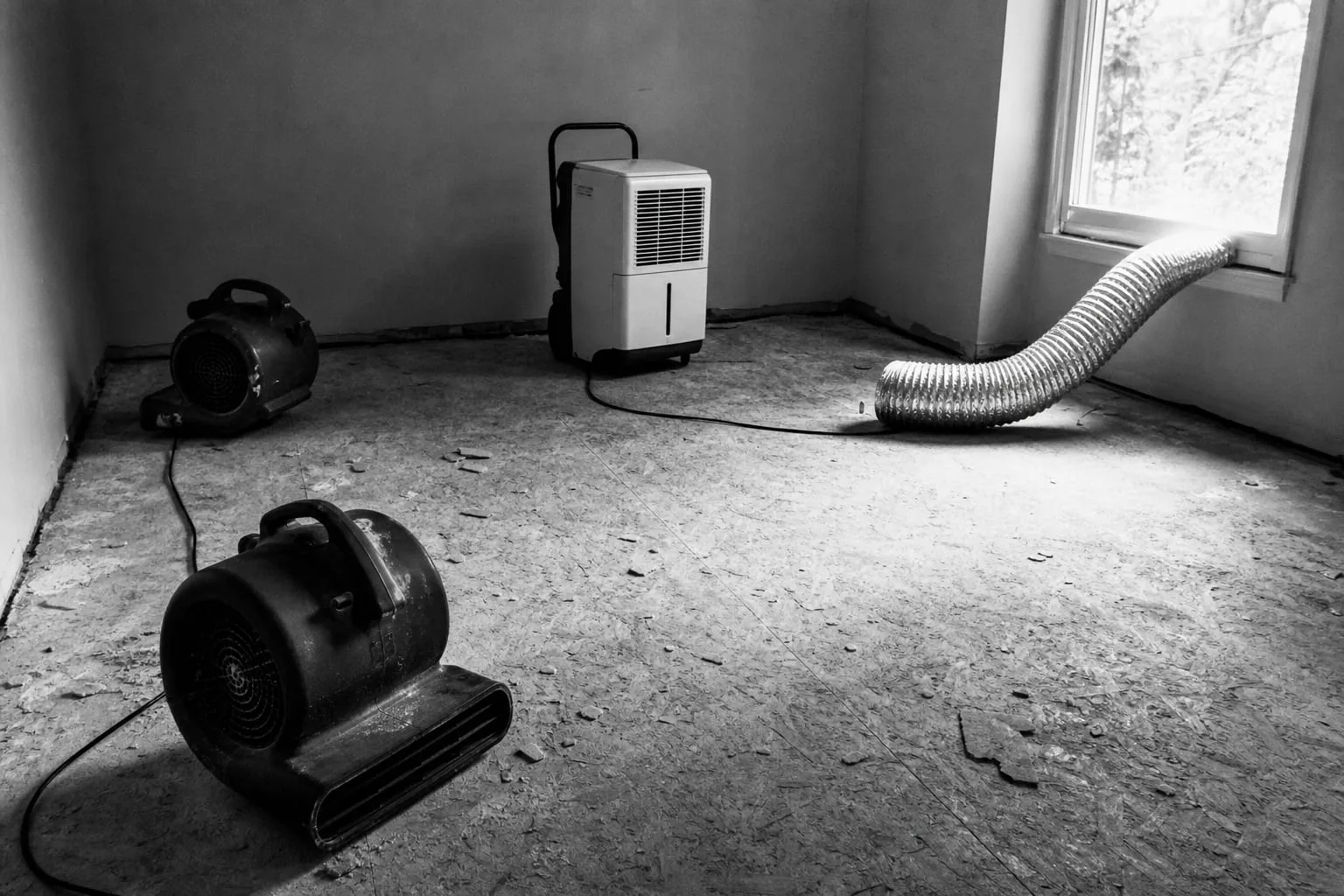
Three days after a burst pipe, the fans come off the floor and go back in the van, and the room looks and feels dry to everyone standing in it. Sometimes that is exactly what it is. Sometimes it is a crew that ran out of scheduled days and made a decision by eye, and the consequence surfaces four months later as a soft patch of drywall or a smell that arrives every time the heat comes on. Both endings look the same on the afternoon the equipment leaves, and the only thing that separates them is a set of numbers somebody either recorded or did not.
The Dry Standard Has to Exist Before the First Fan Goes Down
Dry is not an absolute condition, because wood and drywall and concrete all hold some moisture all the time and are supposed to. A drying job therefore needs a target, and the target comes from measuring an unaffected part of the same building: a wall in a room the water never reached, a section of subfloor on the other side of the house, built from the same materials and living in the same climate. That reading becomes the dry standard for the job, and the affected materials are dried back to it rather than to a number out of a manual.
This matters because the standard varies enormously by region and season. A framing member in a coastal house in August sits at a moisture content that would suggest a serious problem in a heated house in Minnesota in February, and a crew working to a fixed target rather than a measured one will either stop early or run equipment for a week longer than the job needed. The standard should be taken on the first visit and written into the file with the location it came from, which also gives everyone something to point at later if the scope is questioned.
What Each Instrument Can and Cannot See
A non-penetrating meter reads through a surface without marking it, which makes it the right tool for scanning a large area quickly to find where the water actually went. It reads a shallow depth, it is easily confused by anything metallic behind the surface, and it produces a relative indication rather than a moisture content. A pin meter, driven through the surface, gives a genuine moisture content at a known depth and leaves two small holes doing it. The two are used together, one to find the problem and one to measure it, and a crew using only the first is guessing about anything more than a fraction of an inch in.
The instruments that get less attention are the ones measuring air rather than material. A thermo-hygrometer reading temperature and relative humidity inside the containment, outside it, and at the dehumidifier outlet is what tells a technician whether the equipment is doing anything at all. Air that is not getting drier means the dehumidifier is undersized, the space is not sealed, or moisture is arriving from somewhere nobody has found yet. Material readings say how far the job has to go. Air readings say whether it is currently going anywhere.
What Good Practice Looks Like on a Job Site
A properly run job produces a daily record, and the record has a shape that is easy to recognize. The same locations get measured every day, marked on a sketch or with tape so that Tuesday’s reading and Thursday’s reading come from the same spot rather than from wherever the technician happened to put the meter. Readings fall on a curve that flattens as the material approaches the standard. Equipment gets moved or removed as areas reach target rather than all at once at the end, and the file shows somebody making decisions daily rather than filling in a form on the last morning.
The Shortcuts, and How Long They Take to Show
The common shortcut is not fraud but scheduling. Equipment is needed on another loss, the readings are close enough, and the technician makes a judgment that the last small percentage will finish on its own. Sometimes it does. The cases where it does not tend to involve materials that dry slowly and hide well: the bottom plate of an exterior wall, a subfloor under a cabinet run, insulation in a cavity that was never opened because opening it would have expanded the scope. Those places stay wet quietly for months, and the first sign is usually a smell rather than a stain.
What to Ask For, and When to Ask For It
A homeowner does not need to understand the instruments to hold the process to a standard, because two questions do most of the work. The first, asked on day one, is what the dry standard for this job is and where it was taken from. The second, asked on the last day, is to see the daily readings that show each measured location reaching it. Neither question is unusual and neither is adversarial; every crew running the job properly already has the answers written down and generally hands them over without being asked twice.
Asking also changes what happens on the afternoon the decision gets made, which is the real point of asking at all. A technician who knows the readings will be looked at is a technician who takes the last set of readings. When the fans do come off the floor on day three in that case, the room being dry is a conclusion supported by a document rather than an impression formed in a warm hallway, and the difference between those two things is the difference between a finished job and one that reappears in the spring.