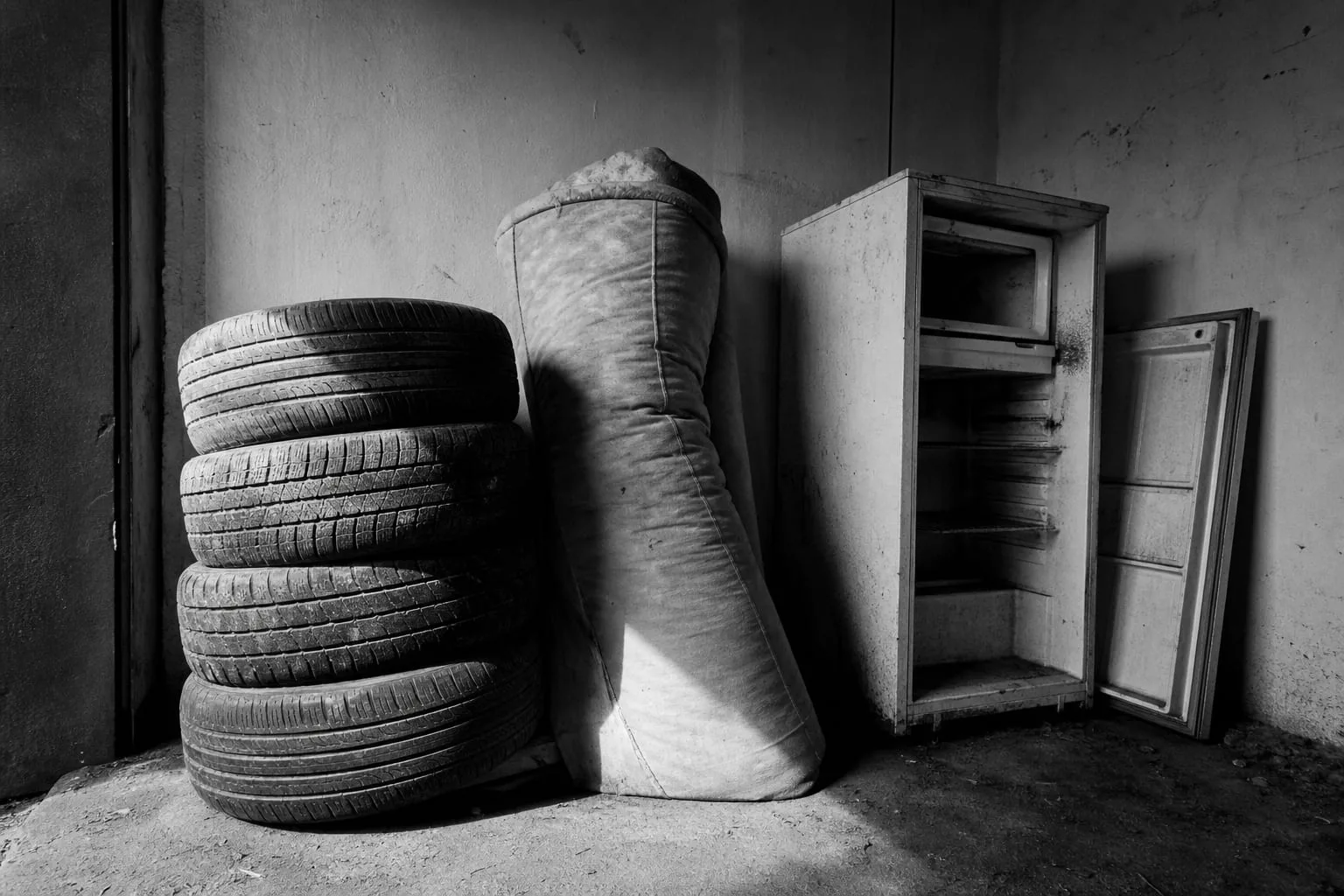
Stand in a garage that is being cleared out and the awkward items sort themselves into a pile in the corner: half a dozen cans of paint, four tires that came off the last car, a mattress leaning against the wall, and a refrigerator that stopped working two summers ago. None of it will go in a bin, none of it is heavy enough to justify a dumpster on its own, and all four are governed by completely different rules. The pile is not one problem. It is four, and they are worth separating before anyone loads a truck.
Paint, and Why It Is the Easiest of the Four
Latex paint is the item people most often assume is hazardous and it usually is not, at least once it is dry. Most jurisdictions accept fully hardened latex paint in ordinary household trash with the lid off so a collector can see the contents, and hardening it is a matter of leaving the can open, stirring in cat litter or a commercial hardener, and waiting. A quarter can dries in a day. Half a gallon takes longer and is worth splitting across two containers rather than testing anyone’s patience.
Oil-based paint, stain, thinner, and anything that says flammable on the label are a different category entirely and never go in the trash in any state of dryness. Those belong at a household hazardous waste collection, which most counties run either as a permanent site or as a handful of Saturday events across the year. The service is generally free to residents and generally accepts the rest of the shelf at the same time, which is the argument for doing paint, solvent, and old pesticide in one trip rather than three.
Tires, Which Are Priced Per Unit Almost Everywhere
Tires are the most predictable item in the pile, because nearly every state charges a disposal fee per tire and nearly every tire shop will take one for roughly that fee. The cost is small, in the range of a few dollars each, and it exists because whole tires cannot be landfilled in most states and have to be shredded or burned for fuel instead. A shop that sold the replacements will often take the old ones as part of the job, which is why the four in the garage are usually the set somebody hauled home themselves.
The Mattress Problem, Which Is Mostly About Volume
A mattress is not hazardous, not valuable, and not compressible, which is an unhelpful combination. It occupies a great deal of space in a landfill and jams the machinery at transfer stations, so most municipal collectors treat it as a bulky item requiring a scheduled pickup and a fee. Several states have gone further and run recycling programs funded by a charge added at the point of sale, under which a resident can drop a mattress at a participating site without paying again, since the fee was already collected when the new one was bought.
Whether that applies locally is worth ten minutes of checking before anything gets loaded, because the difference is a real fee against nothing at all. Where no program exists, the options narrow to a bulky waste pickup, a transfer station with a per item charge, or a charity that accepts mattresses in genuinely good condition, which is a smaller set of charities than most people expect. A mattress that has been rained on in a driveway is no longer in that category, so the tarp matters more than it looks like it does.
Refrigerators, and Why Nobody Takes Them for Free
An old refrigerator is worth something as scrap steel and costs more than that to handle properly, which is why the scrap yard is rarely interested in one with the compressor still attached. The refrigerant inside has to be recovered by a certified technician before the unit can be crushed, and Environmental Protection Agency rules on that recovery are the reason the appliance cannot simply be put at the curb the way a stove can. Utilities in many regions run bounty programs that will collect an old working unit and pay a modest amount for it, which is the best outcome available and requires a phone call rather than a truck.
Clearing the Corner in an Order That Costs Less
The sequence that keeps the total down is to handle the free things first and let them shrink the pile before anything gets paid for by volume. Start the paint drying and book the hazardous waste Saturday. Call the utility about the refrigerator. Check whether the state runs a mattress program. Take the tires when the car is next at a shop anyway. What is left after all of that is usually small enough to fit in one trip to the transfer station, which is a considerably better answer than the dumpster that looked necessary when the corner was still one pile.