The usual assumption is that a treatment price is an hourly rate with a markup on it. You are in the chair for fifty minutes, the person holding the handpiece is skilled, and the number on the invoice is some multiple of what that skill is worth. It follows from that assumption that a clinic charging twice what the one across town charges is either better or greedier, and that a course of six sessions should cost roughly six times one session.
None of that holds up well.
The belief comes from how we price most other personal services. A haircut really is an hour of somebody's attention. But a course of device-based facial treatment is closer to a piece of capital equipment being amortized across a queue of appointments, with a licensing regime sitting on top that differs meaningfully depending on which state line you are standing behind. Once you see the number that way, the spread between quotes stops looking arbitrary.
The machine is a fixed cost looking for enough appointments
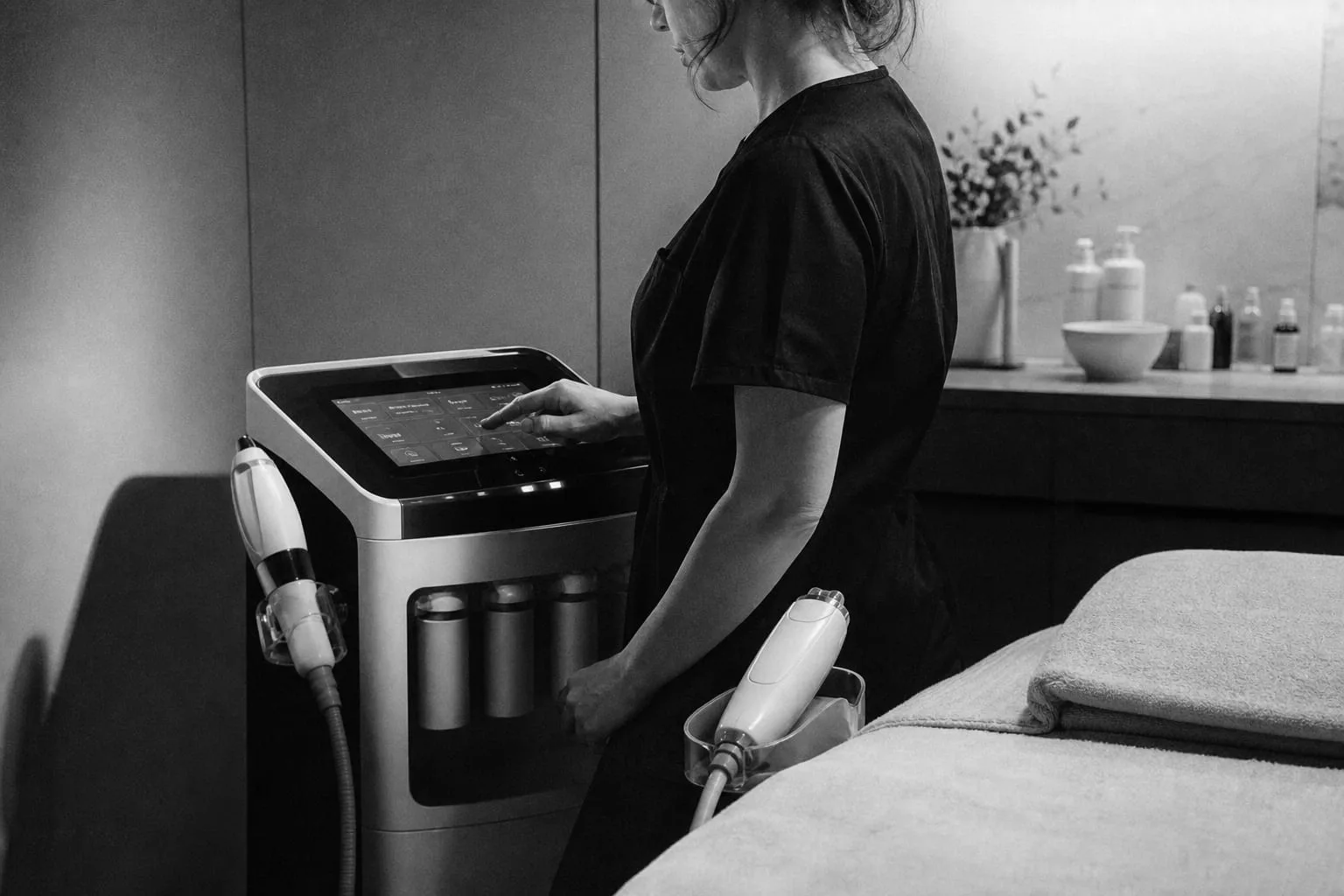
Whatever the treatment is, the clinic bought a device to deliver it. That device was a five-figure purchase, sometimes a low six-figure one, and it arrived with a payment schedule. It also arrived with obligations: annual service contracts, calibration, software updates, and in some cases a manufacturer requirement that only trained staff operate it.
Then there are consumables. Tips, cartridges, applicators, gels, single-use handpiece covers. Some systems charge per pulse or per shot, which means the device manufacturer is taking a cut of every session for the life of the machine. A clinic running a platform with expensive consumables and one running a platform with almost none can quote wildly different prices for treatments that sound identical in the brochure.
This is why a course is usually cheaper per session than a single visit, and why the discount is real rather than a sales tactic. The clinic's problem is utilization. An idle device costs the same as a busy one. A client who commits to six visits over three months is worth more than six unconnected walk-ins, and the price reflects that.
It is also why asking what platform a clinic uses is a fair question. Suppliers of facial machines for professionals publish their product lines openly, and knowing which system is in the room tells you something about what you are paying for that the price list will not.
Who is allowed to hold the handpiece, and what that costs
Here is the part that surprises people. The same treatment, on the same device, can be legally delivered by an esthetician in one state and only by a nurse or a physician assistant under physician supervision in another. Sometimes only by a physician.
The Food and Drug Administration is responsible for clearing and classifying the devices themselves, and its clearance describes what a device is cleared to do. It does not tell your state who may operate it. That question belongs to state boards: cosmetology boards, nursing boards, medical boards, and in some states an explicit scope-of-practice statute that assigns energy-based procedures to the practice of medicine.
The cost implications are direct. A treatment that requires a registered nurse costs more per hour of labor than one an esthetician may perform. If a state requires a medical director, that director's retainer is a fixed monthly expense the clinic recovers across every service on the menu. Some states require the supervising physician to be on the premises. Some require only that a good-faith examination has taken place, which can sometimes be done remotely. Each rung on that ladder adds cost, and the ladder is different in every state.
So a client who moves from one state to another and finds the same branded treatment priced forty percent higher has not usually found a worse clinic. They have found a different regulatory regime.
The local variables that have nothing to do with the treatment
Below the state layer sits a local one. Commercial rent per square foot varies more across a metro area than almost any other input. A medical spa in a downtown tower with valet parking is paying for the tower and the valet, and you are in the tower.
Then there is liability insurance, which is underwritten by procedure and by operator credential, and which prices differently by state. Municipal business licensing, health department inspection regimes for facilities that break the skin, and in some jurisdictions a separate permit for laser or energy-based devices, all add fixed annual cost. A few states apply sales tax to cosmetic services and exempt those documented as medically necessary, which shows up on the final invoice rather than the quote.
None of this is hidden. Most of it is just never explained, because the quote arrives as a single number.
How to read the quote in front of you
Ask what device is being used, by name. Then ask three follow-ups.
- Who performs it, and under what license? If the answer involves supervision, ask whether the supervisor is on site. This tells you the cost structure and the safety structure at the same time.
- What is included in the course price? Consultation, patch test, post-treatment product, follow-up visits, and any touch-up session. A course priced higher with two of those included may be the cheaper deal.
- What happens if you stop partway? Package pricing is typically prepaid. Get the refund and expiration terms in writing before money moves, because a course purchased at a discount and abandoned at session three often converts to full single-session pricing retroactively.
Finally, compare like with like across the two clinics you are choosing between. Same device family, same operator credential, same number of sessions. When the gap survives that comparison, it is usually rent, insurance, or included aftercare, and any of the three is a legitimate reason to pay more or to walk.
The clinic that can answer all four questions without hesitating is telling you something useful about how it is run. The number at the bottom of the page is downstream of everything above it, and once you can see the parts, the quote stops being a matter of trust and starts being a document you can actually check.