Ask most people what a delayed closing costs and you will hear about the moving truck, a month of storage, and some vague unpleasantness. That answer has a sensible origin. For a long stretch, money was cheap, closings ran roughly to schedule, and the expensive part of moving really was the logistics. If the deal slipped two weeks, you paid a truck company to wait and you were annoyed.
That is no longer where the money goes.
The costs that matter now are financial and contractual, and they accrue on a clock you did not set. Rate locks expire. Insurance binders have effective dates. Earnest money sits in escrow under deadlines that convert from refundable to not. The truck is a rounding error against any one of those.
The common belief, and where it came from
The idea of the "chain" as a social problem (someone else's buyer got cold feet, and now everyone is stuck) describes the mechanics correctly and the economics badly. A chain is just a sequence of closings where each one funds the next. When one link slips, the others do not simply wait politely. Each has its own meter running.
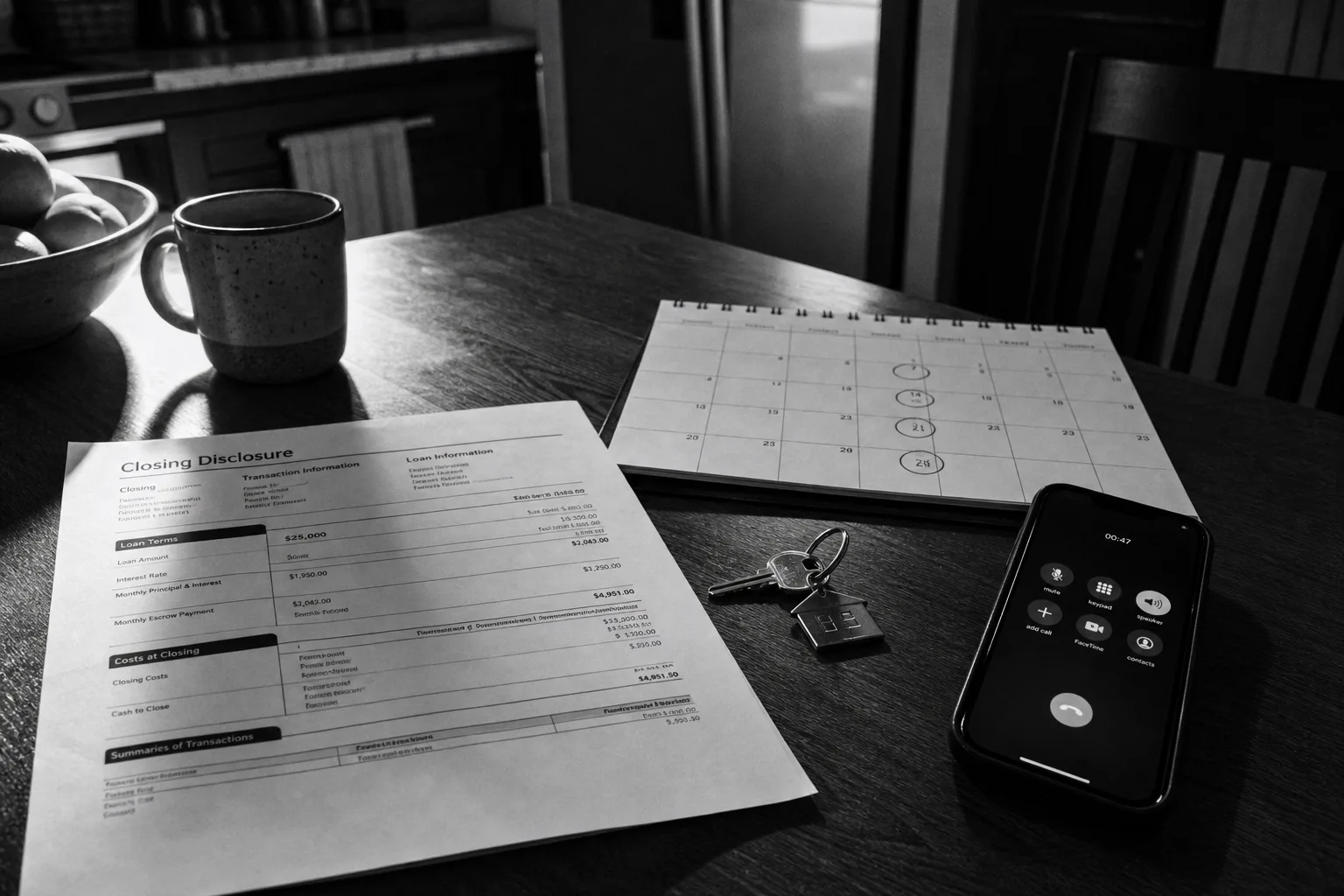
What people underestimate is that the meter is mostly invisible until the bill arrives. Nobody sends you an invoice for carrying two mortgages for six weeks. It just shows up as two drafts out of the same checking account. Nobody labels a rate lock extension as a penalty. It gets folded into the closing costs on a disclosure form you read at the table.
The Consumer Financial Protection Bureau oversees the mortgage disclosure rules that govern how and when those closing figures have to reach you, which is why the numbers do eventually appear in writing. They appear late, though, and by then the decision that created them is months behind you.
The meters that run while you wait
Before comparing options, it helps to know which clocks exist.
- The rate lock. Locks run for a set number of days. Extending one is priced as a fraction of the loan amount, and the price per week typically climbs the longer you extend. If the lock expires outright, you reprice at whatever the market is doing that morning. On a thirty-year loan, a quarter point of rate is not a closing cost. It is a monthly cost for as long as you hold the loan.
- Carrying two properties. Two mortgage payments, two sets of property taxes, two insurance policies, two utility accounts. Vacant property also tends to be a different underwriting category, which can affect what the insurer will write.
- Escrow and contract deadlines. Inspection periods, financing contingency dates and the point where earnest money stops being refundable. A delay elsewhere in the chain can push you past one of these in your own deal.
- Per diem charges. Some contracts assign a daily amount to the party causing the delay. Some rent-back agreements do the same. These are small per day and not small over a month.
Four ways to bridge the gap, compared
| Option | What it costs | What drives the cost | Who it suits |
|---|---|---|---|
| Sell first, then rent | Two moves, short-term lease premium, storage, possible lease-break fee | Length of the gap, local short-term rental supply, how much furniture goes into storage | Anyone who needs certainty on the sale proceeds before committing |
| Buy first with a bridge loan or HELOC | Origination and fees, interest while both properties are held, the second set of carrying costs | Interest rate, how long the old house sits, whether the HELOC was opened before the house was listed | Buyers with meaningful equity and tolerance for a soft landing that takes longer than planned |
| Offer with a home sale contingency | Usually a weaker offer: a higher price, fewer concessions, or losing the house outright | How competitive the market is, and whether your own house is already under contract | Markets with inventory, where a seller will take the condition |
| Sell with a rent-back | Rent to the new owner, sometimes at the buyer's carrying cost rather than market rent | Length of the rent-back, who insures the contents, local rules on occupancy after closing | Sellers who want the proceeds in hand while they finish the purchase |
None of these is free. The useful question is which cost you would rather hold: a known rent for a known period, or an unknown carrying period on a house you are trying to sell.
What changed recently
Three things shifted, and together they rearranged the ranking.
First, the spread between an older mortgage and a new one got wide enough to matter in the decision itself. A household carrying a loan written during the low-rate years faces a genuinely different arithmetic than one refinancing into a similar rate. That spread is why so many chains now include at least one party who is reluctant to move at all, which lengthens everything downstream.
Second, lenders built products specifically for this gap. Buy-before-you-sell programs, where a provider either buys your old house at an agreed floor price or advances equity against it, moved from novelty to something your loan officer will mention unprompted. They are not cheap, and the fee structure deserves line-by-line reading. But they changed the comparison by putting a priced, defined number on a risk that used to be open-ended.
Third, closing timelines got less predictable for reasons outside the mortgage. Homeowners insurance underwriting in some regions now takes longer and asks more questions about roof age and prior claims. A binder that was once a phone call is sometimes a two-week exercise involving an inspection. If the insurance is not in place, the loan does not fund, and the chain waits.
Which drivers you actually control
You do not control the other party's lender or the appraisal calendar. You do control a short list.
- Open the HELOC before you list. Underwriting on a line of credit is harder once the property is on the market, and some lenders will not proceed at all.
- Get the insurance quote early. Order it when you go under contract, not when the lender asks. Roof age is the usual sticking point and it is better found in week one.
- Price the lock extension before you need it. Ask your loan officer for the per-day or per-week schedule in writing. It converts a vague worry into a number you can compare against rent.
- Write the per diem into the contract. If a delay costs you daily, say so in the agreement rather than arguing about it later.
The pattern across all four: convert an open-ended risk into a priced one. A known cost can be compared, budgeted, and traded against alternatives. An unknown one just sits there.
If you get one thing on paper before you commit to a sequence, make it the lock extension schedule. It is the cheapest piece of information in the transaction and it reframes everything else you are deciding.