Picture the same house under two arrangements. In the first, an annual service plan is paid every year, a technician arrives each spring and autumn, and repairs come at a discounted rate with priority scheduling. In the second, nothing is paid until something stops working, at which point a number is called and an invoice arrives. Over a single year the first looks more expensive and the second looks like a gamble. Over ten, the comparison is considerably closer than either side of the argument usually admits.
What a Service Plan Actually Buys
A maintenance plan bundles several distinct things and only one of them is the inspection. There is the scheduled visit itself, usually twice a year for heating and cooling. There is a discount on parts and labor when a repair is needed. There is priority scheduling, which means being seen in a day rather than a week during a heatwave or a cold snap. And there is the administrative fact that somebody else remembers the appointment, which is worth more than it sounds.
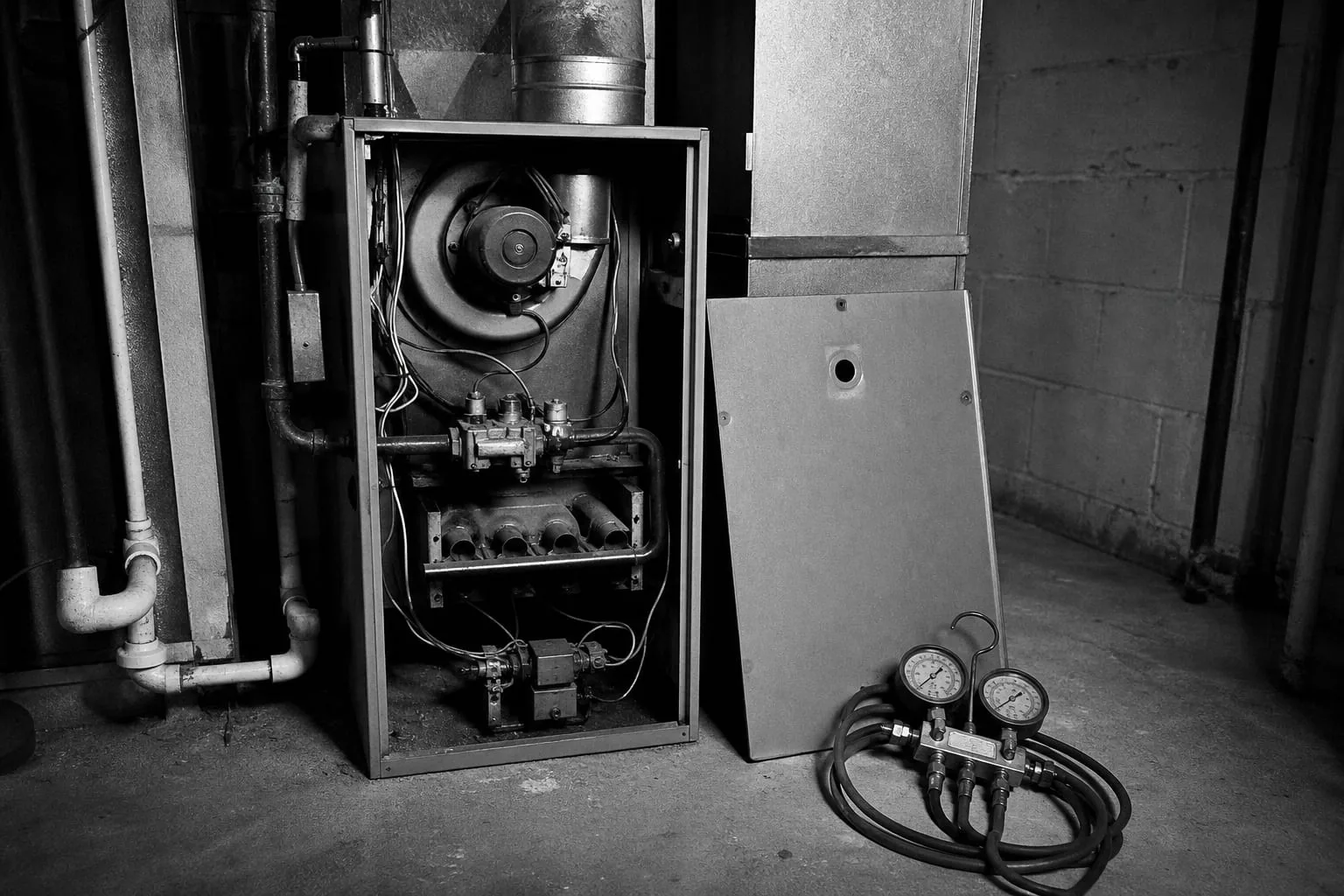
What the visit consists of varies enormously between companies, and this is where the plans separate. A thorough service includes cleaning the coil, checking refrigerant pressures against the design values, testing the flame sensor and heat exchanger, measuring temperature differentials and looking at the electrical contacts. A cursory one is a filter change and a look. Both are sold as a service plan, and the price difference between them is frequently smaller than the difference in what gets done.
What Calling Somebody Costs When You Need Them
The alternative arrangement has no standing cost and a set of variable ones. Each call carries a diagnostic charge whether or not anything is repaired. Rates during an emergency, in the evening, or at a weekend are higher, and the times when heating and cooling equipment fails are precisely the times when demand is highest and availability is lowest. A household that calls in the middle of a July heatwave is competing with everyone else on the street.
The larger cost is indirect and does not appear on any invoice. Equipment that is never serviced fails earlier, because dirty coils make a compressor work harder and a system running low on refrigerant runs for longer to achieve the same result. Manufacturers also condition warranty coverage on documented annual maintenance, and a household making a claim in year six on a ten year parts warranty may be asked for records that do not exist.
Ten Years of Each, Side by Side
Laid out across a decade, the plan side is predictable: ten annual fees, plus repairs at a discounted rate, plus the visits themselves. The call-when-needed side is a smaller number of larger events, and the total depends almost entirely on how many repairs occur and when. On equipment that behaves well the second arrangement wins, sometimes clearly. On equipment that does not, the first wins, and the margin widens if a major component fails inside a warranty period that requires maintenance records.
The honest summary is that the two totals land closer together than the marketing on either side suggests, and that the variance is much higher on the second. A household choosing between them is largely choosing between a known moderate cost and an unknown one with a lower expected value, which is the same trade being made anywhere else that insurance exists. Neither answer is wrong, and the choice should follow from how comfortable the household is with the unknown version.
Filters are the variable that quietly decides much of this and they sit outside both arrangements. A system with a restricted filter runs longer, works harder, and eventually freezes a coil, which produces a service call that neither the plan nor the ad hoc arrangement was supposed to be needed for. Changing them on a schedule is a household task rather than a contractor one, it costs very little, and a household that does it reliably will see fewer failures under either arrangement than one that does not. Any comparison between the two options assumes this is being done.
What Changes the Answer
Three factors move it decisively. The age of the equipment is the first, since a system in its first few years needs very little and a system past a decade needs attention often enough that a plan pays for itself. The second is warranty status, because a plan that produces the documentation a manufacturer requires is buying an option on a claim that could be worth many times the annual fee. The third is climate, since equipment running most of the year in a hot or cold region accumulates wear faster.
Efficiency is the fourth and the least discussed. A system running with restricted airflow or incorrect charge consumes noticeably more electricity to do the same work, and the difference persists every month rather than appearing as an invoice, which is why it goes unnoticed. Efficiency information published through Energy Star is the reference most households have seen for choosing equipment, and it describes performance for a unit operating as designed, which is the condition maintenance is supposed to preserve.
The contractor relationship is the fifth factor and the hardest to price. A plan creates a standing arrangement with a company that has records of the equipment, has seen it annually, and knows the house, which shortens every diagnosis and matters a great deal when something fails at an awkward moment. A household calling a different company each time starts from nothing each time. That is not an argument for a plan specifically, since the same continuity comes from calling the same contractor for an annual service, but it is a real value that the raw arithmetic misses entirely.
The Version That Usually Works Out Better
For most households the arrangement that comes out ahead is a hybrid, and it is available even where nobody advertises it. Pay for a single annual service, in the off season when the rate is lowest and the schedule is open, from a contractor who will say in writing what the visit includes. Decline the plan while the equipment is young and reconsider it once the system passes eight or ten years, when the repair frequency starts to justify the discount and the priority scheduling.
What that arrangement preserves is the part of the plan that actually protects the equipment, which is the annual visit and the documentation it produces, without paying a standing fee for a repair discount that may never be used. The two houses in the comparison end up in roughly the same place financially, and the one that had a technician look at the system once a year is the one still running the original equipment at year twelve, which is where the real difference eventually shows up.