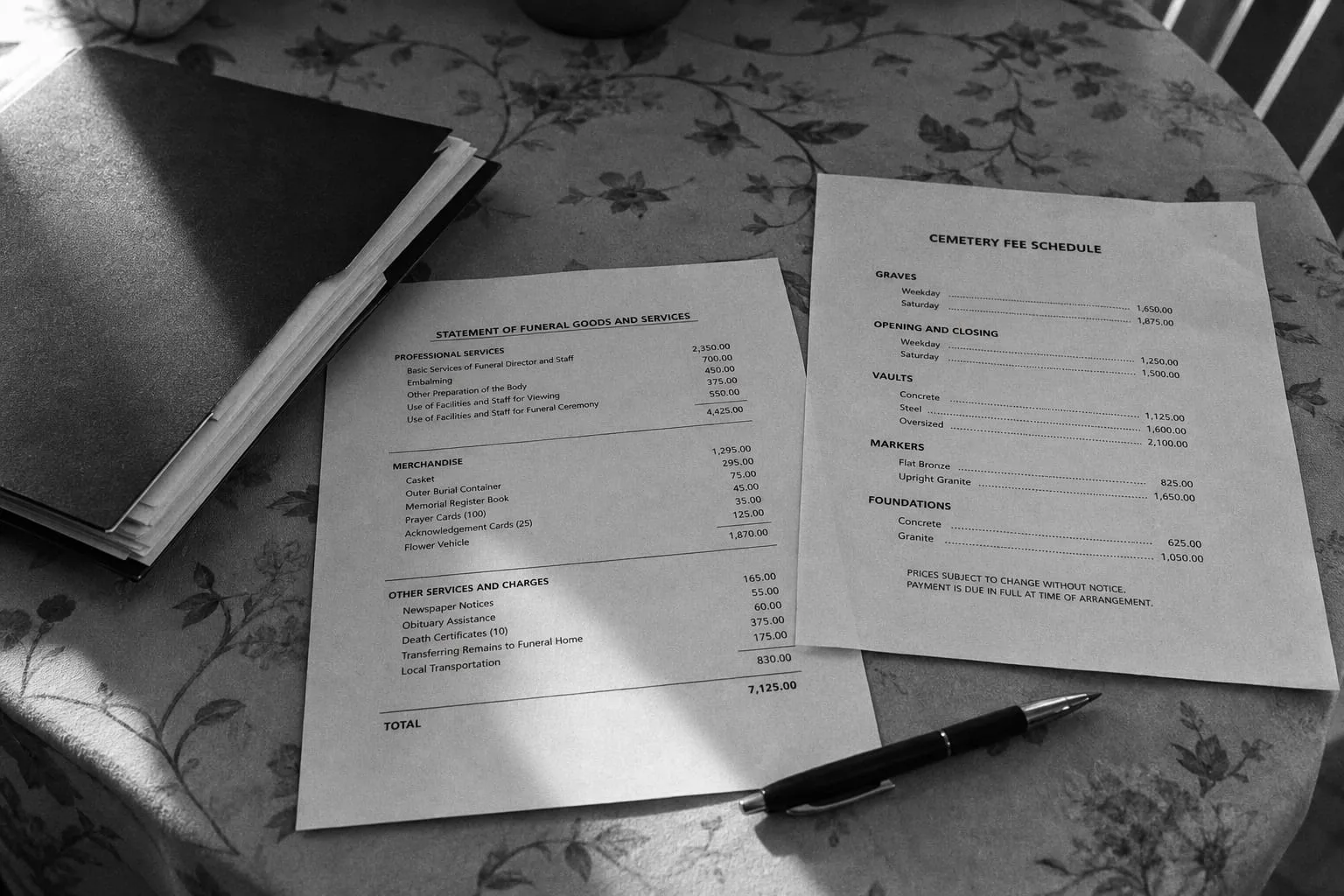
A funeral bill looks like one transaction. It is almost always two, and sometimes three. The funeral home is the party everyone deals with, because it answers the phone at two in the morning and it sends someone to the hospital. The cemetery is the party most families never think of as a vendor at all, and it is the one whose charges show up last, without a quote, at the point when there is no practical way to shop.
Sorting the bill into its parts is not complicated. It just has to happen in an order.
Ask for the itemized list before you discuss anything else
The Federal Trade Commission is responsible for the Funeral Rule, which governs how funeral providers price and disclose their services. The practical effect for you is a document called the general price list. You are entitled to it, on paper, to keep, at the start of an in-person discussion about arrangements, before anyone shows you a casket. You can also get pricing over the phone.
Read the list as three groups.
- The one charge you cannot avoid: a basic services fee. It covers the provider's overhead, planning, permits, and coordination. It is included in every arrangement.
- Charges you select: transfer of remains, refrigeration or embalming, use of facilities for a viewing, a hearse, a graveside service, a casket or an alternative container.
- Cash advances: amounts the funeral home pays out on your behalf. Clergy honoraria, death certificate copies, obituary placement, flowers, musicians. If the provider marks these up or takes a rebate, that has to be disclosed.
Two points get missed regularly. Embalming is not generally required by law, and a provider cannot tell you it is; it becomes a practical necessity mainly for a public viewing or certain delays. And you may buy a casket or urn from an outside seller, with no handling fee added for the privilege, and the provider must accept it.
The second price list, from the party nobody calls a vendor
The cemetery is a separate business, with separate pricing, and in most cases it is not the party the Funeral Rule was written to cover. Nothing on the funeral home's list tells you what the cemetery charges. Ask the cemetery directly, in writing, and ask early.
Its column typically includes:
- The interment right itself, meaning the plot or the niche.
- Opening and closing the grave, priced separately from the plot, and often higher on a Saturday, a Sunday, or outside standard hours.
- An outer burial container, sometimes called a vault or a liner. State law rarely requires one. Individual cemeteries frequently do, as a condition of their own grounds maintenance, and that is a private rule rather than a legal one. Ask which it is.
- An endowment or perpetual care contribution.
- A recording or transfer fee for the deed.
- A fee to set a marker, plus rules on what size, material, and orientation are permitted.
A monument dealer is often a third party again. The stone, the engraving, the foundation, and the setting fee can come from two different invoices with two different lead times.
Decide in the first two days only what the first two days require
The pressure in the first week comes from a small number of genuinely time-bound items. Everything else has been pulled forward by habit.
What has to be settled immediately: authorization to transfer and hold the body, whether there will be a viewing (because that drives embalming or refrigeration), the disposition method, the date and hour of interment or cremation, and the number of certified death certificate copies you order. Banks, insurers, the DMV, and title offices each want their own certified copy. Ordering more at the outset is cheaper than a second request later.
What can wait without penalty: the memorial service, which does not have to be the same day as burial or cremation and can be weeks out; the permanent marker; the urn, if the remains are held in a temporary container; the obituary in a paid publication; and any reception. None of these become more expensive for being deferred, and all of them are cheaper when chosen on a normal weekday by someone who has slept.
Where a delay stops being recoverable
Three points are one-way doors. Cremation, once performed, closes every option that depended on the body. A signed authorization for embalming closes the argument about whether it was required. And the interment date, once scheduled, locks in the cemetery's overtime and weekend rates along with it.
Everything else is reversible for a while. Contract terms are worth reading on the day you sign, not later: the statement of funeral goods and services selected is the itemized total the provider must give you before you pay, and it is the document to compare against the price list you were handed at the start. If a line appears there that never appeared on the price list, ask what it is before the check goes out.
The families who spend the least are not the ones who negotiated hardest. They are the ones who asked the cemetery for its numbers on the first day, and left the marker until spring.