The decision you make at the bin takes about two seconds. The decisions made after it involve at least four people with job titles you have probably never heard, and the one with real authority over your outcome is different in a township that contracts collection than in a city that runs its own trucks. That difference is not cosmetic. It determines whether a greasy pizza box is a minor nuisance or the reason a whole load gets charged out as trash.
What follows is a comparison of those four roles: what each one controls, what each one cannot control, and how the balance shifts by region.
The route driver: the only person who sees your bin
A residential route runs somewhere in the range of several hundred to roughly a thousand stops a day depending on density, truck type and whether the arm is automated. In a dense city with automated side-loaders, stops per hour run high and the driver's view of your cart is a few seconds on a camera feed, if there is a camera. On a rural route with a rear-loader and a helper, the crew handles material by hand and sees everything.
That gap decides whether contamination gets caught at the curb or travels. Where the driver has eyes on the cart, you get a tag, a photo, sometimes a skipped pickup. Where the truck is automated, nothing happens at your house at all, and the problem moves downstream to a facility that has no idea which address it came from.
This is the first regional fork. Some municipalities have written cart-tagging and contamination inspection into the hauling contract, with a stated number of audits per route per year. Others have not, and the driver has no authority to refuse anything. If you want to know which applies to you, the hauling contract or franchise agreement is a public document, and the solid waste coordinator can tell you whether inspection is a required duty or a courtesy.
The sorter on the line: seconds per item, and a list they did not write
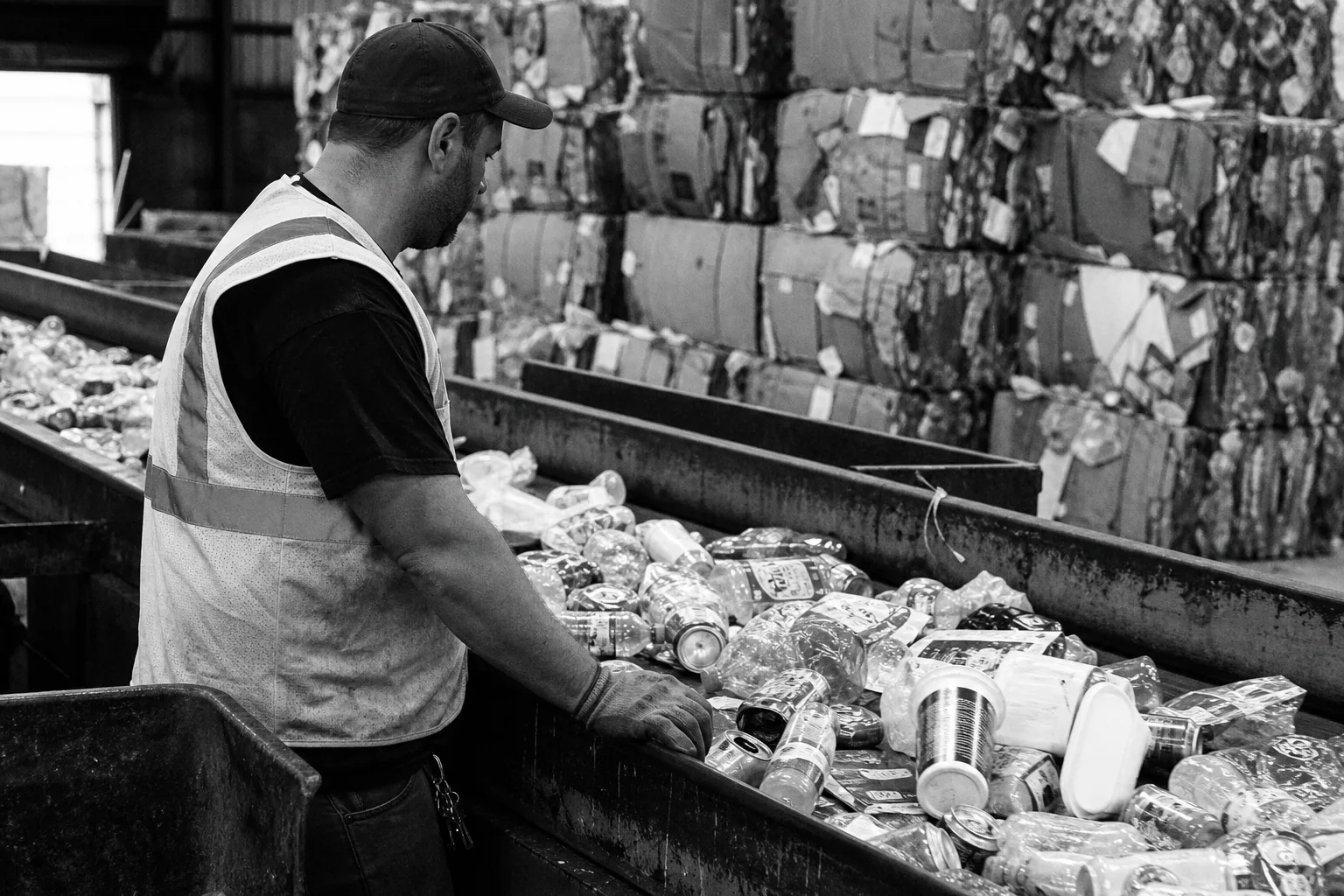
Inside a materials recovery facility, the belt moves at a set speed and the people positioned along it have on the order of a second or two per item. Optical sorters, magnets, eddy current separators and disc screens handle the bulk; humans handle quality control and the things machines consistently get wrong, which is mostly film plastic, textiles, hoses and anything long and flexible.
Here is the part that surprises people. The sorter does not decide what is recyclable. They are pulling to a specification written into the contract between the facility and whoever buys the bale, and that specification is about commodity grade, not about environmental merit. A rigid plastic tub can be perfectly recyclable in the abstract and still get pulled off the line as a contaminant because the facility has no buyer for that grade this quarter and no bunker space to store it waiting for one.
Facility capability varies enormously by region, and it is the single largest reason two neighboring towns publish different accepted-materials lists. A plant built or retrofitted in the last several years may have optical units that identify polypropylene reliably. An older plant may not, in which case your tubs and lids are landfill no matter how carefully you rinsed them. Neither list is wrong. They describe different machines.
The broker and the end market: distance decides the economics
Bales leave the facility and are sold, usually through a broker or directly to a mill, at prices that move month to month. Old corrugated cardboard, mixed paper, aluminum, natural HDPE and PET each trade separately, and the spread between the best and worst month in a year can be large enough to flip a facility from profitable to subsidized.
Freight is the lever people underestimate. A ton of baled cardboard has a certain value at the mill gate, and trucking it several hundred miles can consume a meaningful share of that. So regions with nearby end markets accept more materials and accept them more reliably. The Southeast has paper mills. The Pacific Northwest and parts of the Midwest have glass processing within reasonable haul distance. Parts of the Mountain West have neither, which is exactly why glass is the material most likely to be dropped from curbside collection there and routed to a drop-off site instead.
When a town announces it is no longer taking a material, this is almost always the reason. Not a change of heart. A change in the delivered price minus freight.
The coordinator, and the state law sitting above them
The municipal recycling coordinator writes the list on your bin lid, fields the complaints, and negotiates the next contract. They have less discretion than residents assume, because what they can offer is bounded by the facility that serves them and the state framework above that.
Three state-level regimes produce visibly different outcomes:
| Regime | What changes at the household level |
|---|---|
| Container deposit (bottle bill) states | High-value aluminum and PET leave the curbside stream and go back through redemption. The curbside bale is lower value, so the program leans harder on paper and cardboard revenue. |
| Extended producer responsibility states | Producers fund part of the system. Accepted lists tend to standardize across municipalities over time, and the coordinator gains room to accept materials that do not pay for themselves. |
| Neither | The list tracks the facility's capability and the current commodity market almost directly. Lists change with less notice and vary between adjacent towns. |
The Environmental Protection Agency oversees municipal solid waste policy at the federal level, but collection rules are set locally, which is why two towns twenty minutes apart can give you opposite answers about the same yogurt container and both be giving you correct instructions for their own system.
Which person to call, depending on what you want to know
Sorting the question by who actually holds the answer saves a lot of time:
- Why was my cart skipped? The hauler's customer service, then the coordinator if the hauler is unresponsive. The driver's instructions came from the contract.
- Is this specific item accepted? The coordinator, or the facility's published list if the municipality names its facility. Not a general website, and not another town's list.
- Why did you stop taking glass? The coordinator, and expect the answer to be about processing distance and freight.
- Where did my material actually go? Facilities report tonnage and destination into state reporting systems in many states. The coordinator can usually pull the most recent figures, with the caveat that they lag by months.
Nobody in this chain can tell you the fate of your individual bin, and anyone who offers a precise percentage for your household is guessing. What they can tell you, concretely, is which materials their facility currently has a buyer for. That single question, asked of the right person, resolves most of what residents actually want to know.
Ask it once a year. The machines change, the markets change, and the list on the lid is usually the last thing to be updated.