Most families arranging a funeral believe they are dealing with one business. They are usually dealing with three: the funeral home, the cemetery, and the monument company. The funeral home takes the first call, sends the first invoice, and absorbs most of the questions. The cemetery is a separate legal entity with its own price list, its own scheduling calendar, and its own rulebook, and almost nobody phones it until day three. That delay is where avoidable cost and avoidable frustration tend to collect.
Day one and two: the decisions that set the price floor
The first twenty-four hours involve very few choices. Someone has to authorize transfer of the body into the funeral home's care, and someone has to be legally entitled to do it. State law sets that order of priority, usually spouse first, then adult children, then parents. If the next of kin is three states away, the transfer still happens; the paperwork just gets signed electronically.
The decision that moves the total more than any other comes next, and it is binary: burial or cremation. Everything downstream prices off it. Burial obligates you to a plot, an opening and closing fee, frequently an outer burial container, and eventually a marker. Cremation collapses several of those into nothing, though it does not automatically eliminate the cemetery if the family wants a niche or an in-ground urn interment.
By the second meeting you should be holding an itemized price list. The Federal Trade Commission is responsible for the rule that requires funeral providers to give you itemized pricing and to let you buy only what you want, rather than a bundled package. Ask for the itemized version even if a package looks simpler. The package is not always more expensive, but you cannot tell which line items you are paying twice for until they are broken out.
Order more certified copies of the death certificate than feels reasonable. Each one costs a small fixed fee, and every bank, pension administrator, insurer, and county office wants an original. Going back for more later costs a trip and a wait.
The cemetery's invoice is a second invoice
Here is the part that surprises people. The funeral home's charges cover professional services, transfer, preparation, staff for the service, and the casket if you buy it there. The cemetery bills separately for the right to be buried there and for the physical work of the burial.
That second invoice has a predictable structure, even though the amounts vary enormously by region and by cemetery type. Expect these lines:
- Interment rights. You are buying the right to use the space, not the land itself. Municipal and religious cemeteries generally price below private ones, and urban cemeteries with limited remaining inventory price well above rural ones.
- Opening and closing. The excavation, the equipment, the crew, and the restoration of the sod afterward. Weekend and holiday burials carry a surcharge at most cemeteries. That surcharge is real money and it is avoidable by scheduling on a weekday.
- Outer burial container or grave liner. State law rarely requires one. Individual cemeteries very often do, because without one the ground settles and the grounds crew inherits a maintenance problem.
- Foundation or setting fee for the marker. Charged by the cemetery, not by whoever makes the marker, and typically billed later.
- Perpetual care. Sometimes folded into the interment rights, sometimes a separate percentage.
Anyone who quotes you a single national average for that stack is guessing. The honest answer is that the cemetery's total commonly lands in the same order of magnitude as the funeral home's, and in high-cost metropolitan areas it can exceed it. Call two or three cemeteries in the first week and ask each for their full fee schedule in writing. It takes an afternoon and it is the single highest-return hour in the whole process.
The rulebook nobody reads until the marker is ordered
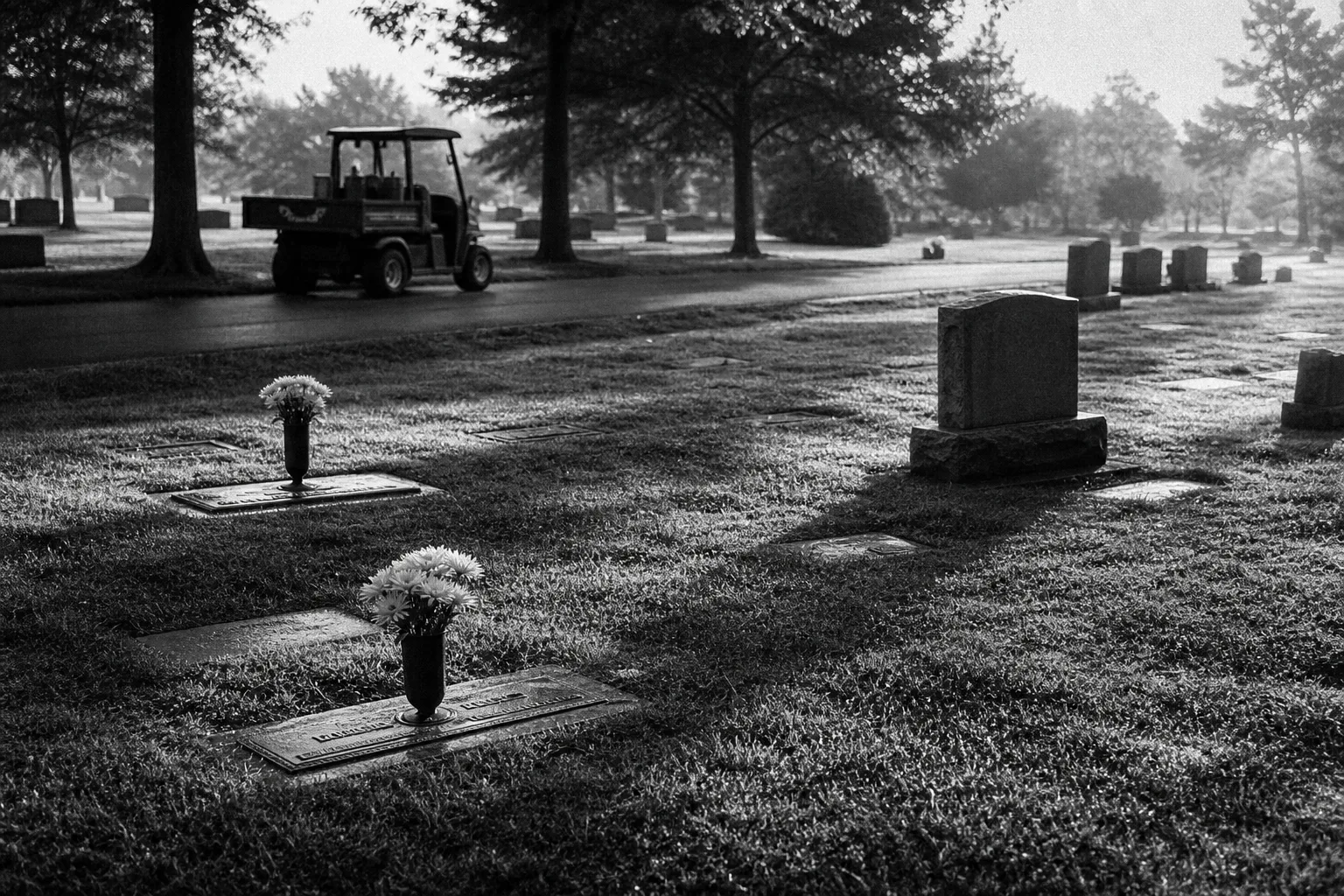
Cemeteries regulate what can be placed on a grave, and the rules are not negotiable after the fact. Some sections permit only flush bronze markers set level with the turf, which makes mowing straightforward. Others allow upright granite within a defined footprint and height. Color, thickness, base dimensions, vase policy, and even the material of the lettering can all be specified.
Families often start pricing grave headstones during the first week while the funeral is still being planned, which is fine, provided you get the cemetery's written specifications before signing anything. A monument company can build almost anything. A cemetery can refuse to install it.
Cost drivers on the marker itself are consistent: overall size, granite color (some quarries are simply scarcer), whether the design is flat-etched or carved in relief, the length of the inscription, and whether you are buying a single or a companion stone. A companion stone bought now, with the second name and date left open, costs less than two separate stones and less than reopening the engraving later, though that second engraving will still carry a setting charge when the time comes.
What the first week should actually produce
By day seven, you want four things settled: the disposition decision, a signed itemized statement from the funeral home, a written fee schedule and rules packet from the cemetery, and a date on the cemetery's calendar. The marker can wait months, and usually should, because the ground needs to settle before a foundation is poured.
Anything sold to you as urgent in that week, other than the disposition and the scheduling, is worth one night's delay. Very little in this transaction genuinely expires overnight.
The families who come through the week with the fewest regrets are almost always the ones who treated the cemetery as a vendor to be interviewed rather than a venue that came attached to the funeral home. Two phone calls, made early, tend to decide more than any catalog does.