Here is the situation. You are under contract on a half-acre suburban lot, closing set for the third week of February. The listing photos, taken in July, show a neighbor's storage shed sitting what looks like a few feet from the side line, and a gravel parking pad beside it that may or may not be on the property you are buying. Your lender wants a survey. You want to know whether you are buying a lawsuit.
Those are two different documents, and the second one costs more.
What the lender asks for and what you actually need
A lender's survey requirement is usually satisfied by the thinnest product a licensed surveyor sells: a boundary survey showing the lot lines, the house, and any obvious improvements, certified to the lender and the title company. It is a real survey. It is also scoped to protect the loan, not to settle a question about a shed.
The product you need in this specific case does three additional things. It locates the shed and the gravel pad as physical objects with measured distances to the line. It states whether the surveyor found the original corner monuments or set new ones. And it is certified to you by name, so that if the measurement is wrong, you are someone with standing to complain.
Ask three surveyors for a quote on the same lot and the spread will surprise you. Most of that spread is scope. The cheap quote is often a desk product: the existing recorded plat redrawn, with a field visit short enough to confirm the house is where the plat says it is. The expensive quote includes time spent searching for monuments that may be buried, time spent locating improvements, and time spent on the written report that explains what was found. The hourly rate for a licensed surveyor does not vary nearly as much as the total does.
I cannot tell you what your lot will cost. It depends on the size of the parcel, how far the crew drives, how good the record is, and how long it takes to find the corners. What I can tell you is the shape of it: the field time, not the drafting, is what moves the number, and winter moves the field time.
What February changes, concretely
Snow cover is the obvious one. Iron pins and concrete monuments sit at or just below grade. Under six inches of snow and a frost layer, a crew with a magnetic locator can usually still find a buried iron, because the locator reads steel through snow. They cannot find a wooden stake, a notched tree, or a painted mark on a curb. If the record corner for your lot is described as a stone or a drill hole, winter makes that a longer afternoon.
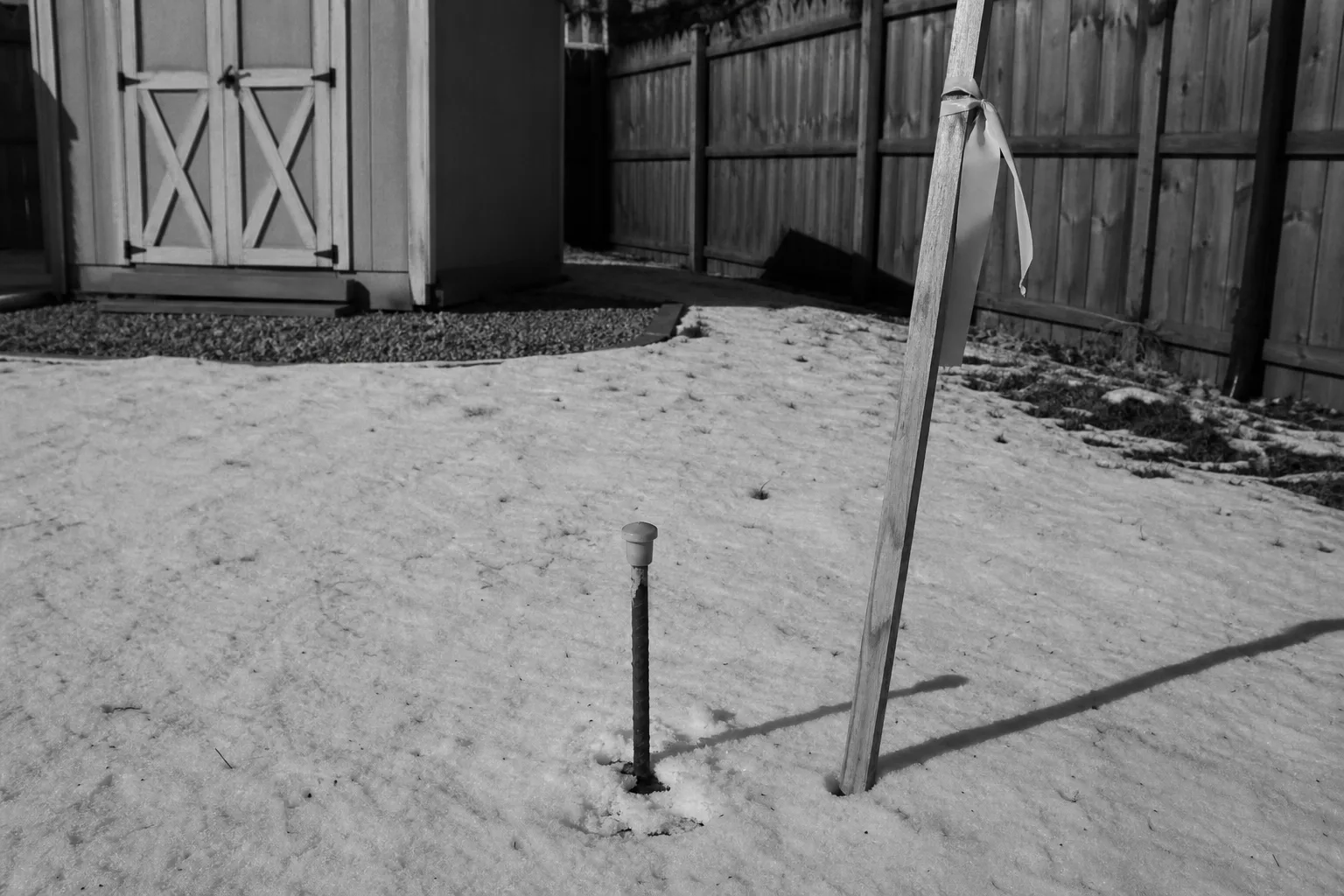
Frozen ground is the second. If the corners are gone and new monuments have to be set, driving a five-eighths inch rod through frost is slow, and in hard frost some crews will not set permanent monuments at all. They will set a temporary offset stake, note it, and return in spring. A survey that quietly skips monumentation because the ground was hard is a survey that leaves the next owner in exactly the position you are in now.
Then there are the two things winter makes easier. Leaf-off conditions mean the crew can actually see down a wooded line and run a clean sight. And vegetation that hides a fence, a retaining wall, or an old hedge line in August is flat and visible in February. For the particular question you are asking, whether a shed and a gravel pad cross a line, winter is a genuinely good time to look.
The third thing is scheduling. Surveying demand tracks the construction season. A request made in February often gets a shorter queue than the same request made in May, which matters when you have a closing date and a contingency window measured in days.
The difference between a good job and a barely adequate one
Both documents will be signed and sealed by a licensed professional. Both will be accepted by the title company. The differences are specific and readable.
- Found versus set. A good survey labels every corner: "found 5/8" iron rod," "set iron rod with cap," "corner falls in pavement, offset set." A thin one shows a dot and a bearing. If you cannot tell whether anything physical exists on the ground, nothing was resolved.
- Improvements located. The shed should appear with its actual footprint and a dimension to the line, not as a generic rectangle copied from an aerial. Same for the gravel pad, the fence, the driveway apron, and any retaining wall.
- Encroachments called out in words. Good practice is a note on the face of the drawing: shed encroaches 1.4 feet onto subject parcel, or does not encroach. A drawing that leaves you to scale it off with a ruler is not answering the question.
- The certification block. Read who it runs to. If your name is not there, you are reading someone else's document.
- Disclosure of winter limits. The honest report says what was not accessible and why. "Northeast corner not recovered, snow cover and frozen ground; offset stake set, permanent monument to be set upon thaw." That sentence is worth paying for. It tells you what is still open.
- Flagging that survives. Pin flags vanish under snow and under a lawnmower. Ask for lath with tall ribbon, and ask the crew to photograph each corner. Photos cost nothing and are the only record you will have in March.
If the lot is anywhere near a flood zone
One add-on is worth asking about while the crew is already on site. If the parcel sits in or near a mapped special flood hazard area, an elevation certificate prepared during the same visit is far cheaper than a separate mobilization later. The Federal Emergency Management Agency is responsible for the flood mapping that insurers and lenders work from, and the certificate is the document that ties your particular structure to that mapping. Winter does not complicate it much. Snow depth is accounted for; the shot is to the structure, not to the snow.
What to do with it before you close
Read the survey the day it arrives, not the morning of closing. If it shows an encroachment, you have three ordinary paths: a boundary line agreement recorded between the parties, an easement granted for the life of the structure, or a seller obligation to have the thing moved before closing. All three take time. A survey delivered with forty-eight hours left in your inspection period is a survey you cannot act on.
And if the report flags a corner that could not be set until the ground thaws, put a date on it. Ask the surveyor what they charge to return in April and set the permanent monument, get that in writing before you fund, and calendar it. The shed is not going anywhere. Neither, once it is properly marked, is the line.