Most renewal reviews take about eleven minutes. Someone opens the PDF, searches for the dollar figure, compares it to last year's, decides it is roughly what they expected, and closes the tab. That is a skim, and it is what the vendor's renewal calendar is built around. A proper read takes somewhere between ninety minutes and half a day depending on how many seats and integrations you are carrying, and the difference between the two is not diligence for its own sake. It is money, and usually a specific, findable amount of it.
I cannot tell you what that amount is for your contract. Anyone who quotes you a percentage saved is guessing. What I can describe is where the variance sits, and why the eleven-minute version reliably misses it.
The skim finds the price. The read finds the mechanism
A price is a fact about one year. A mechanism is a fact about every year after that, and it is the mechanism that is written into the agreement in language nobody reads aloud.
Three clauses do most of the work. The first is the uplift: the permitted annual increase, which may be a fixed percentage, may be tied to an index, or may be silent, and silence favors the party sending the invoice. The second is the notice window, the number of days before term end by which you must give written notice of non-renewal. Thirty, sixty, and ninety are all common. The third is the seat ratchet, the clause saying committed quantities can go up mid-term but cannot come down until renewal. Add a contractor in March and you have raised your floor for the following year.
A barely adequate review confirms this year's number is tolerable. An adequate one establishes what the number is permitted to do without anyone asking you.
Four dates, and only one of them is on the invoice
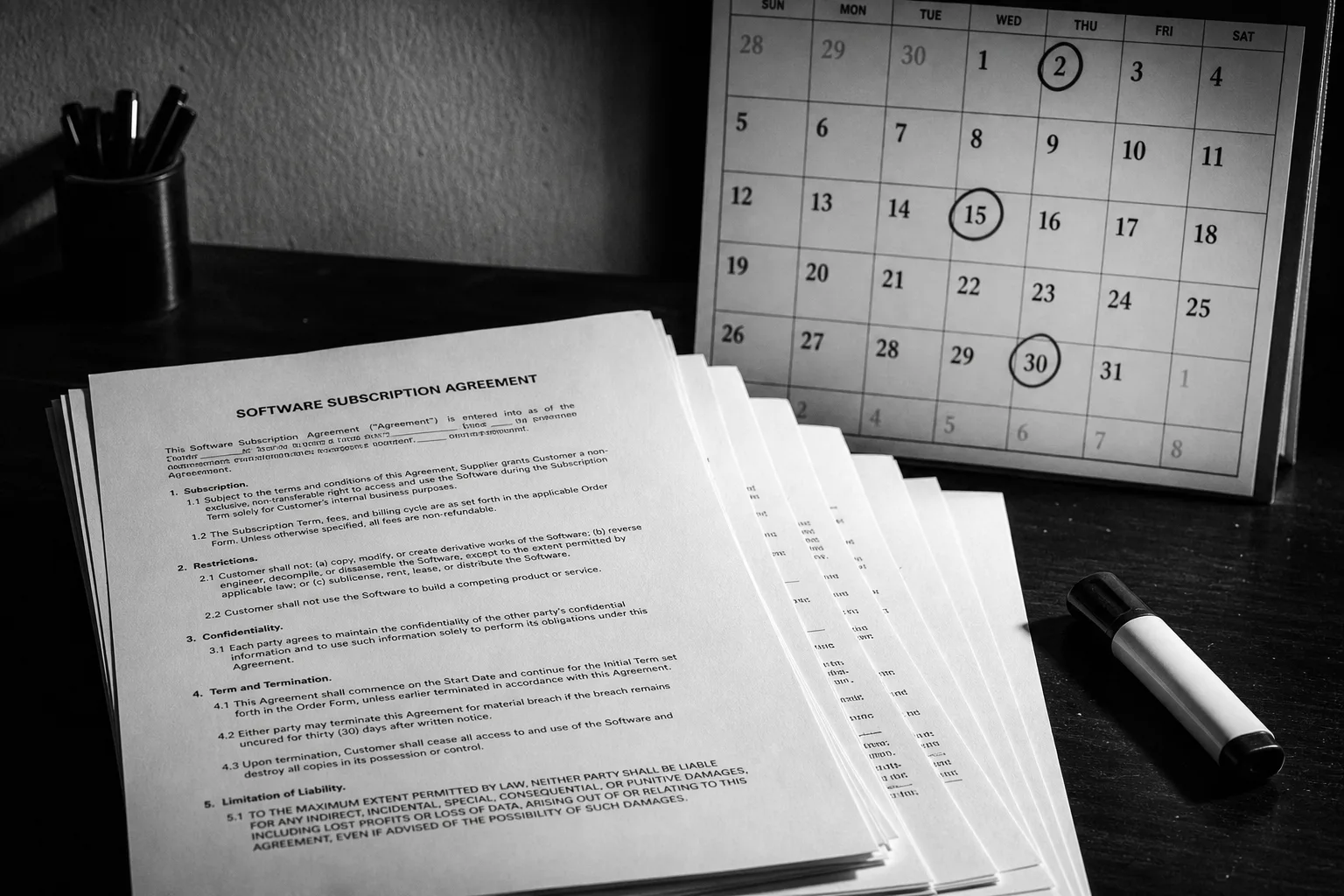
Write them down in a single line on one page. The term end date. The notice deadline, which is the term end minus the notice period, and which is the only date that actually constrains you. The date any negotiated discount expires, which is frequently earlier than the term end and is where a flat-looking renewal turns into a step change. And the post-termination data export window, usually somewhere between fifteen and ninety days.
The notice deadline is the one people find late. If the term ends on January 31 and the notice period is ninety days, your real deadline is early November, which means the evaluation has to start in September. Discovering this in December is not a small administrative annoyance. It is a decision made for you, for twelve months, by a calendar.
The Federal Trade Commission oversees how automatic renewal and negative option terms are presented to buyers, and the consumer side of that has tightened considerably. Business-to-business agreements are a different animal. The protections you may have come to expect on a personal subscription do not travel with you into a commercial software agreement, which is precisely why the read has to be yours.
What the total actually is, for a business with a season
Sticker price per seat per month is the least informative number in the document. Build the real one: committed seats times the per-seat rate, times twelve, plus the support tier, plus storage or API overage above whatever the threshold is, plus any implementation or premium onboarding fee that recurs rather than sitting in year one only. Then compare that against usage you can actually verify from the admin console.
Seasonal operators feel this harder than anyone. A wedding and events business might run fourteen active users in June and four in January, but the contract is written against the June number all twelve months. The same asymmetry shows up in per-event tooling: a planner running thirty weddings a year may be paying an annual platform fee for a Wedding Guest Photo Sharing with QR Code service that is genuinely in use for perhaps forty days of the year, and the sensible question at renewal is whether the pricing model is annual, per event, or per event with a floor, because those three produce materially different totals at thirty events and at nine.
The read is what surfaces that question. The skim confirms the invoice matches last year's and moves on.
The exit clause is part of what you are buying
Nobody negotiates the termination section with any energy, because at signing nobody plans to leave. At renewal you have a year of data in the system and considerably more to lose.
Look for four things. What format your data comes out in, and whether "export" means a structured file or a set of CSVs with the relationships stripped out. How long you have to retrieve it after termination. Whether there is a transition assistance provision and whether it is billed at a rate that is stated or a rate that is "then-current." And whether termination for convenience exists at all, or whether you are locked to the full term absent a material breach.
A vendor whose export is clean and whose window is generous is telling you something useful about how they expect to keep your business. That is worth noting in the file, favorably.
Start ninety days out, and say what you want in writing
The practical difference between a good renewal and an adequate one is calendar position. Ninety days out you have leverage, because non-renewal is still procedurally available to you. Eleven days out you have a preference.
What a good process looks like: pull the executed agreement and every amendment, because the amendments are where the pricing actually lives. Pull twelve months of usage. Write a one-page summary of the four dates, the uplift terms, and the real annual total. Then send the vendor a short written note listing what you want changed, before they send you the renewal paperwork. Asking first and asking in writing is a meaningfully different posture than reacting to a quote.
Expect the range of outcomes to be wide and honest about itself: sometimes nothing moves, sometimes the seat count comes down to reflect what you use, sometimes an uplift cap gets written in that saves you nothing this year and a good deal in year three. The point is that you find out on purpose, in September, with the document in front of you and time to act.