The first folder most people assemble in a dispute is about forty photographs, a screenshot of a text thread, and a receipt. It feels substantial. It is better than nothing, and it is roughly the weakest category of evidence there is, because every item in it was made by the person asking to be paid.
That is not a comment on your honesty. It is a comment on who the reader of the file is. An adjuster, a small claims judge, a card issuer's dispute analyst and a state licensing board all run the same silent sort: who made this record, when did they make it, and did they have a reason to make it other than this argument. Records that pass that sort carry weight out of proportion to their length. A six-line letter from a licensed engineer can settle something that four hundred photographs cannot.
So the practical question for a first-timer is not how much evidence to gather. It is whose work sits next to your decision, and how early you can get it.
The sort that happens before anyone looks at your photos
Think of evidence in three tiers, roughly by how much the reader discounts it.
The top tier is made by someone with a license, a certification, or a statutory job, who created the record in the ordinary course of that job. A municipal inspector's field card. A utility's service ticket. A lab report with a sample ID and a chain of custody. A manufacturer's field technician writing up a warranty denial. These are strong because the person had professional exposure if they wrote something false, and because they were not working for you when they wrote it.
The middle tier is made by a qualified third party you hired. An independent inspector, a public adjuster, a structural engineer, a moisture remediation firm doing a scope. This is still strong. It is discounted a little, because you paid, and the discount shrinks the more the report shows measurements rather than conclusions.
The bottom tier is everything you made yourself. Photos, videos, notes, your own timeline.
Here is the part nobody explains to a first-timer: the bottom tier is not useless. It is just a different tool. Your records establish when and what you said at the time. They almost never establish cause, and cause is what most disputes actually turn on. Water on a floor is not in question. Whether the supply line failed or the installer left it finger-tight is in question, and a photograph of a wet floor has nothing to say about it.
The six people whose paperwork outweighs yours
Most household disputes sit next to a small cast of people who are already producing records. A first-timer usually meets them too late, after the record has been written without their input.
- The permit and inspection office. If the work required a permit, there is a file. It shows what was approved, which inspections passed, which failed, and on what date. A failed rough-in that was never re-inspected is a devastating document, and it costs a records request to obtain.
- The manufacturer's field representative. On flooring, roofing, windows and appliances, manufacturers send out their own inspectors when a warranty claim is opened. Their report is written to protect the manufacturer, which is exactly why it is credible when it says the product was installed outside specification.
- The independent testing lab. Moisture content, asbestos, lead, mold speciation, concrete strength. A number with a method attached ends arguments that adjectives extend indefinitely.
- The licensing board investigator. If you file a complaint against a licensed contractor, many states send someone to look. Whatever the board decides about discipline, the investigator's findings exist afterward.
- The insurer's adjuster and the engineer they retain. Their scope of loss is a line-item document. You are usually entitled to a copy. It is also the single most useful thing to hand a second estimator, because it tells them exactly what they need to disagree with.
- Your card issuer or bank. In a billing dispute, the issuer's own file of what was represented at the point of sale is a record you did not have to create. The Federal Trade Commission oversees consumer protection rules in this space, and deadlines for disputing a charge are short enough that a first-timer who waits for the contractor to come back usually misses them.
None of these people work for you. That is the point.
What an independent report costs, and what actually moves the number
I am not going to give you a national figure, because the one that matters is the one in your county, and the spread between metros on the same scope is wider than most people expect. What I can tell you is the shape.
A visual inspection with a written report, no destructive testing, is the cheap end. Same-day, a few hours on site, a document of a handful of pages. A licensed professional engineer stamping an opinion on a structural or water intrusion question is the expensive end, and it can be several times the first number. A lab test sits apart from both and is priced per sample, which is why the sample count is worth thinking about before anyone arrives.
What moves the number, in rough order of effect:
- Whether anything has to be opened up. Cutting drywall, lifting flooring, pulling siding. This adds trade labor and a repair afterward, and it is frequently the difference between a report that says "consistent with" and one that says "the cause is."
- Whether a stamp is required. An engineer's seal costs more than an inspector's signature. Ask whether your forum actually needs one. Many do not.
- Whether you need testimony later. Report-only pricing and deposition or hearing pricing are different products. Ask for both rates at the start, even if you never use the second.
- Travel and scheduling. Rural addresses and rush turnarounds both carry surcharges.
Call three providers and you will have your local range inside a day. That range is knowable. A number I quote you here would not be.
One more thing worth weighing honestly. An independent report is worth commissioning when the amount in dispute is a multiple of the report, not a small premium over it. Below that line, the better move is usually to collect the free records first (permit file, manufacturer inspection, insurer's scope) and see whether they settle the question on their own. Quite often they do.
The order to run it, if this is your first one
Sequence matters more than volume, and the first-timer's instinct is backwards: people document the damage thoroughly and the conversation not at all.
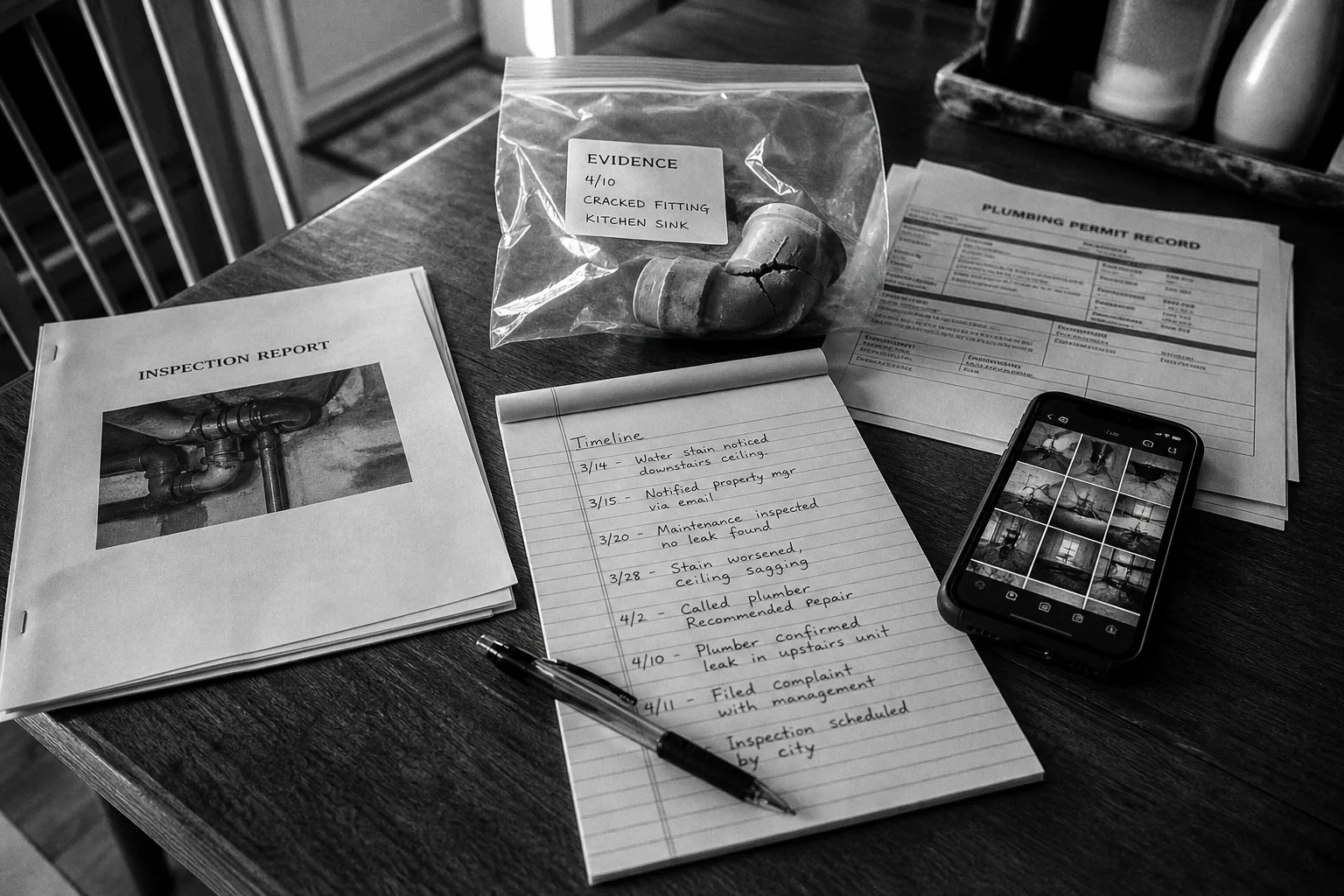
Start by writing down the timeline while it is fresh, with dates, names, and who said what. Do it even if it feels theatrical. A note made in week one reads differently from a note made in month six, and a reader can usually tell which they are holding.
Then move anything verbal into writing. After a phone call, send a short email: "Confirming what we agreed on today." You are not building a trap. You are creating a dated record that the other side had the chance to correct and did not.
Then request the records other people already hold, in this order, because the free ones are also the fast ones: permit and inspection history, the manufacturer's warranty inspection if a product is involved, the insurer's scope of loss, the utility or service ticket.
Preserve the physical evidence. Keep the failed part. Bag it, label it with the date, and do not let anyone leave with it without a receipt. A cracked fitting in a labeled bag is worth more than any photograph of the same fitting.
Only then decide whether to hire your own expert, with the free records in hand so you can tell them precisely which question you need answered. Experts charge by the hour and answer the question they are given. A narrow question is a cheaper question.
What makes a report usable once you have it
Three features separate a document that settles things from one that sits in a folder.
It states a method. "Moisture readings taken with a pin meter at twelve locations, recorded on the attached plan" survives challenge. "The subfloor was wet" does not.
It separates observation from conclusion. A reader will accept measurements from someone they have never met. They are more careful with opinions, and a report that keeps the two in different paragraphs makes the measurements easy to accept on their own.
And it gives a range where a range is honest. An expert who says the repair will cost exactly one number is less persuasive than one who gives a band and explains what pushes it to either end. The same is true of cause. "Consistent with installation error, and inconsistent with the alternative explanation offered, for these two reasons" is stronger than false certainty, because the person reading it has seen false certainty before.
Your own photographs still belong in the file. They just belong behind the documents that explain them.
Most people only do this once or twice in a lifetime, which is why the learning curve feels steep and why the other side, who does it weekly, seems so relaxed. The gap closes faster than you would think. Not by out-documenting anyone, but by making one call to the permit office before you make the angry one.