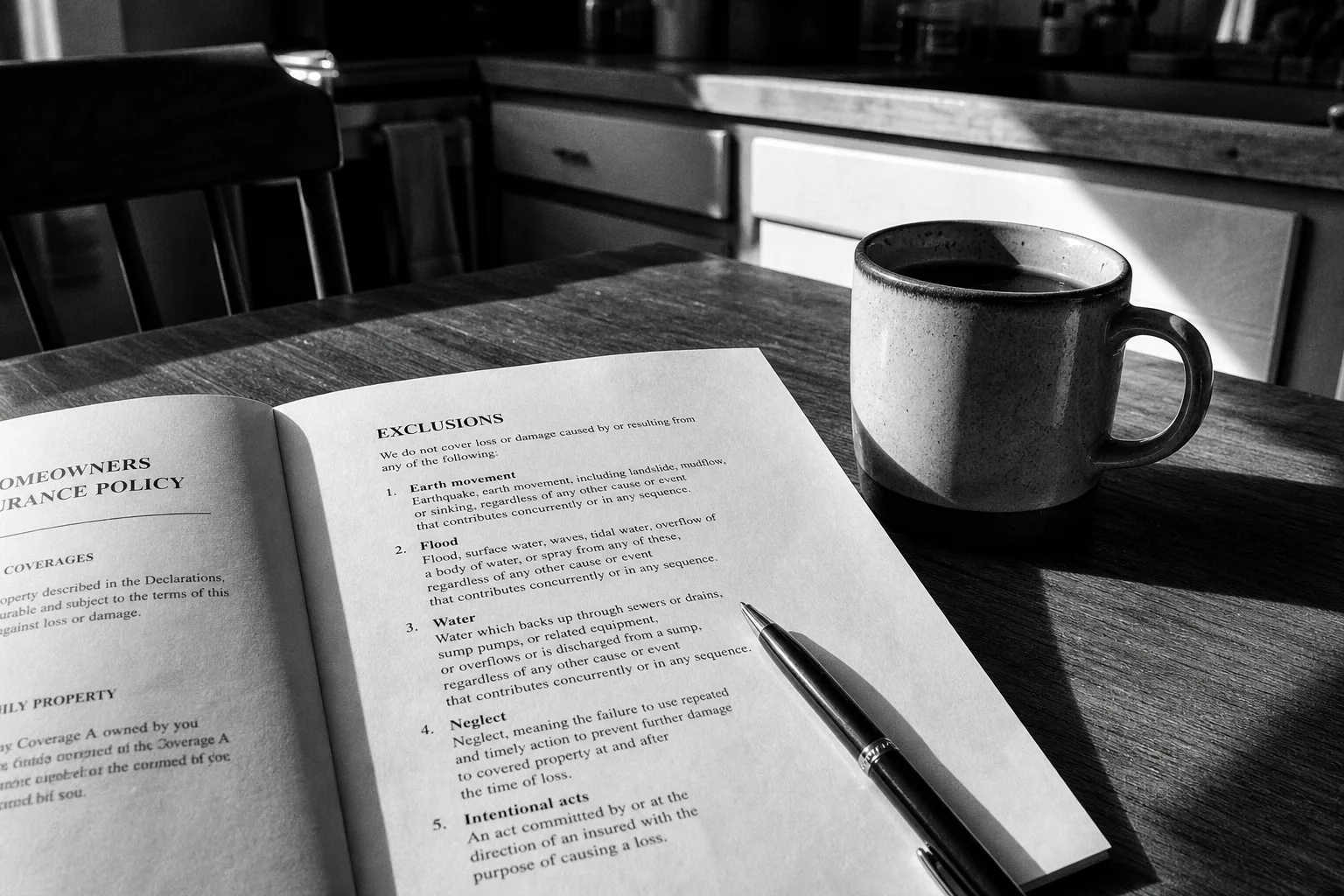
An exclusion clause is not there to surprise you. It is there because the insurer priced the policy on a set of assumptions about how the house will be used, maintained, and occupied, and the exclusions are those assumptions written down in enforceable language. Read that way, the exclusions section stops being a legal appendix and becomes something closer to a maintenance schedule with a price attached.
Most people meet an exclusion once, badly, after a loss. The more useful time to meet one is on an ordinary Tuesday, when the decision it governs is still cheap to change.
1. What your policy means by "occupied"
Vacancy and unoccupancy clauses are the ones that catch otherwise careful households, because the trigger is a number of consecutive days rather than anything you would think of as risky behavior. The typical range is 30 to 60 consecutive days, and the clause usually suspends or narrows coverage for specific perils rather than voiding the policy outright. Vandalism, glass breakage, water damage and theft are the ones most commonly pulled.
The week-to-week version of this is not a second home sitting empty all winter. It is the rental between tenants. It is the house you inherited and are slowly clearing out. It is a parent's place while they are in rehab after a fall, which nobody thinks of as vacant because the furniture is still in it.
Two things move the number. First, whether the policy distinguishes vacant (empty of people and belongings) from unoccupied (furnished, nobody living there), because the thresholds often differ. Second, whether your insurer will issue a vacancy permit or endorsement, which many will, usually for an added premium. I cannot tell you what that endorsement costs, because it is rated off the property and the length of the gap. I can tell you it is almost always cheaper than the uncovered loss it exists to prevent, and that it has to be arranged before the clock runs, not after.
2. The business-use line, and what counts as business
Homeowners policies exclude or sharply limit business property and business liability on the premises. Standard forms carry a low cap on business property in the home, often somewhere in the low four figures, with an even lower limit for the same property off premises. Liability is the harsher half: if someone is hurt on your property in connection with your business activity, the liability section may not respond at all.
What makes this an ordinary-week problem is how modest the triggering activity can be. Piano lessons on Thursdays. A woodshop that sells on weekends. Inventory for an online storefront stacked in the spare room. A licensed daycare, which is almost always excluded outright and needs its own policy. None of this feels like running a business in the sense the clause seems to be reaching for, and all of it can fall inside the definition.
The fix is usually small. An in-home business endorsement, or a separate commercial policy if the activity has grown past what an endorsement will carry. The conversation worth having with your agent is not "am I a business" but "here is what actually happens in this house on a given week."
3. Gradual versus sudden, which is really a deadline
Nearly every property policy covers sudden and accidental water discharge and excludes damage that occurs over a period of time: continuous or repeated seepage, leakage over weeks or months, and the rot, mold and deterioration that follow. Some forms put a number on it, often 14 days.
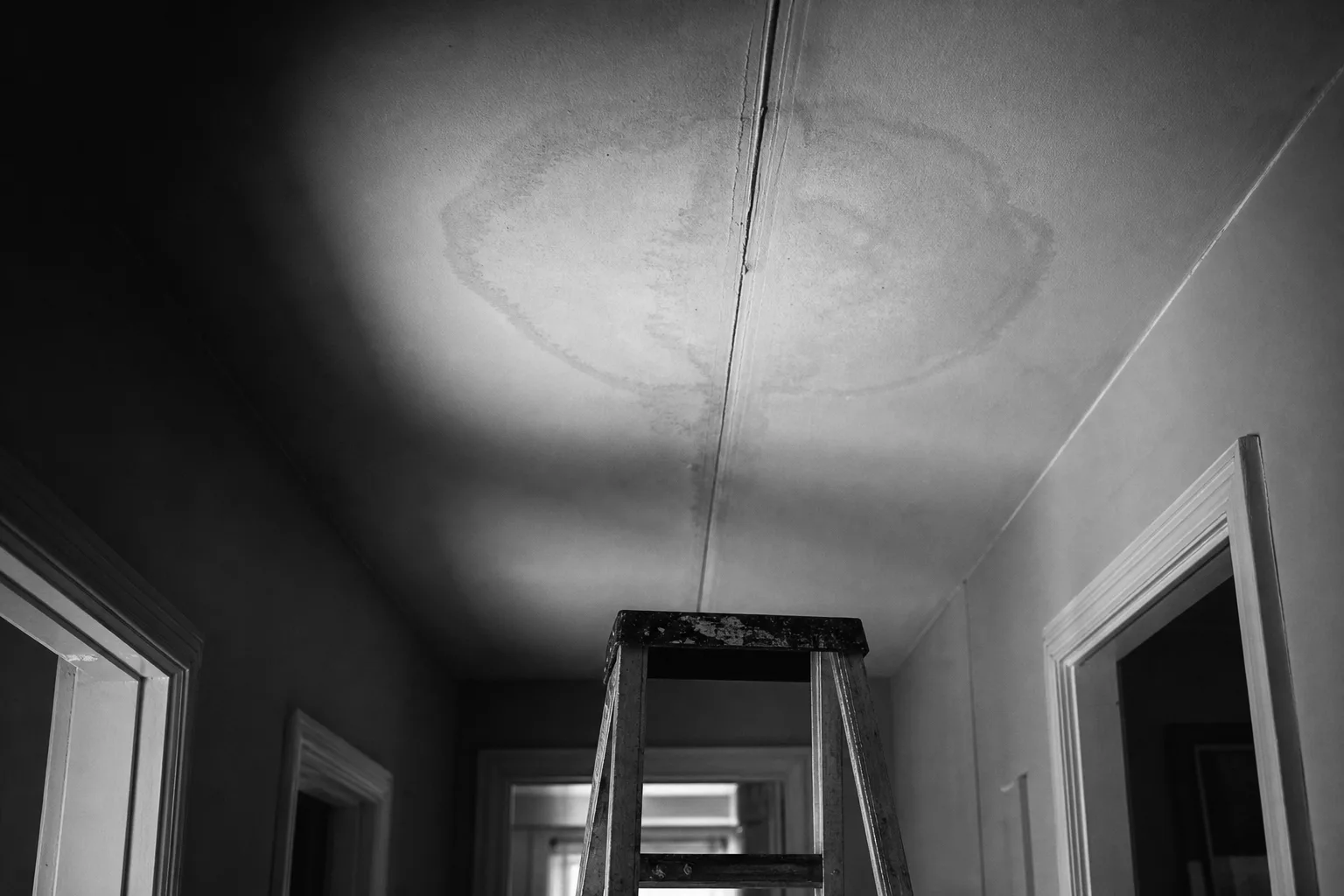
Read that as a deadline, because that is how it functions. The clause does not ask whether you knew about the leak. It asks how long the water was moving. A supply line that bursts at 3 a.m. and floods a kitchen is covered. The same volume of water arriving through a failed shower pan over eight months is not, and the repair bill is frequently larger.
So the clause converts into a household habit, and a cheap one: look behind the washing machine, under both bathroom vanities, at the water heater pan, and at the ceiling below the upstairs bathroom. Once a month takes about ten minutes. The point is not diligence for its own sake. It is that the difference between a covered loss and an excluded one is often a matter of weeks, and the only person positioned to notice inside that window is you.
Flood is a separate matter entirely. Surface water from outside the house is excluded from standard homeowners coverage and sits with the National Flood Insurance Program, which the Federal Emergency Management Agency administers. Separate policy, separate waiting period, separate claim.
4. Who and what is named by the policy
Liability sections carry exclusions attached to specific things rather than specific events: certain dog breeds, trampolines, diving boards, pools without a fence of a stated height, ATVs, and in many states any resident driver who has not been disclosed. The common thread is that each one is a condition of the property or household you could state in a sentence, and the insurer wants it stated.
The everyday consequence shows up at the moment of change. A nephew moves in for a semester and gets added to the car rotation. The trampoline arrives for a birthday. A rescue dog of uncertain parentage becomes part of the household. Each of these is a five-minute phone call that nobody makes, and each can convert a liability claim from covered to excluded.
Disclosure sometimes raises the premium and sometimes does not. It fairly often produces a requirement instead: fence the pool, net the trampoline, exclude the dog from liability while keeping the rest of the policy intact. Those are workable outcomes. The one outcome you cannot work with is finding out after an injury.
5. Wear, neglect, and the age of the roof
Wear and tear, deterioration, mechanical breakdown and faulty maintenance are excluded on essentially every form. This is the exclusion that explains the gap between what people expect a policy to be and what it is: coverage for sudden events, not a service contract on an aging building.
Where it bites hardest is roofing. Many policies now settle older roofs on an actual cash value basis rather than replacement cost, with depreciation applied by age. The age thresholds vary by insurer and by state, commonly somewhere in the fifteen to twenty-five year band, and the schedule is written into the endorsement. Pull the declarations page and look for the wording on roof surfacing. If your roof is approaching that line, the renewal in front of you is the one where the decision gets made, not the claim three years out.
Documentation does real work here. Dated photographs after every inspection, receipts for repairs, the gutter cleaning invoice. None of it is glamorous and all of it answers the question an adjuster is required to ask about whether the damage was sudden or accumulating.
Exclusions are the clearest statement your insurer will ever make about what it expects from you, and all five of these are legible in an afternoon with the declarations page and a pen. The actions they imply are small: a phone call before a long absence, a monthly look under the sink, a sentence about the trampoline. The money they move is not.