Condensation is the only building defect that announces itself in the morning and disappears by lunch. That timing is the whole problem. By the time someone with authority to spend money walks past the window, the evidence has evaporated, and the conversation resets to opinion. The fix is not a better argument. It is a record, and a clear idea of which of three very different conditions you are actually looking at.
The three look nearly identical through a phone camera. They have almost nothing in common underneath.
Interior, interpane, exterior: three problems wearing the same coat
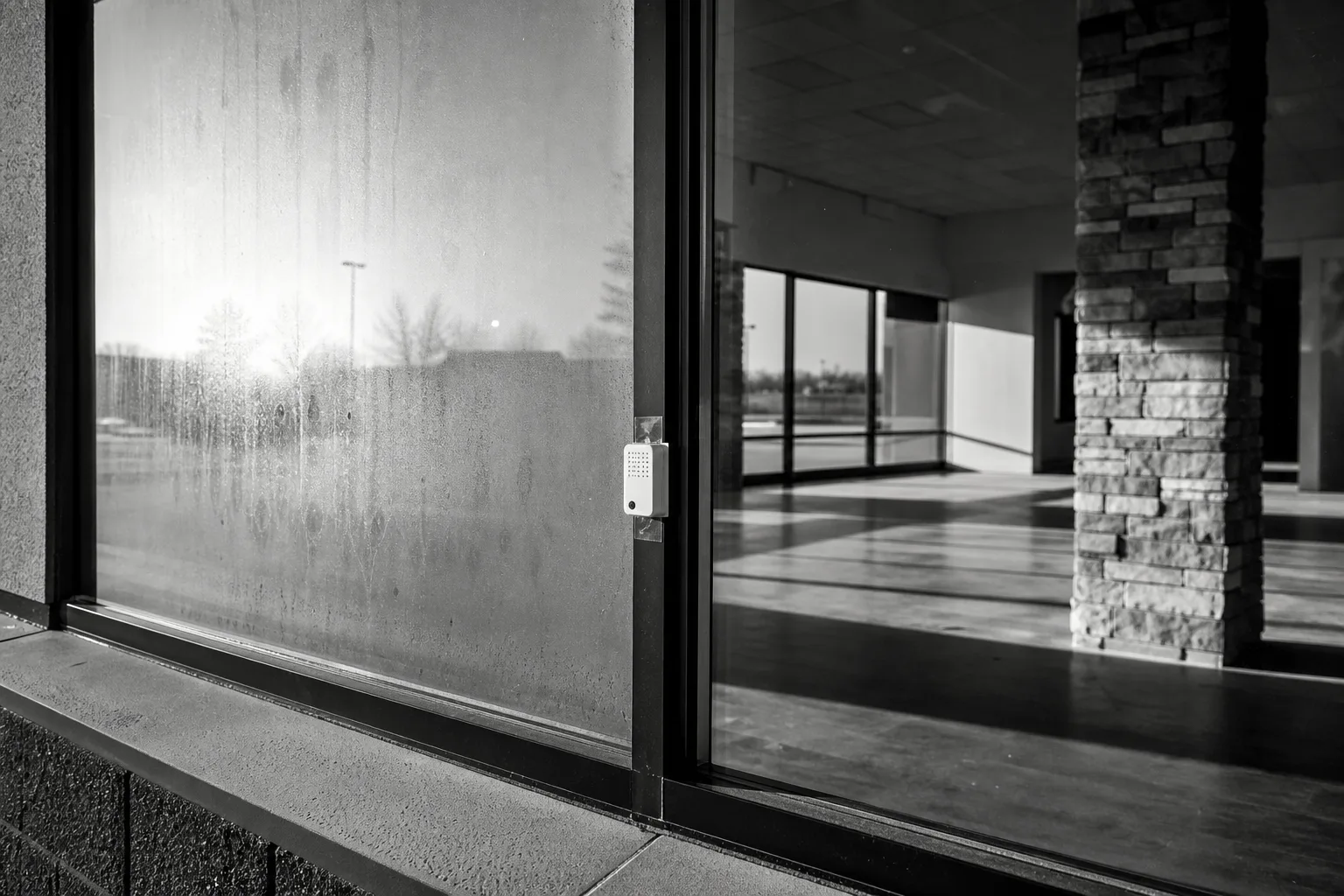
Wipe the glass. If the moisture comes off on your hand, it is on the room-side surface, and it is telling you about the air in the room, not about the window. Room air holds a certain amount of water vapor; the inside face of the glass is the coldest surface in the room; when that surface drops below the dew point of the air touching it, water appears. Everything that follows is arithmetic. Raise the surface temperature, lower the humidity, or move the air. Those are the only three levers.
If the moisture does not wipe off from either side, it is sealed inside the insulating glass unit. The desiccant in the spacer has saturated, the perimeter seal has lost its integrity, and outside air (with its water in it) is now cycling through the cavity every day. This is a component failure. It is not caused by your tenants' behavior, it does not respond to a dehumidifier, and it is the one case of the three that is frequently somebody else's financial problem.
If the moisture is on the outside face, you are looking at dew. The exterior surface of a genuinely good window gets cold overnight because the glass is no longer leaking heat outward to warm itself. Clear sky, calm night, humid air, and the outer lite falls below ambient dew point exactly the way a parked car's hood does. It burns off within an hour or two of sun.
That last one surprises people who have just paid for an upgrade, which brings us to what has shifted.
What changed, and why the complaints changed with it
Two things moved at once over the past decade or so, and they push in opposite directions.
Glass got better. Low-emissivity coatings, argon or krypton fill, and warm-edge spacers raised the center-of-glass and edge-of-glass surface temperatures substantially over clear double glazing, and dramatically over single glazing with a storm panel. The Department of Energy is responsible for the federal efficiency programs that drove much of this, and the practical consequence is that the inside face of a modern unit is far less likely to be the coldest surface in the room. Interior fogging on the glass itself has become less common in new work, while exterior dew (a symptom of the coating doing its job) has become more common. People report the second as a defect. It is closer to a receipt.
Envelopes got tighter. Air sealing, better weatherstripping, and continuous insulation cut the infiltration that used to dry a building out for free all winter. Moisture generated inside now stays inside unless something moves it. So the same square footage of glass in a tighter building sees higher interior humidity, and the condensation that does appear tends to show up at the frame, the sill, the spacer line, or on the coldest window in the coldest corner rather than across the whole pane.
Which means the modern version of this complaint is narrower and more diagnostic than the old one. Fog across every window in a building is a ventilation and humidity problem. Fog on two units out of forty is a fenestration problem, and the two units will usually turn out to share a date code.
The measurement tools, compared honestly
You need three numbers to settle an argument about interior condensation: indoor relative humidity, indoor air temperature, and the temperature of the glass surface. Two of those are trivial to get. The third is where people improvise badly.
| Tool | What it settles | What it will not tell you |
|---|---|---|
| Handheld hygrometer | Whether indoor humidity is in a defensible range at the moment you are standing there | Anything about overnight, when condensation actually forms |
| Logging temperature/humidity sensor | The overnight curve, per room, over days or weeks. The single highest-value purchase here | Surface temperature, unless you tape a probe to the glass |
| Infrared spot thermometer | Surface temperature at one point, fast. Good for comparing center of glass to spacer line to frame | Reliable readings on low-e coated or reflective glass, where emissivity assumptions go wrong |
| Contact thermocouple or taped probe | Actual glass surface temperature you can put in a report | Anything about the rest of the window |
| Thermal imaging camera | Pattern: which units are cold, where the edge seal is failing, whether the frame is bypassed | Numbers you should quote. Treat the image as a map, not a measurement |
| Pin or pinless moisture meter | Whether the sill, drywall return, or framing below the window has been wet long enough to matter | Where the water came from |
Price bands, with the caveat that they move: a usable logging sensor sits in the same range as a good smoke alarm, an infrared spot thermometer somewhat above that, and a thermal camera worth carrying is an order of magnitude higher again. A contractor's site visit will typically cost more than the first two tools combined, which is the entire argument for buying them.
What I will not give you is a dew point table pretending to be an answer for your building. The threshold depends on glass makeup, frame material, interior air film, whether the blinds are closed (they make it worse, by insulating the glass from room air), and outdoor temperature overnight. Anyone quoting a single humidity figure that is safe for all buildings is guessing.
The paperwork that turns a symptom into a claim
Interpane fogging is the case with money attached, and it is decided almost entirely on documents.
Start with the date code. Most insulating glass units carry a stamp, etched mark, or spacer-embedded code identifying the fabricator and the manufacture date. Photograph it, in focus, with the unit's location noted. That code plus a warranty certificate is the claim. Without it, you are asking a fabricator to take your word for the age of a unit, and they will decline politely.
Then collect, in one folder:
- The original purchase order, invoice, or contract, with the glass specification as ordered (makeup, coating, fill gas, spacer type)
- The IGU fabricator's sealed unit warranty, and separately the installer's labor warranty. These are almost never the same length, and the labor half is usually much shorter
- Dated photographs of each affected unit, with a tape measure or ruler in frame for size
- Your logging data if interior condensation is also in dispute, since it demonstrates you ran the building within a reasonable range
- Any prior service tickets touching those openings
The reason to assemble this before making the call is that sealed unit warranties are typically pro-rated and typically cover glass only, not labor, scaffolding, or access. On upper floors that distinction is most of the cost. Commercial commercial glass installers will usually quote the labor and access separately from the replacement glass for exactly this reason, and a folder that separates the two lets you compare quotes on the part you are actually paying for.
One more piece of recent housekeeping worth noting: the per-unit labels carrying the certified performance ratings are usually removed at installation, so the specification survives only in your submittal package. Keep it. It is the document that establishes what you were owed.
Deciding what to spend, in order
The sequence that wastes the least money runs cheapest and most reversible first.
- Log humidity and temperature in the two or three worst rooms for at least a week of cold weather. Cost: trivial. This alone resolves a meaningful share of complaints, because it either exonerates the glass or indicts it.
- Check the operational stuff: exhaust fans running and actually ducted outside, unit ventilation not switched off, blinds not sealed tight against the glass overnight, humidifiers turned down.
- Survey the units. Wipe test each complaint, note which fog between the panes, photograph date codes.
- Group the failures. If they cluster by date code, elevation, or floor, you have a manufacturing or installation batch, and that changes the conversation from replacement to remedy.
- Only then price replacement, glass and access on separate lines.
The reason this order holds is that steps one through four cost days and almost no money, while step five is irreversible. A building that skips ahead frequently replaces glass that was performing correctly and finds the same windows fogging the following January, because the water was always coming from the laundry room.
Condensation is a measurement problem that people keep treating as a taste problem. A twenty-dollar sensor, a photograph of a date code, and a folder with the original spec in it will settle most of these before anyone climbs a ladder, and the ones it does not settle become a clean, specific scope instead of an argument about who is imagining things.