Water does its worst work quietly. The visible puddle is dealt with in an hour; the water that traveled under the baseboard and into the subfloor is still there on day four, and by then nobody can prove when it arrived or how far it went. That proof is the whole job of the first forty-eight hours. Not heroic extraction. Measurement, documentation, and a short list of purchases you can defend later.
What follows is the kit and the paperwork. Both are smaller than people expect.
The tools that earn their place, and the ones that do not
Five items cover most of what a household can usefully do before a restoration crew or an adjuster arrives.
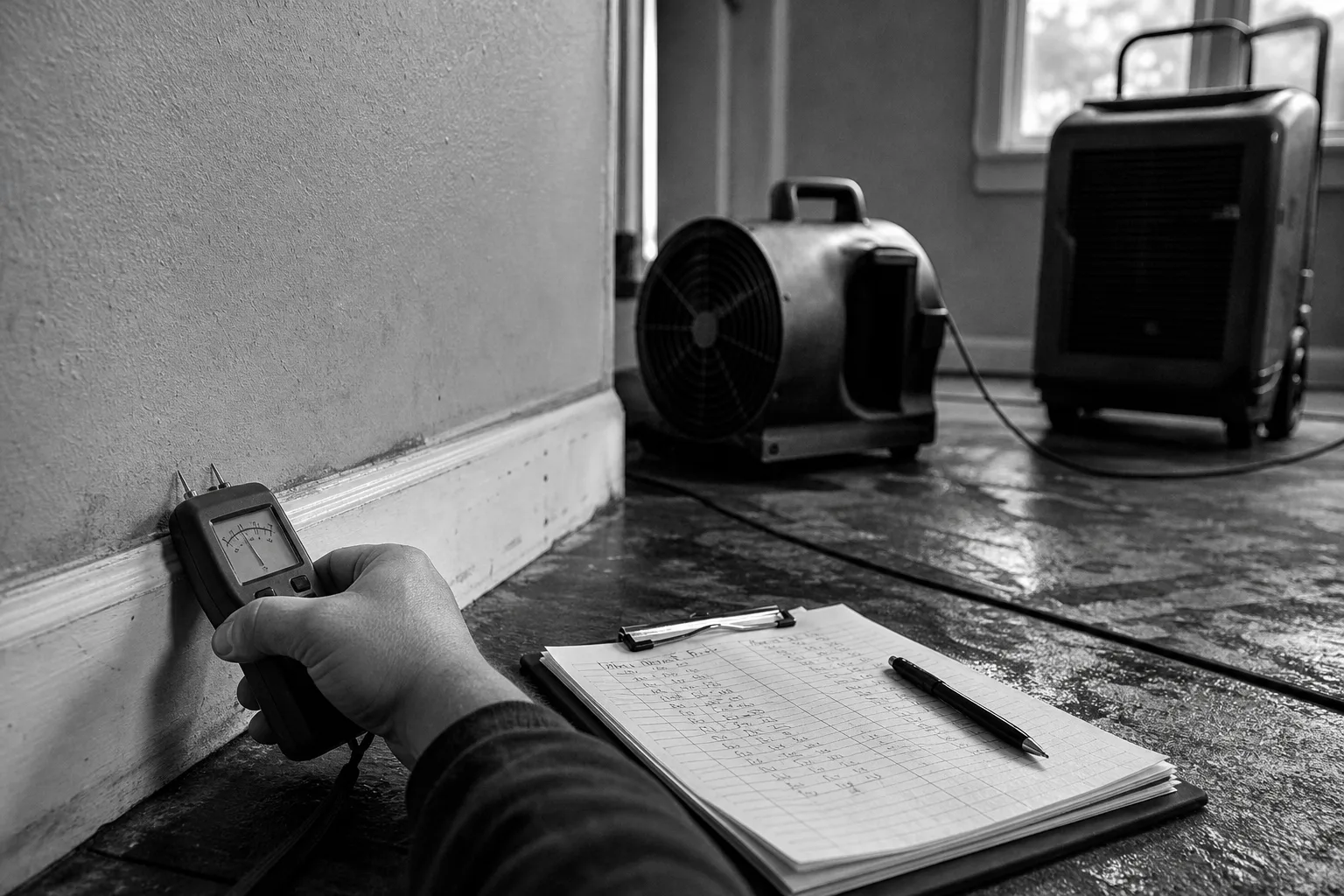
A moisture meter is the one that changes outcomes. A pin-type consumer meter costs roughly what a mid-range cordless drill costs, and it answers a question no amount of looking can answer: is this drywall still wet eighteen inches above the floor? Pin meters read a percentage in wood and drywall. Pinless meters scan without holes and are better on finished surfaces. Either is fine. What matters is that you take the same readings, in the same marked spots, twice a day, and write them down. An absolute number from a cheap meter is not laboratory grade. The trend across three days is still real, and the trend is what tells you whether drying is working.
A shop vacuum rated for wet pickup. Household vacuums are not, and running one on standing water ends with a dead vacuum and a conversation about whether that counts as covered damage.
Air movers and a dehumidifier. These are rental items, priced by the day, and the rental counter will want a credit card and a return date you probably cannot predict on day one. Take the equipment anyway. A room that sits wet for four days and a room that is under air movement within six hours are two different repair bills, and the gap between them is usually larger than a week of rental.
A headlamp, so both hands are free, and a camera, which is the phone already in your pocket.
What does not earn its place: anything that commits you. Do not cut drywall to a line you chose yourself, do not pull up tack strip and tile before anyone has photographed it in place, and do not throw away the failed supply line, the hose, or the section of pipe. That component is physical evidence of cause. Put it in a plastic bag, label it with the date, and set it somewhere a contractor will not tidy it into a dumpster.
The folder, opened before you clean anything
One folder, digital or physical, with the date in its name. Everything about this event goes in it and nothing else does. The contents are unglamorous and they are what carries you through a claim review two months from now.
- The claim number and the names. Every person you speak to: name, role, company, phone number, date and time, and one line on what they said. Adjusters rotate. Mitigation crews change lead techs. You will be the only continuous party to this file.
- Photographs taken before anything moves. Wide shot of each affected room from the doorway, then closer, then the detail. Include a reference object for scale. Photograph the source. Photograph the water line on the wall, which fades within a day and never comes back.
- A room-by-room contents list. Item, approximate age, approximate purchase price, and a photo. Nobody enjoys this. It is also the single document that most often decides whether a contents settlement feels fair.
- Receipts, all of them. Fans, the meter, the dehumidifier rental, the tarps, the box of contractor bags, the motel night, the laundromat. Photograph each receipt the day you get it, because thermal paper fades and a faded receipt is a receipt you no longer have.
- The drying log. Date, time, location, reading. One line each.
The drying log is the part people skip and the part that pays. It converts an argument into a record. When a mitigation invoice says equipment ran for six days, your log either supports that or quietly does not.
What the first two days can and cannot tell you about money
Here is the honest shape of it. Within forty-eight hours you can know three things with reasonable confidence: where the water came from, how far it spread, and whether the affected materials are still holding moisture. You cannot know the final cost. Anyone who gives you a repair figure on day one is giving you a guess wearing a suit.
What moves that number, in rough order of effect:
- Category of water. Clean supply water, gray water from an appliance, or sewage. The category drives what can be dried in place and what must be removed, and it is the difference between a moderate bill and a large one.
- How long materials stayed wet. Hours matter. Carpet and pad that get airflow quickly often survive. The same carpet on day three usually does not.
- What the water reached. Finish flooring is one line item. Subfloor is another. Insulation inside a wall cavity is a third, and it is the one that turns a two-room job into a whole-floor job.
- Whether the cause is covered. Sudden and accidental discharge is treated very differently from long-term seepage, and the distinction often comes down to what your photos and your log show about timing.
The Environmental Protection Agency is responsible for federal guidance on indoor mold and moisture, and the general principle in that guidance is the one worth internalizing: wet materials dried promptly are usually salvageable, and the window is measured in days rather than weeks. That is also why the readings matter more than the opinions.
The week that follows, which nobody describes to you
The dramatic part ends fast. Then comes the ordinary version, and it lasts longer than the emergency did.
You live with noise. Air movers are loud in a way that makes phone calls hard and sleep worse, and the dehumidifier runs on top of them. The electric bill for that month will be visibly higher. Keep the bill; it is a documented additional living expense in some policies and worth asking about in all of them.
You empty a condensate bucket, or you run a hose to a drain and check it anyway, because the hose kinks and a full bucket shuts the machine off at two in the morning without telling you. You take meter readings before coffee and after dinner, log them, and discover around day three that one corner is not moving. That corner is information. It usually means trapped water behind a cabinet toe-kick or under a floating floor, and it is the finding that justifies a small, deliberate opening in the drywall rather than a large speculative one.
Laundry moves somewhere else for a while. Furniture lives on foil tabs or blocks so legs do not stain damp flooring. One room becomes storage and stays that way longer than you planned. Somebody has to call the rental counter to extend the equipment, and somebody has to call the adjuster back, and if those two people are not the same person, the folder is how they stay aligned.
Set a recurring reminder for the same two times every day for the first week. Readings, photos of anything that changed, receipts photographed. It takes about ten minutes a session, and it is the difference between a file that answers questions and a file that invites them.
By the end of the second day you should be able to hand any professional who walks in the door a single folder containing the source, the spread, the readings, the photos, and the receipts. That is a household in control of its own claim.