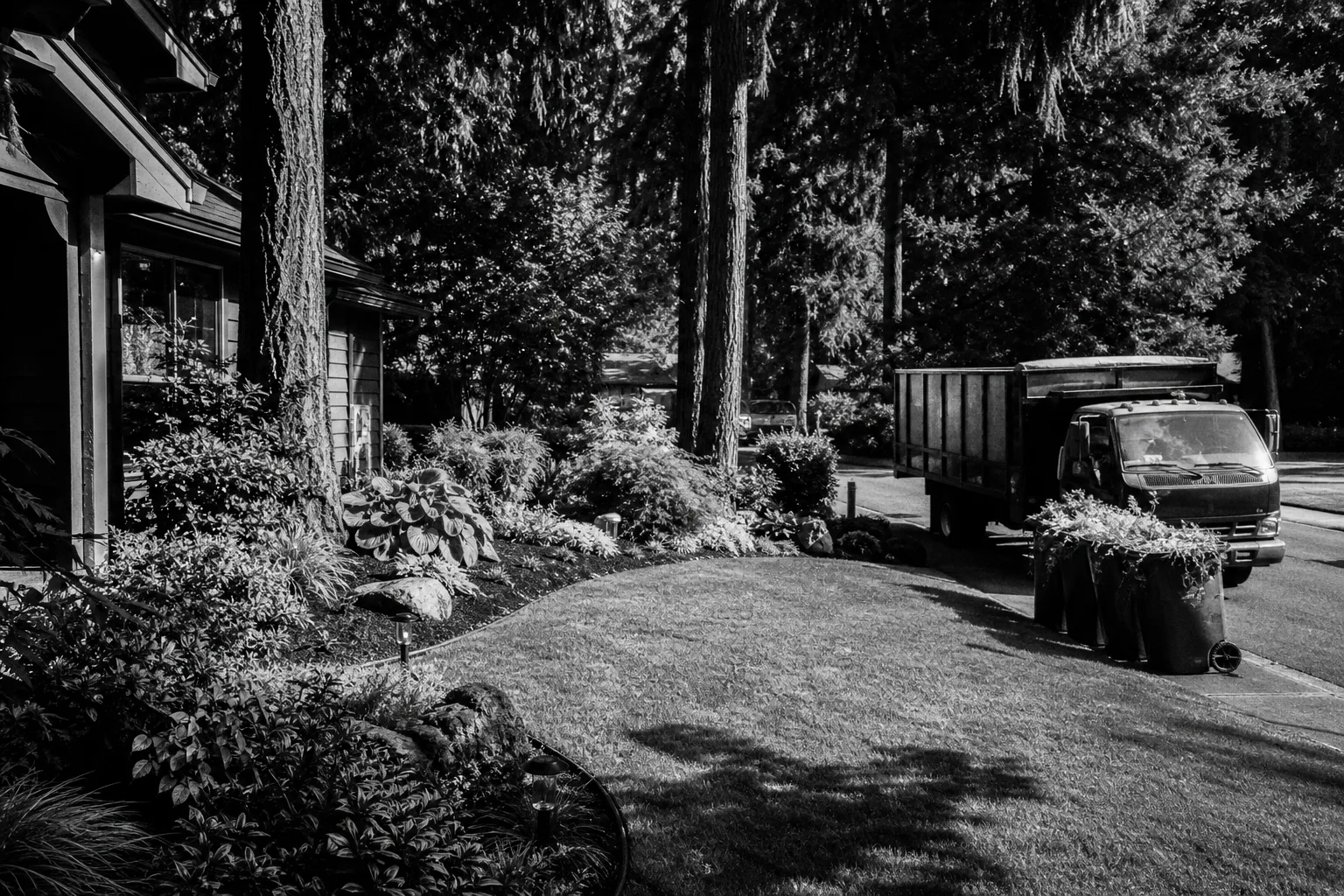
The install invoice is the number everyone remembers. It arrives once, it is itemized, and it is usually negotiated. The upkeep number never arrives as a single document. It shows up as a mowing subscription, a water bill that climbs in July, a pruning visit every second or third year, a truck full of yard debris, and one unplanned call about a tree that started dropping limbs on the driveway. Added together over five years, it routinely outruns what the garden cost to build.
The useful question is not whether upkeep is expensive. It is which parts of it run on a weekly clock, which run on a seasonal clock, and which run on a multi-year clock where falling behind converts a maintenance job into a replacement job.
The weekly layer: labor, and almost nothing else
Routine garden spending is mostly someone's hours. Mowing, edging, blowing, deadheading, pulling what came up in the beds, hauling the clippings away. Materials barely register. What moves the price is how long the crew is on site and how hard the site is to work.
Four things drive that number more than anything on a plant list.
- Access. A crew that parks at the curb and walks a mower through a side gate works faster than one carrying equipment up a flight of steps or through a house. Narrow gates, steep driveways, and no place to stage a truck all add time to every single visit, not just the first one.
- Disposal. Green waste goes somewhere, and that somewhere charges by weight or volume. A garden that generates a lot of clippings generates a lot of dump fees. Hedges are the usual culprit.
- Edge length. Not square footage. The perimeter between lawn and bed, lawn and path, bed and fence. Edges are hand work, and hand work is the expensive kind. A lawn broken into four shapes costs more to keep tidy than one rectangle of the same area.
- Plant palette. Perennial borders want deadheading, cutting back, and dividing. Massed shrubs want a shear twice a year. Neither is wrong, but one of them is a standing weekly commitment and the other is two appointments.
If you are comparing bids for routine maintenance, ask for the visit frequency and the expected crew hours per visit. Two companies quoting a similar monthly figure can be proposing substantially different amounts of attention, and that difference becomes visible in August.
Water is a utility cost that behaves like a maintenance cost
Irrigation is the line item people forget to count because it arrives from the water utility rather than from a landscaper. Outdoor use is where a household's summer bill separates from its winter bill, and the Environmental Protection Agency oversees the efficiency labeling program that covers irrigation controllers and sprinkler bodies, which is a reasonable place to start if you are replacing either.
The sequence here matters. The controller should be checked and reprogrammed before the first hot stretch, not during it. A spring walk-through with the zones running one at a time will find the head that got clipped by a mower, the rotor spraying the fence, and the drip line that a root pushed to the surface. That walk-through is an hour of someone's time. Finding the same problems in late July costs you the hour plus whatever died while the zone was running dry, plus two months of water that went into a sidewalk.
A leak in a buried line is the version that hurts. It does not announce itself above ground. It announces itself on a bill, one cycle later, after the money is already spent.
The multi-year layer, where delay stops being recoverable
Weekly work can be skipped for a month and caught up. Some work cannot.
Hedges are the clearest example. A hedge kept at a set height and width is sheared on a schedule and stays within its own footprint. A hedge allowed to run for three or four seasons has to be reduced hard to get back, and on many species the interior is bare wood that will not break new growth. The choice at that point is an ugly hedge for several years or a removal and a replant. There is no version where you pay the original number.
Trees follow the same logic on a longer cycle and with much larger figures attached. Structural pruning on a young tree is a short visit from a small crew. The same tree, twenty years on with codominant stems and included bark over a roof, is a different job with a different truck and a different insurance exposure. A removal is ordinarily several times the cost of a prune, and a removal done urgently after a storm, with a crane and a road closed, is several times a scheduled removal.
This is why the first thing to book in a Pacific Northwest garden is not the mower but the assessment. Douglas firs, big leaf maples and cedars on a city lot are the single largest maintenance liability most Seattle households own, and a certified arborist working for a tree service in seattle will tell you which stems need attention this year, which can wait three, and which trees are regulated as exceptional and cannot be removed without permission from the city. Knowing which category each tree sits in changes both your budget and your sequence.
Plan the tree work for late summer or the dry window, before the wind season. Crews are easier to book, access is better, and you are not bidding against every other homeowner on the block the morning after a storm.
What a realistic annual plan looks like
Set the budget in four buckets rather than one. It makes the trade-offs visible.
| Bucket | Clock | What drives the number |
|---|---|---|
| Routine visits | Weekly or biweekly, growing season | Crew hours, access, edge length, disposal |
| Water | Monthly, summer-weighted | Zone design, controller settings, leaks |
| Seasonal tasks | Two to four times a year | Mulch, fall cleanup, gutter-adjacent leaf load, bed renovation |
| Tree and structure work | Every two to five years | Species, size, proximity to roofs and lines, permits |
The fourth bucket is the one that gets left out, and it is the one that does not forgive being left out. Treat it as a sinking fund: put something aside every year even in the years nothing is scheduled, because the year it is scheduled it will not be a small invoice.
Mulch belongs in the third bucket and earns its place. A two to three inch layer, topped up annually before things warm up, suppresses enough weed germination to shorten every routine visit for the rest of the season. It is the rare maintenance purchase that reduces the next maintenance purchase.
Where to start if you have inherited all of this
Walk the property once with a notebook before you hire anyone. Note the trees and roughly how close they sit to the house, the power drop, and the neighbor's fence. Note where water pools after rain. Count the gates and measure the narrowest one. Find the irrigation controller and see whether it still has a schedule in it.
Then book in this order: the arborist assessment, the irrigation check, the routine maintenance contract. The first two change what the third needs to cover, and doing them in the other order means paying someone weekly to work around problems nobody has priced yet.
A garden that is kept on schedule mostly stays the cost it started at. That is the whole argument for the schedule.