Most people hearing a defense fee for the first time assume it works like a repair estimate: one number, one problem, problem goes away. That belief has a reasonable origin. Almost every other professional quote a household receives is priced against a finished result. The roof stops leaking. The transmission works. Payment and outcome sit on the same line.
Legal fees are not quoted against an outcome. They are quoted against a defined quantity of work, bounded by a stage of a process that may stop early or may keep going. Two attorneys can give you numbers that differ by thousands and both can be honest, because they have drawn the boundary in different places. Once you know where the boundary lives, the quotes become comparable and the paperwork that defines it is short enough to read in an evening.
The quote is priced against a stage, not a case
A criminal matter moves through recognizable phases: arraignment, discovery and pre-trial motions, negotiation, then trial, then whatever follows a verdict. A flat fee almost always covers a named set of those phases and stops.
The most common arrangement is a fee that carries the case through everything short of trial. If the matter resolves by negotiation, and many do, that fee is the whole bill. If it goes to trial, a second fee attaches, sometimes quoted up front and sometimes quoted later. An attorney who gives you a lower number than the one down the street may simply be quoting the pre-trial phase while the other quotes both.
Ask directly: what ends this fee? The answer should be an event you can recognize when it happens, not a feeling. "Through resolution at the district court level" is an event. "Until the case is done" is not.
There is also a second proceeding that trips up nearly every first-timer. A drunk driving arrest typically generates a criminal case and a separate administrative action against the driver's license, run by the state licensing agency on its own calendar. They are distinct matters with distinct deadlines. Representation at the license hearing is frequently quoted as a separate line item, and when a quote looks surprisingly low it is often because that line is absent.
Fees and costs are different money
The fee pays for the attorney's time and judgment. Costs are money the office spends on your behalf and passes through: filing fees, certified transcripts, service of subpoenas, an investigator, a private expert to review the testing.
In a drunk driving case the cost side is not trivial, because the evidence is instrumental. Breath testing devices are built to model specifications associated with the National Highway Traffic Safety Administration, which is responsible for the federal standards governing evidential breath testing equipment. The machines are calibrated on a schedule, by people who sign records, using reference solutions with their own paperwork. Getting an independent expert to examine those records costs money that is not the attorney's fee, and a thorough quote says so in writing before you sign.
Hourly arrangements add one more variable: the billing increment. Six-minute increments and fifteen-minute increments produce different totals for the same work, particularly on a case with many short phone calls. It is a fair question and nobody good is offended by it.
The paperwork that makes the quote legible
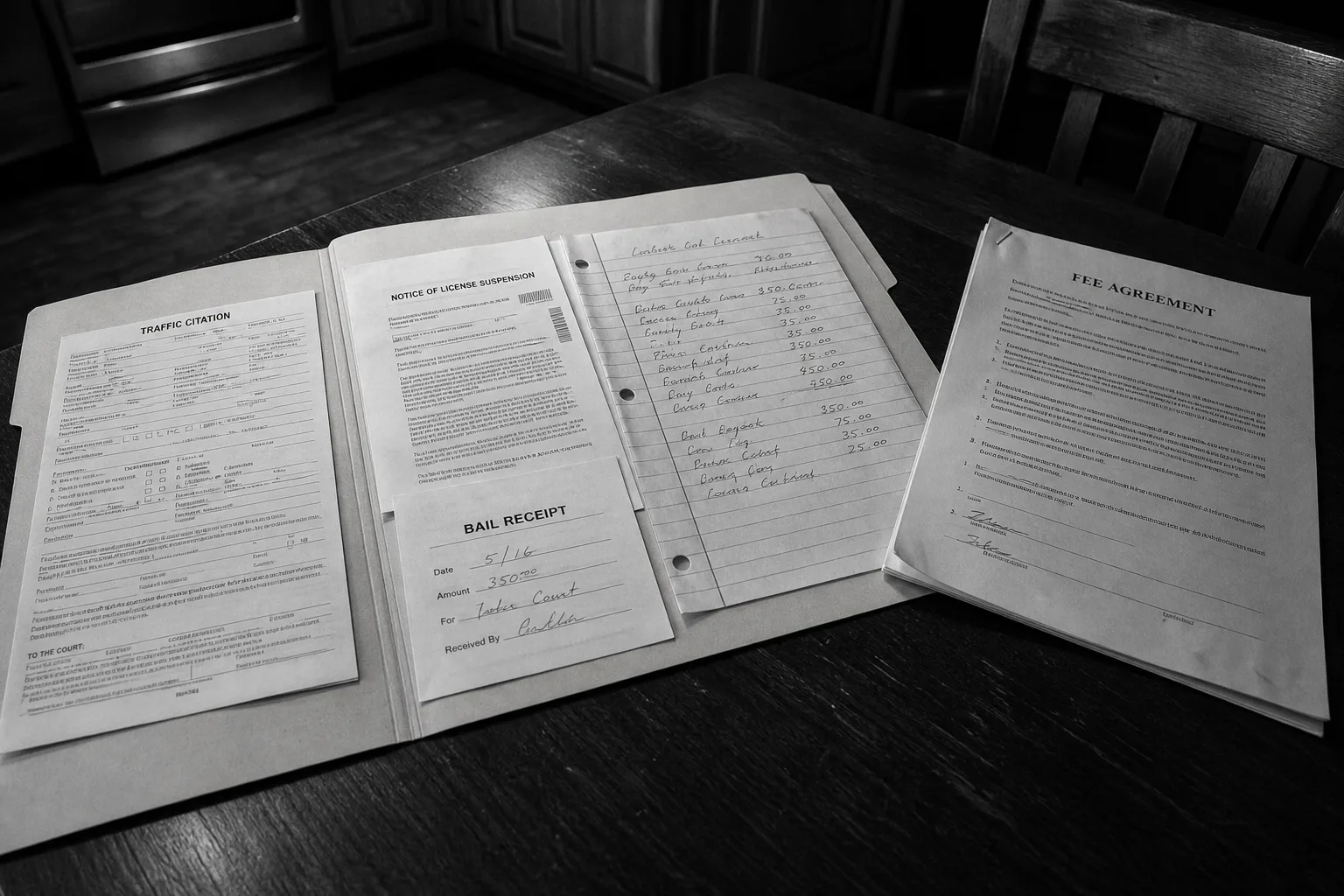
You can walk into a consultation with nothing and still get useful advice. You will get a sharper quote if you bring a folder. The documents below are the ones that define scope, and the gaps in them are what an attorney is pricing uncertainty against.
- The citation and any court paperwork handed to you at release. It names the charges and the first court date.
- The notice regarding your driver's license. This is the one with the short fuse. There is usually a window measured in days to request the administrative hearing, and missing it forfeits that proceeding entirely.
- Bail or bond documents, including anything a bondsman had you sign.
- Release conditions, which may already require an ignition interlock device, monitoring, or abstention.
- Anything with a number on it: a printed breath result, a notice that blood was drawn, a receipt for a towed vehicle.
- Your own written account, made now rather than in four months. Time of day, what you had eaten, the route, how long the stop lasted.
That last item is the one people skip and later wish they had not. Memory degrades on a predictable schedule and the version you write this week is worth more than the version you reconstruct in the spring.
Reading the engagement letter before you sign it
The fee agreement is the only document in this process that is written for you rather than about you, and it is usually three or four pages. Read all of them. Five clauses carry the weight.
Scope. A list of what is included, and ideally a list of what is not. Appeals, retrials, probation violations, and license hearings commonly sit on the excluded list.
Earned-on-receipt language. Some flat fees are deposited into a client trust account and drawn down as work is performed. Others are treated as earned when paid. This determines what, if anything, comes back if you change counsel in week three.
Costs and authorization. Whether you are billed for costs as incurred, and whether the office must get your approval above a stated dollar threshold before retaining an expert.
Communication. Who returns your calls and within what period. Trivial-sounding, and the single most common source of complaints about otherwise competent representation.
Termination. How either side ends the relationship and what happens to money and files.
When you sit down with a dui defense lawyer for an initial consultation, bring the folder and ask for the fee agreement to take home rather than signing across the desk. A firm confident in its pricing will hand it over.
Comparing two numbers honestly
Build a one-page grid before the second consultation. Rows: pre-trial representation, license hearing, motion practice, trial, costs, billing increment if hourly, payment schedule. Columns: each attorney. Fill it in from what you were told, and leave blanks where you were not told.
The blanks are informative. A quote with no blanks is a quote someone has thought about. And once the grid is full, the comparison takes about four minutes, which is the point of building it.
The number was never the price of an outcome. It is the price of a clearly marked stretch of work, and the paperwork that marks the stretch is already sitting in your hands.