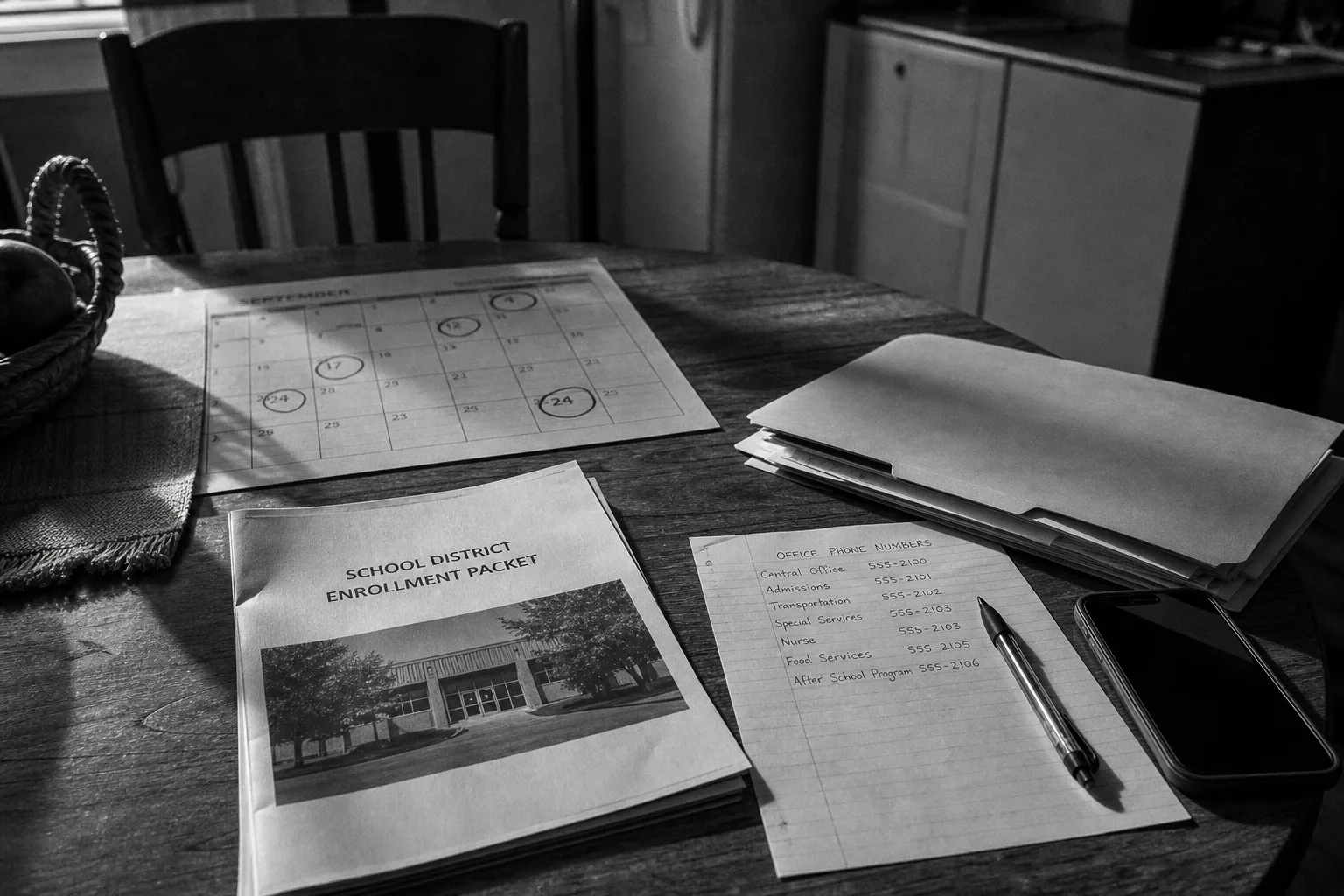
A large school district does not have an enrollment deadline. It has six or seven, held by separate offices that do not share a calendar, and only one or two of them are printed in a place a parent is likely to look. The date on the district's admissions page is usually the latest of the set. The ones that quietly govern your outcome sit upstream of it, in records rooms and verification units and a routing department that closes its books weeks before the first bell.
The practical problem is not understanding the rules. It is finding out, early enough to act, which clerk is holding the stopwatch.
The deadlines are owned by different departments, and they do not coordinate
In a small district, one person handles enrollment. In a district with tens of thousands of students, the work is split across units that report through different chains and answer to different compliance obligations. A choice or magnet application is processed centrally by an admissions or student placement office. Residency is verified by a separate team, sometimes contracted out. Immunization and health clearance runs through a health services office that follows state law and public health guidance. Transportation routing belongs to an operations department that has to build bus routes before it knows who is riding them. Records transfers are handled by the registrar at your child's previous school, who is not employed by the district you are applying to and has no stake in your timeline.
Each of those units sets its own cutoff, based on how long its own work takes. None of them is being difficult. The routing planner genuinely cannot add a stop in late August. The health office genuinely cannot clear a student without a document the pediatrician has not sent.
Here is the shape of it:
| Deadline | Who owns it | Typical behavior if missed |
|---|---|---|
| Choice, magnet, or lottery application | Central placement or admissions office | Hard close. A later round may exist, with far fewer seats. |
| Residency or address verification | Verification unit, sometimes a vendor | Application held, not denied. Recoverable, but it stalls everything behind it. |
| Immunization and health clearance | Health services, under state law | Student cannot start. Recoverable at any time, but only by producing the record. |
| Transportation request | Operations and routing | Often a firm cutoff for the first routing cycle. Added later as capacity allows. |
| Special education records and services transfer | Case manager at both ends | Services continue by law, but the meeting that adjusts them is scheduled around staff availability. |
| General registration | School site office | The most flexible date, and the one most often published. |
Read that table once and the strategy becomes obvious. The published date is the soft one. The dates nobody mails you are the hard ones.
Which ones genuinely cannot be missed
The absolute deadline in almost every large system is the lottery or choice application close. It is absolute for a structural reason: once applications close, a computer runs an assignment algorithm across every applicant at once. A late application cannot be inserted into a run that has already happened. There is no clerk with discretion, because discretion would invalidate the result for everyone else. Some districts hold a second round or a late application period, and those are real, but they allocate whatever is left after the main run. The difference between the two is not a few weeks of inconvenience. It is a different set of schools.
The second hard one is less obvious: the transportation routing cutoff. Buses are planned as a system, and a route built in July is not reopened in September for one address. In districts that offer home-to-school service, families sometimes win a seat at a desirable campus and then discover they have no way to get a child there, because the two decisions were made by two offices eight weeks apart. Families comparing the best schools in los angeles and other large urban systems tend to research academics thoroughly and leave logistics to the end, which is backwards when the logistics office closes first.
Almost everything else is recoverable. Residency documents can be produced late. Immunization records can be chased down. A records request from a prior school can be escalated. These cost you time and phone calls, not outcomes, as long as they are resolved before the one deadline that cannot be re-run.
The people on the other side of the counter, and what each can actually do
Knowing who to call matters more than how often you call. The front office at the school site is helpful, pleasant, and almost entirely without authority over central deadlines. Site staff can tell you whether your paperwork arrived, confirm what is missing, and push a records request. They cannot move a lottery date, override a verification hold, or add a bus stop. Asking them to do so burns goodwill and a week.
The placement or enrollment office downtown owns the application calendar. They will usually answer a direct, specific question about whether a round is open and what a second round covers. Vague questions get vague answers, because the staff handling thousands of applications are not able to reconstruct your individual file on a cold call.
The verification team wants documents in a specific format. Ask what they accept before you send anything. A utility bill with a different name on it, a lease without a signature page, a piece of mail from the wrong month: each of those comes back, and the round trip is often two weeks.
The registrar at your child's current school is the single most underestimated person in this process. Records transfers are not instantaneous, and a registrar in June is closing out an entire school year. A polite request made in April is handled in April. The same request made in August joins a queue.
If your child has an IEP or a 504 plan, the case manager is the one person who should hear from you first, not last. Federal special education requirements are administered through the U.S. Department of Education, and services follow the student, so the question is never whether support continues. It is who schedules the meeting that confirms placement, and that person's calendar fills fast in late summer.
The order to work it in
Sequence beats speed. Start with the items that depend on someone else's turnaround time, because those are the ones you cannot compress later.
- Request records first. Transcripts, the current IEP or 504, and the immunization record. All three come from third parties. Ask in writing, and ask for a copy for yourself, not just a school-to-school transfer.
- Assemble residency proof second. Confirm the accepted document list before you gather anything. Keep originals.
- Find the routing and transportation cutoff third, before you finalize a school preference list. If a campus is unreachable without a bus and the bus cannot be guaranteed, that belongs in the ranking.
- Submit the choice application fourth, well inside the window. Early submission does not improve lottery odds in most systems, but it does leave room to fix an error the system flags.
- Handle site registration last. It is the most forgiving step and the one with a human you can talk to.
The point at which delay stops being recoverable is the lottery close, and everything before it is a countdown to that date rather than a deadline in its own right. A missing immunization record in March is an errand. The same record missing the week applications close is the reason an otherwise complete file sits unprocessed.
Call three offices in one afternoon and write down the dates each one gives you. Place them in order. The earliest date on that list is your real deadline, and it will almost certainly belong to a department you had not thought about, which is exactly why finding it in winter is worth the hour it takes.