Most people arrive at the monument decision believing they have already been through the hard part. The funeral home gave them an itemized price list, they were told they could decline what they did not want, and nothing about the process felt unregulated. So when the conversation turns to the marker, the assumption carries over: you choose the stone you like, you pay for it, the cemetery puts it in.
That assumption is not stupid. It comes from somewhere real. It is also the reason a woman named Deborah, arranging her mother's burial and having never done this before, nearly ordered a memorial her mother's section would not accept.
The protection she was thinking of covers a different purchase
The itemized price list, the right to decline packages, the requirement that prices be disclosed over the phone: those come from the Funeral Rule, which the Federal Trade Commission oversees. It applies to funeral providers selling funeral goods and services. It is genuinely useful and it is the reason the casket conversation now happens with a printed sheet on the table.
It is not a general law of memorials.
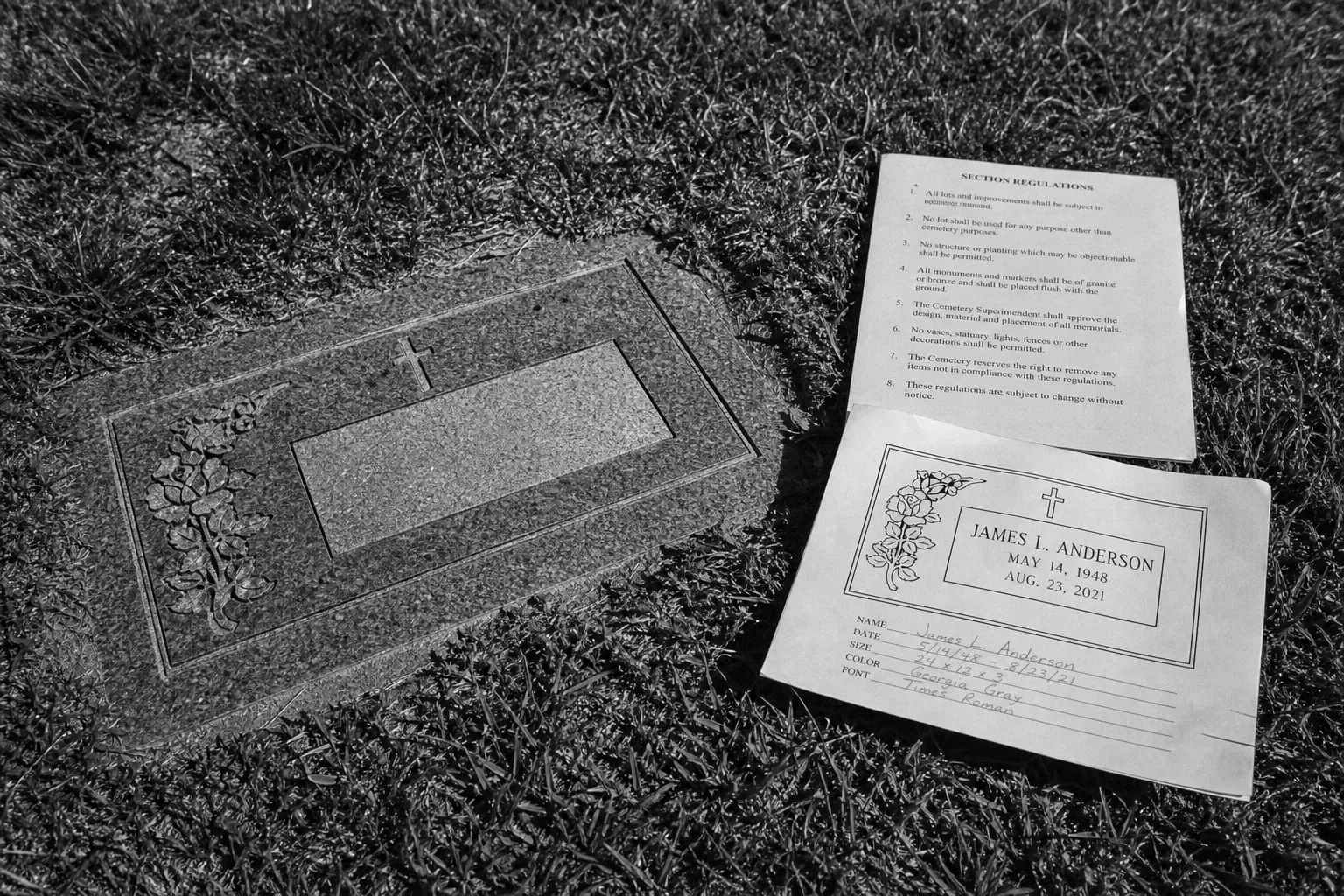
Cemeteries are regulated separately, state by state, and monument dealers are separate again. In many states a cemetery is governed by its own recorded bylaws plus whatever a state cemetery board or licensing agency requires. What that means in practice is that the document controlling Deborah's decision was not a federal disclosure form. It was a two-page sheet of section regulations that the cemetery office had, that nobody had handed her, and that she had not thought to ask for.
What she bought was a right to be buried there, not a right to place anything
The deed for a grave space is usually an interment right, not ownership of the land. The cemetery keeps control over what goes above ground, and it exercises that control by section. This is where first-time buyers get surprised, because the rules are not uniform even inside one cemetery.
The section her mother's plot sat in was a flat-marker section. Bronze or granite, set flush with the turf, within a stated maximum size. The upright monument Deborah had been shown at the dealer's yard, and had already picked a stone color for, could not go there. Not as a matter of taste. As a matter of the recorded rules for that section, which existed to keep the mowers running.
The sheet also covered things she would not have guessed at:
- Which materials were permitted, and which finishes were not
- Whether a foundation had to be poured by the cemetery, and the separate setting fee for it, quoted by marker size
- Whether vases, photo ceramics, or solar lights were allowed, and whether they could be permanently affixed
- Who was allowed to do the installation, and whether outside dealers were admitted at all
- What happened to the endowment or perpetual care charge, and whether it was already paid
That last group is worth asking about early, because a cemetery that only admits its own installers is not being obstructive. It is telling you where the price comparison actually stops.
The turn in the case was a phone call before a signature
Deborah called the cemetery office and asked for the section regulations in writing before she signed the monument order. That is the whole intervention. It took one afternoon.
She learned the section was flat-marker only. She learned the cemetery would pour the foundation and set the marker, and that the fee was separate from the dealer's price, which meant the two quotes she had been comparing were not comparable. She learned her mother's plot was a double depth space, which changed the inscription layout, because a second name would eventually go on the same marker.
The dealer was fine about it. Dealers deal with this constantly. What they cannot do is fix an order after the stone is cut.
The decisions that close behind you
Some of this is reversible and some is not, and the line falls in an unintuitive place. The marker can be cleaned, reset if it settles, sometimes even moved. But once granite is cut and sandblasted, it stays cut.
So the items that deserve a slow, seated, second reading are narrow:
- The inscription proof. Spelling of every name, including middle names and maiden names. Dates. Any nickname the family assumed everyone agreed on.
- Layout for a future name. If a spouse will share the marker, the space has to be designed in now, and centered text usually cannot be uncentered later.
- Material and finish. Color and polish are chosen from a sample the size of a coaster and read differently at full scale outdoors.
- Size against the section maximum. An oversized marker gets rejected at installation, after payment.
Ask for the proof by email, print it, and let someone who was not in the room read it cold. Fresh eyes catch a wrong middle initial that the family has looked past four times.
Deborah ordered a flush granite marker, sized to the section rule, with the layout planned for two names. It went in without a problem. The part she now tells people is not about the stone at all. It is that the cemetery's rule sheet is a public document, it is free, and it arrives in time to be useful if you ask for it before you sign anything.