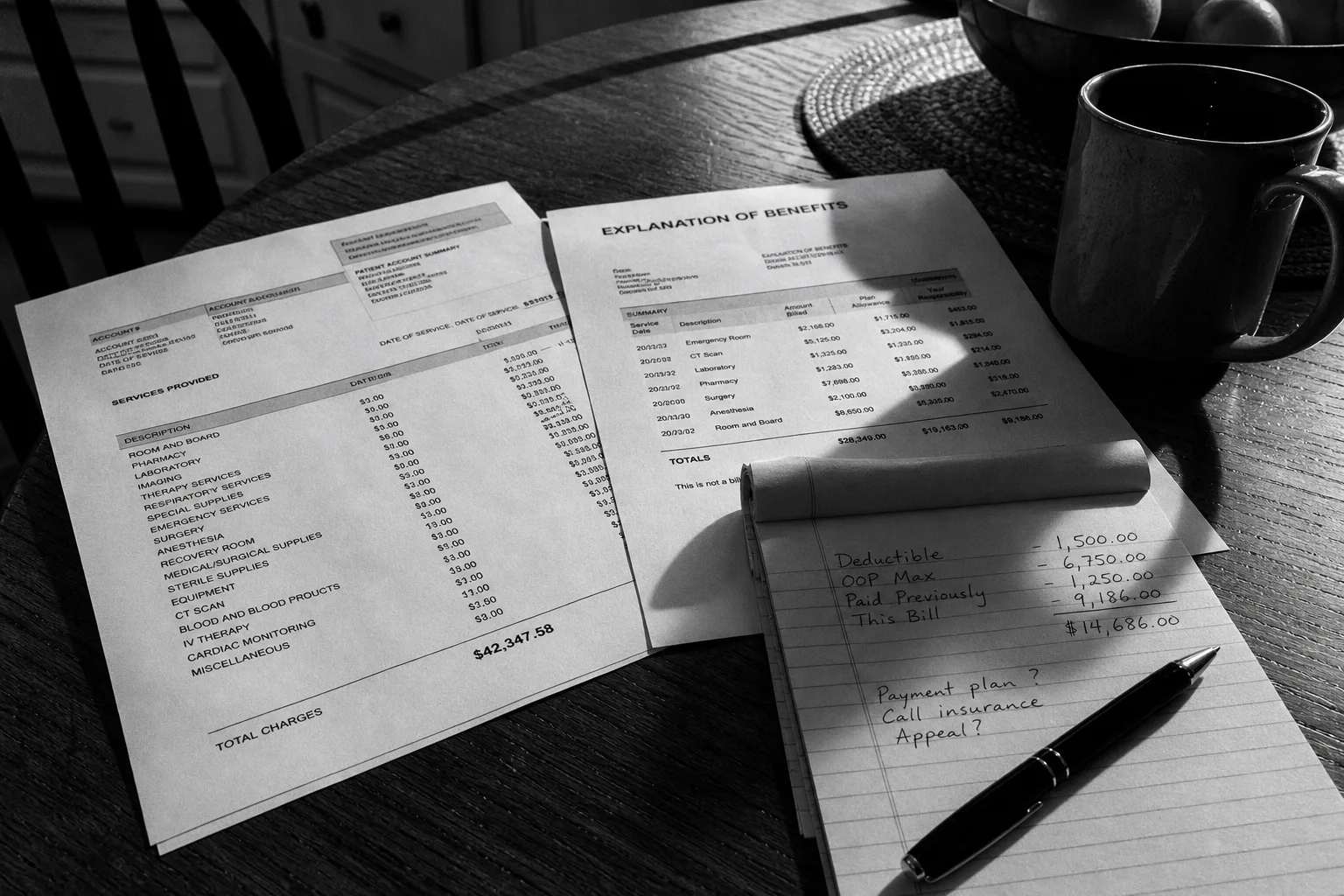
The document that arrives in the mail three weeks after a procedure is usually not an itemized bill. It is a summary: a date range, a department, a total, an amount your plan paid, and a balance. Four to eight lines, often fewer. Nothing on it can be checked against anything, which is the point at which most people either pay it or ignore it.
The itemized version exists. It has to. And over the past few years the rules around what a provider must disclose, when, and in what format have moved more than they did in the previous two decades. Knowing what changed is most of the work.
The summary statement and the itemized bill are two different documents
Ask for the itemized statement by name. What comes back is typically several pages and runs from a handful of lines for a clinic visit to many dozens for an inpatient stay. Each line carries some combination of a date of service, a description, a quantity, a charge, and a code.
Three code families do most of the work:
- CPT and HCPCS codes, five characters, describing a procedure, a visit level, or a supply. These are the lines that map to what someone actually did.
- Revenue codes, three or four digits, describing the department or category the charge came from: pharmacy, operating room, recovery, laboratory.
- Diagnosis codes, which explain why. These matter less for arithmetic and more for whether a denial was coded correctly.
Read the quantities before you read the dollars. Quantity errors are the most common thing a layperson can actually find: two units of a drug given once, a room charged for four nights on a three-night stay, a recovery period billed in increments that do not match the time you were there. You do not need to know whether a price is fair to notice that a number is wrong.
Then check the arithmetic in one specific place: charges, minus the plan's contractual adjustment, minus what the plan paid, minus what you already paid at the desk. What remains should equal the balance due. When it does not, the gap is often a payment posted to the wrong account or an adjustment that never came through.
What the No Surprises Act changed, and for whom
Since the start of 2022, federal law has limited balance billing in the situations where patients had the least ability to shop: emergency care, and out-of-network clinicians working inside an in-network facility. The anesthesiologist, the radiologist, the assistant surgeon, the pathologist reading the specimen. Historically those bills arrived separately, weeks later, at full undiscounted charges.
Under the current rules, for covered situations, your responsibility is limited to what you would have owed in network, and the dispute over the rest moves to an independent dispute resolution process between the plan and the provider. That is a structural change worth understanding: the argument is no longer yours to have.
Two practical consequences when you read a line.
First, look at the provider name on each bill, not just the facility name. If a separate bill arrives from a clinician you never chose, at a facility your plan covers, that is the category the protection was written for. Second, ground ambulance charges were largely left outside these protections, so an ambulance bill can behave differently from everything else in the same episode of care. Air ambulance was included.
If you are uninsured or paying cash, a different piece of the same law applies: you can request a good faith estimate in advance of scheduled care, in writing, covering the expected charges. There is also a dispute path when the final bill exceeds that estimate by a meaningful margin. Get the estimate before the date of service or it is of no use to you.
Posted prices moved from theory to something you can pull up
Hospitals have been required to publish their standard charges publicly since 2021, in a machine-readable file and in a consumer-friendly display of common shoppable services. The Centers for Medicare & Medicaid Services oversees that requirement, and the format specifications have been tightened more than once since it took effect, largely because the first wave of files were technically compliant and practically unusable.
The newer versions are better. Not uniformly, but enough that a specific CPT code can often be looked up against the same hospital's own posted rate for your plan.
What this gives you is narrow and useful: a way to test one line. If the itemized bill shows a charge and the posted rate for that code under your plan is materially lower, you have a concrete question rather than a general complaint. What it does not give you is a total. Posted rates cover defined services, and a hospital stay is an assembly of many, so anyone promising you a predicted final figure from these files is guessing.
Medical debt on your credit report behaves differently now
The timeline changed. The national credit bureaus revised how medical collections are treated: paid medical collections come off, unpaid ones do not appear until a waiting period has run, and balances below a set dollar threshold are not reported at all. Regulators, including the Consumer Financial Protection Bureau, have continued to press on how medical debt is furnished and used.
The reason this matters to line-by-line reading is timing. The old incentive was to pay fast to protect a credit score. The waiting period gives you room to request the itemized bill, compare it to the explanation of benefits from your plan, and dispute a line before anything is reported. Use that window deliberately: request in writing, keep the date, and note that a disputed balance is being reviewed.
The order to work in
- Request the itemized statement in writing. Ask for it with codes.
- Put the plan's explanation of benefits next to it. They should describe the same events.
- Check dates, quantities, and units first. Then the arithmetic.
- Identify every separate billing entity and ask whether each was in network.
- Look up two or three of the largest CPT lines against the hospital's posted rates.
- Put questions in one written list, numbered, with the account number on it.
A first pass on a clinic bill takes twenty minutes. An inpatient stay takes an evening, sometimes two. The recoverable amount ranges from nothing to a substantial share of the balance, and which end you land on depends mostly on how many separate entities billed and whether the coding matched what your plan expected.
Anyone who quotes you a percentage before seeing the itemized statement is making it up.