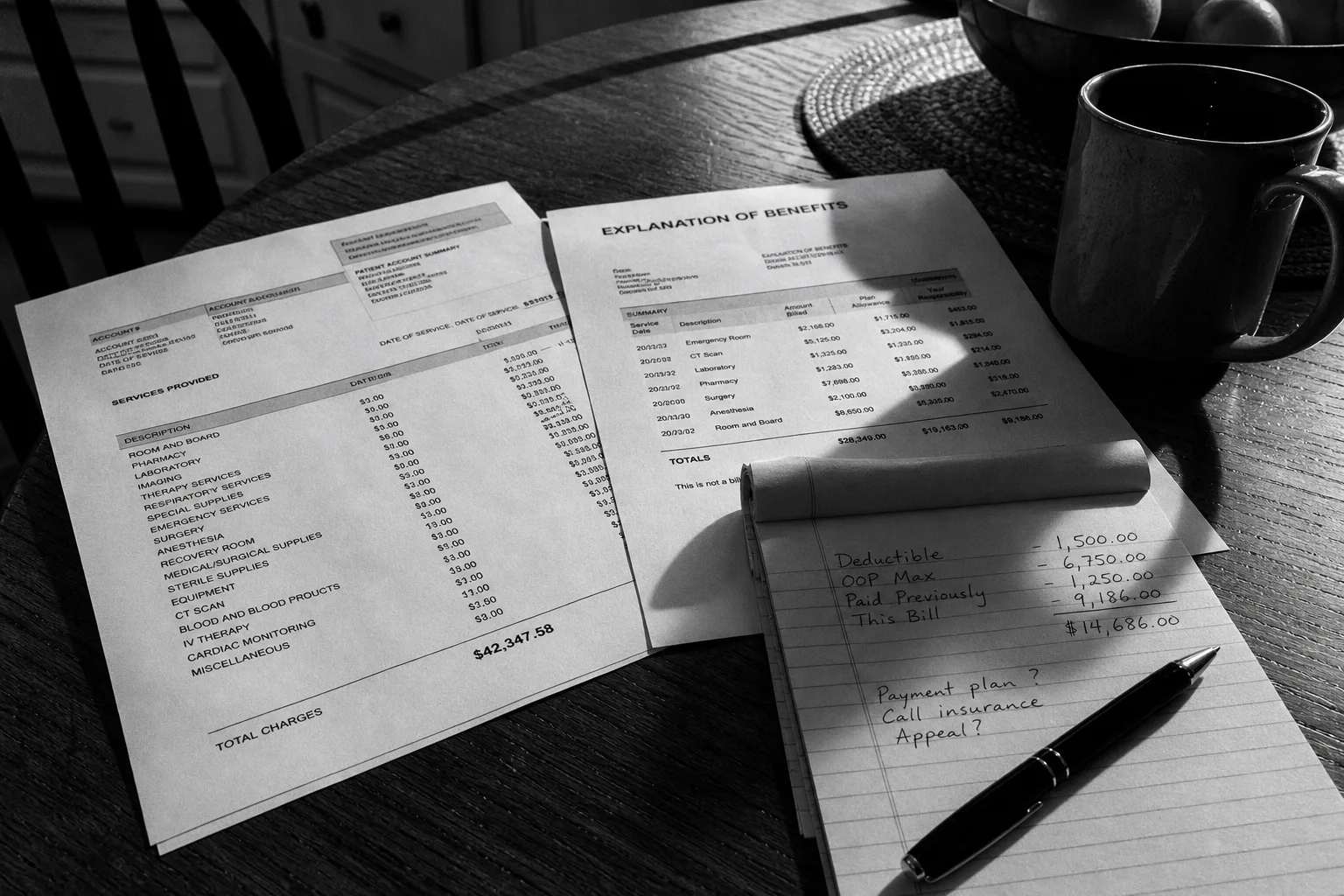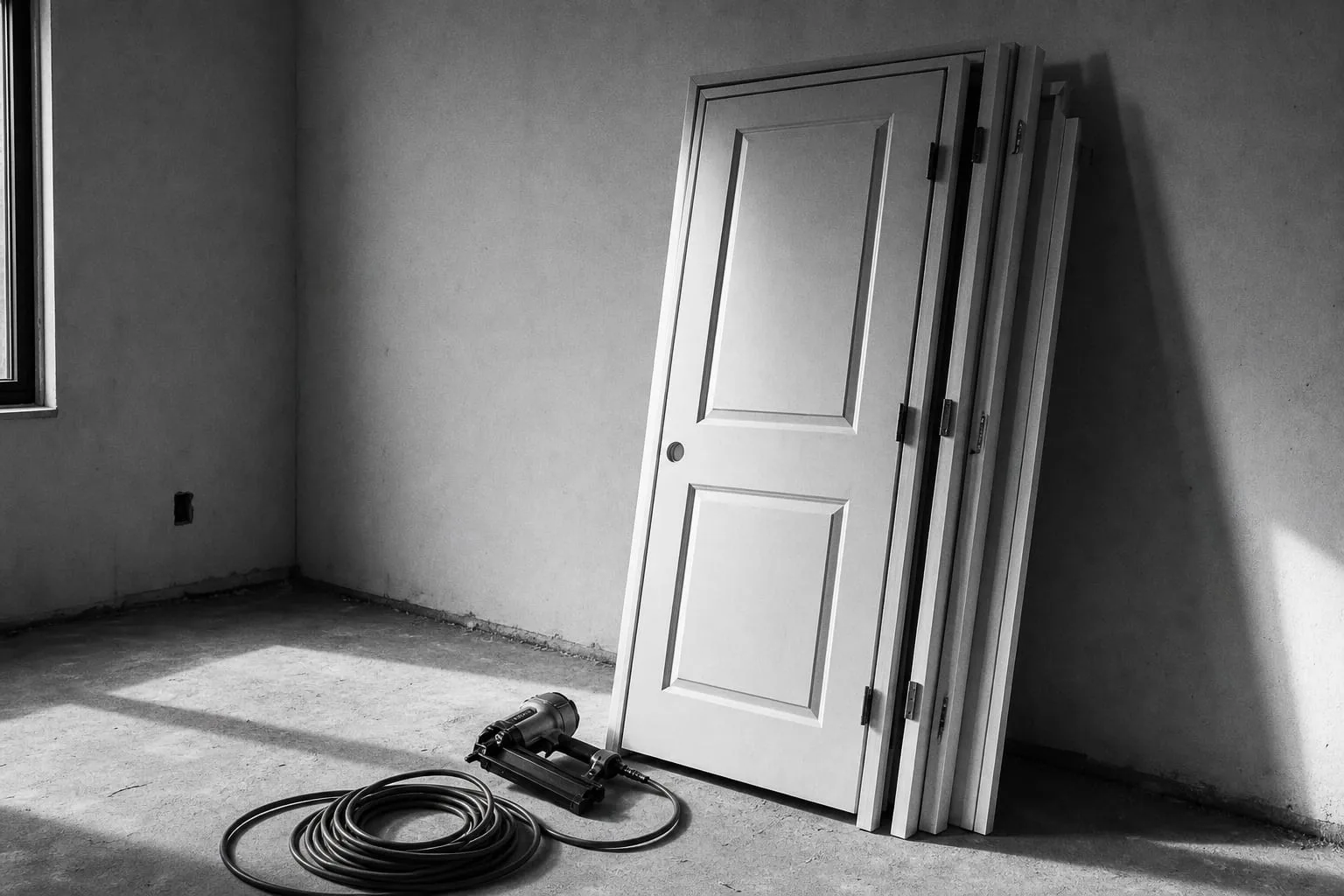
Three contractors look at the same job, replacing the interior doors and trim through a small house, and come back with three numbers. One prices by the hour, one gives a single figure for the whole job, and one quotes a day rate with a note that it should take about a week. Spread across a kitchen table those read as three prices, and most people pick the lowest. They are not three prices. They are three different answers to a question nobody asked out loud, which is who pays for the days the job runs past anyone’s estimate.
What an Hourly Rate Is Really Selling
An hourly rate sells time and nothing else, and the plainness of that is both its strength and the reason customers dislike it. The buyer purchases hours, so when the trim turns out to be nailed into plaster that crumbles at a touch, they purchase more hours, and the extra cost lands where the extra work came from. Risk to the shop sits close to zero, and so does the upside, because a crew that works out a faster sequence and finishes in three days instead of five has handed the savings to somebody else and earned two days less for being good at the work.
The failure here is social rather than financial. Once a customer knows they are buying hours, some fraction of them start watching the clock instead of the work, and a coffee break turns into a line item in a conversation neither party wanted. The repair for that is not a lower rate, which only makes the arithmetic worse without changing the feeling. It is a ceiling: an hourly figure paired with a not-to-exceed number and a written promise to stop and call before crossing it. That converts an open-ended fear into a bounded one, and it costs the shop nothing it was not already prepared to lose.
The Fixed Price and the Contingency Nobody Itemizes
A fixed price sells a defined outcome rather than a quantity of labor. The customer buys doors that latch and casing that sits tight against the jamb, and the number of days that takes becomes the shop’s problem, along with every hour saved by a smarter order of operations. This is why a fixed price is never the hourly rate multiplied by the estimate. It is that figure plus a contingency that does not appear as its own line and does not get apologized for, because the contingency is the actual product on offer: certainty, transferred from the buyer to the seller for a fee.
How large that contingency should be is a question about the shop’s own history rather than about the market. A job done twenty times, where the spread between the fastest run and the slowest is a single day, can be priced near the slow end and left alone. A job done twice is being gambled on with a number chosen because it sounded competitive. The evidence sits in last year’s invoices, and a shop that cannot say how far its estimates usually miss has no business selling the outcome instead of the hours.
The Day Rate, Which Is Not Simply Hourly in Bulk
A day rate looks like the simplest of the three and behaves like neither of the others. The customer buys days, which sounds like buying hours in a larger denomination, except that a day resists being cut in half. An hour lost waiting on a delivery that never came is not an hour off the invoice. It is a morning, and the morning is billed, because the crew was standing in that driveway and could not usefully be anywhere else. That asymmetry is the entire point of the method, and it is why day rates suit travel-heavy work and jobs where another trade controls the schedule.
Customers who have hired trades before understand a day rate immediately and rarely argue with it. Customers who have not will ask why a day costs what it costs, and the answer is worth saying out loud rather than defending later: a day includes the drive out, the loading, the stop at the supply house for the part that was not on the truck, and the last hour of cleanup that nobody enjoys watching being billed. Delivered at the estimate, that explanation reads as thoroughness. Delivered afterward, in response to a question about the invoice, the same sentences read as an excuse.
The Overrun Is the Argument Underneath All Three
Every quote contains a guess about duration, and the guess is wrong in a direction that is entirely predictable. Material arrives short. The existing work is out of square by more than a shim can absorb. The customer changes their mind about the handle sets on the second morning, cheerfully, as though it were nothing, and the change costs a trip and half a day. None of that is unusual and none of it is anyone’s fault in particular. What separates the three methods is not whether the overrun happens but which party has already agreed, in advance and usually without noticing, to pay for it.
Once that is clear the choice gets easier, because the question stops being which method earns the most and becomes which failure the shop can absorb without a bad month. Hourly passes the overrun straight to the customer and strains the relationship at the worst moment. Fixed price absorbs it and rewards accurate estimating with real margin. A shop running fixed pricing on the work it knows cold and hourly with a ceiling on everything else is not being indecisive, it is matching the method to what it actually knows.
Changing Methods on a Customer Used to the Old One
Repeat customers get moved between methods more often than anyone admits, usually because the first one stopped fitting the work. Sequence carries most of the risk. Change the method at the start of a distinct new job rather than partway through one, and never in the same conversation as a price increase, because two changes at once read as opportunism even when neither is. Moving a long-standing client from hourly to fixed because the shop now knows the house well enough to carry the risk is a compliment to both parties, and saying so out loud is worth the sentence.
The sequence that reliably goes wrong is quoting a fixed price, discovering the scope was worse than it looked, and then quietly billing hourly for the difference, which is not a pricing decision but a dispute with a delay built into it. Free costing worksheets from the Small Business Administration hand a shop a structure for the underlying numbers, though no outside template knows how far a particular crew’s estimates tend to miss. Back at the kitchen table, the homeowner comparing three figures is really comparing three offers to carry the same risk, and the shop that has read its own history knows which of those offers it can afford to make.